Years ago, many years ago, back during the early 1970s, my younger brother and I took a road trip in the MGB over to Blackpoint Forest in Marin County, California. It was our first encounter with a Renaissance Faire in the wild as it were, nestled back among the scrub pines and coastal oak trees of California. As I recall, this was during the gas shortages of the early 70s and though Novato was roughly 200 miles from Reno, we must have thought the gas mileage in the MG would allow the trek over the mountains. It did, but the sight of long gas lines was something I remembered to this day.
My brother searched through his collection of slides from that time and came across these photos of our visit to the Faire. It looks much as I had remembered it.
California’s Renaissance Pleasure Faire originated in Agoura Hills in Southern California in 1963. The one we had attended in 1972 opened its Northern California location in 1967. An interesting article on the history of the faire can be found online here.
Today Renaissance Faires, or Festivals take place across the US, many of the largest being held in North Carolina, Maryland, Texas, Ohio, Wisconsin, New York, Arizona, even Georgia. The Renlist has a great website with listings by state and date. Maryland’s festival at Crownsville is one of the largest, many of which attract over 200,000 visitors over their season.
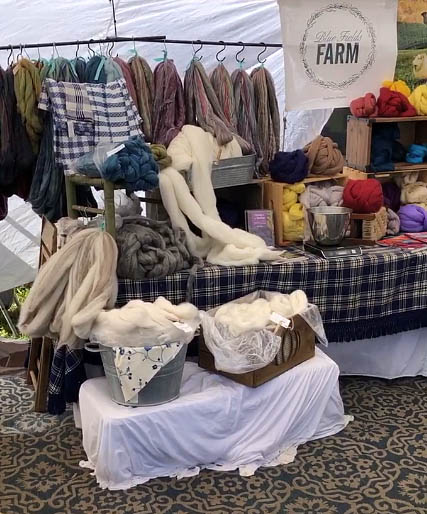
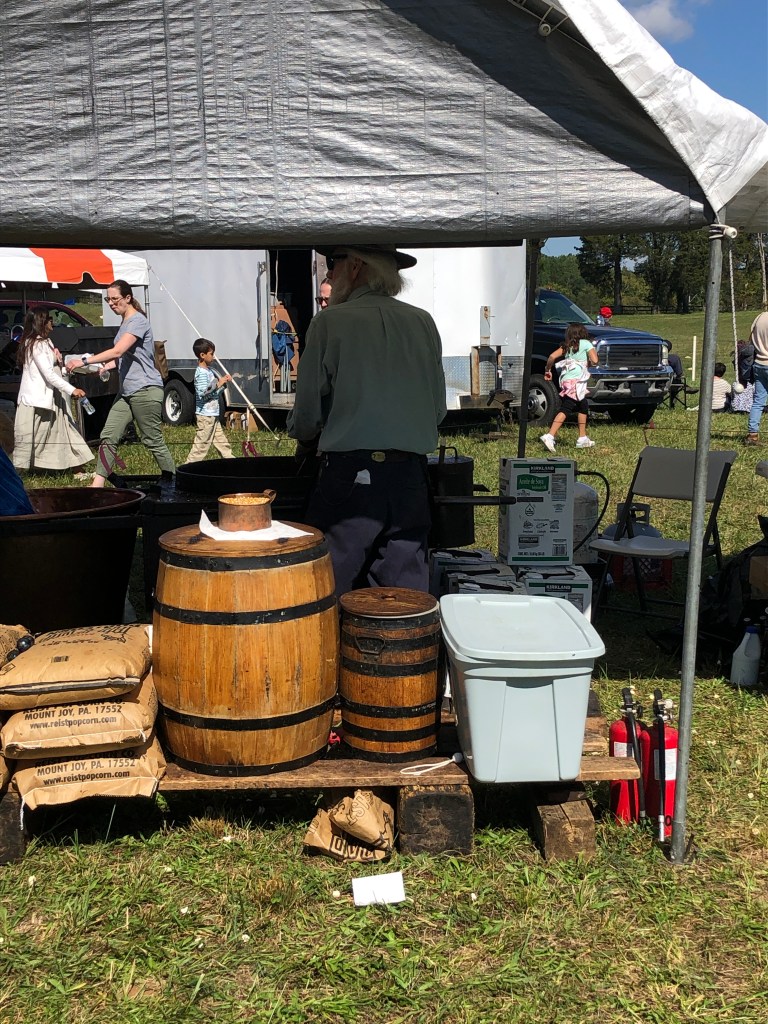
Apart from the lack of period costumes–nearly everyone was in modern dress– and the white tents set up in the field, the Fiber Festival and Sheep Dog Trials we went to recently had much the same feel as the Renaissance Faires I’ve attended in the past. The emphasis here was on homegrown/raised sheep, alpaca, and angora rabbits and the yarns produced from their wool. Whether knitted crafts or woven fabrics, the exhibits and demonstrations would have been right at home with the Renaissance faires and festivals so prevalent across our land.
There seemed to be a greater emphasis on rich colors in the products being sold compared with the muted tones I remember seeing. In the morning sunlight, knit shawls and scarves shimmered and glowed in jewel tones; yet there were many vendors selling natural or un-dyed yarns for a more traditional homespun-look.
The two-day event was held at Montpelier and attracted quite a crowd. The sheep dog trials were a lot of fun to watch and I can see now where my son’s border collie gets her energy!
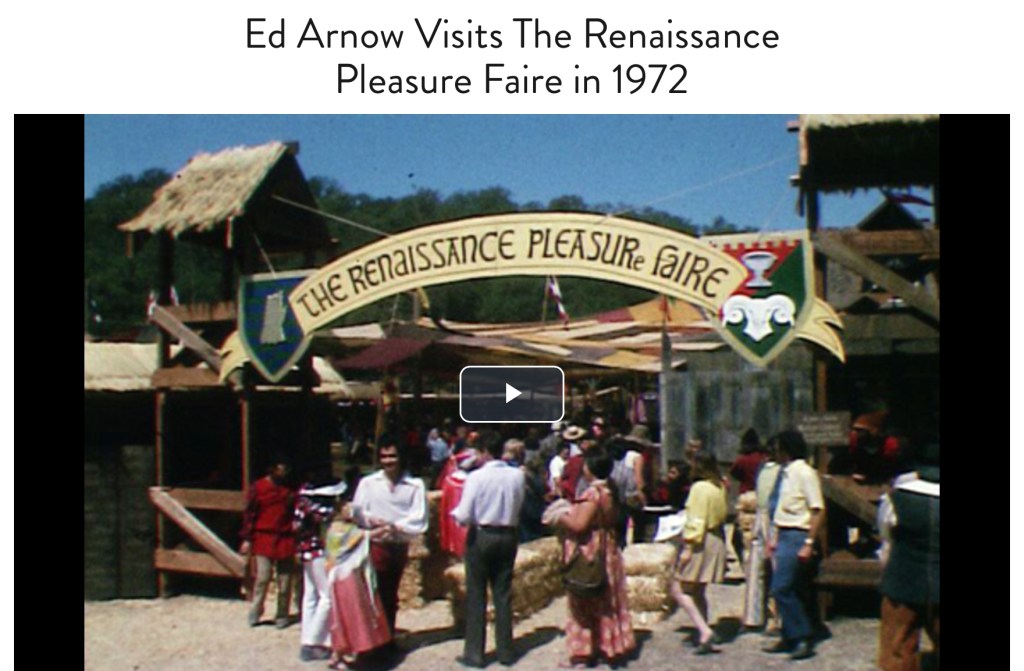
KPIX-TV news footage from September 2nd 1972 featuring a visit by reporter Ed Arnow to the Northern California Renaissance Pleasure Faire, based at the Blackpoint Forest in Novato, Marin County. You can watch the video here, or click the image above to access the San Francisco State University Bay Area Television Archive.
Magic Kingdom opened October 1, 1971. EPCOT Center opened on October 1, 1982. Disney’s Hollywood Studios opened May 1, 1989 and was the third of four theme parks built at Walt Disney World in Orlando FL. Disney’s Animal Kingdom opened on Earth Day, April 22, 1998, and was the fourth–and to this date the last new theme park built at the resort. They have expanded and added on to their existing properties, closing some or adding on to favorites.
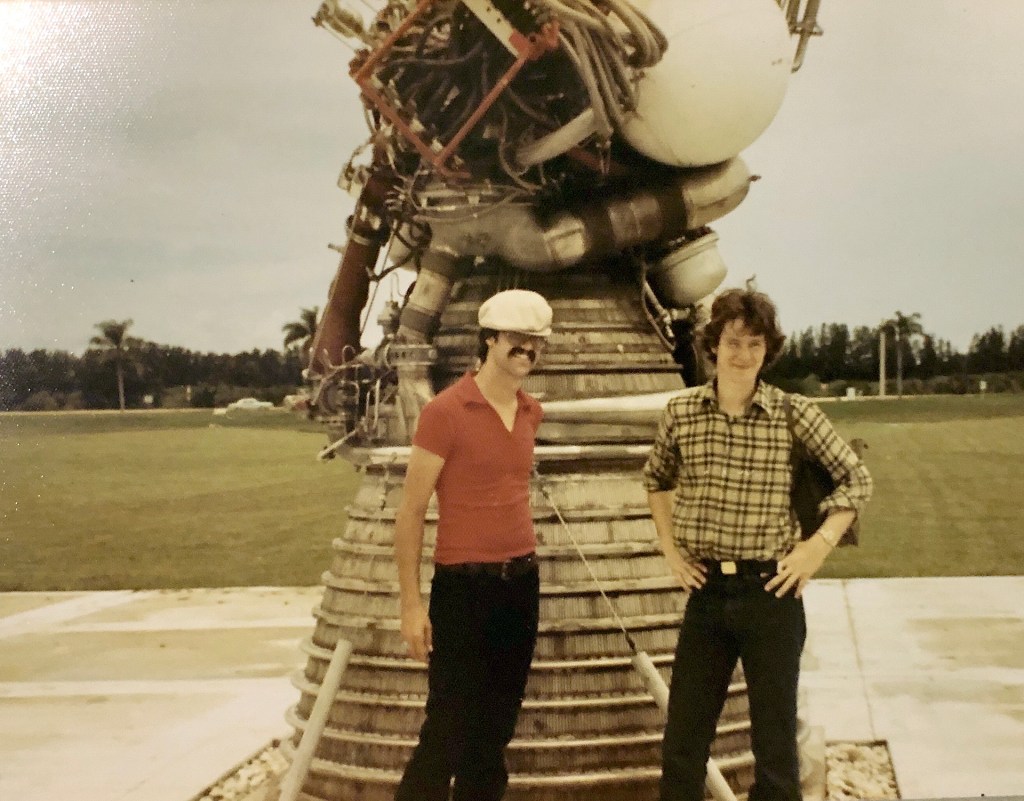
Cape Canaveral 1976
My first visit to Disney’s Magic Kingdom came during the summer of 1976 during my month-long bicentennial bus tour of America. DisneyWorld had opened just five years previously and at that time, only one park was completed. I remember the weather in June was hot and wet. The park was fun, affordable and my friends and I enjoyed it for the day before we took a bus to Cape Canaveral and the Space Center there.
Over the next 21 years three more parks opened, the final one, Disney’s Animal Kingdom opening in April of 1998.
My wife and I stayed at one of the resorts for our honeymoon in January of 1998. We only have few pictures from that time, and truthfully my memories are somewhat dim, but I know we had a great time visiting the Magic Kingdom, Epcot, and Hollywood-MGM Studios (as it was named then). I remember there being virtually no crowds in January of that year.
For our 25th anniversary we went back to DisneyWorld. Much has changed since our first visit and, due to their new reservation system, we weren’t able to visit two of the parks. We did enjoy Epcot and the Animal Park.
In 1997-98 DisneyWorld was celebrating their 25th anniversary; it’s a bit of symmetry that our 25th was celebrated while the parks were still decorated for their 50th anniversary, our silver and their golden. This time I took plenty of photos and we brought home an assortment of mementos and commemorative knick-knacks. Added them to the box labeled “wedding stuff” but I guess I need to update the label.
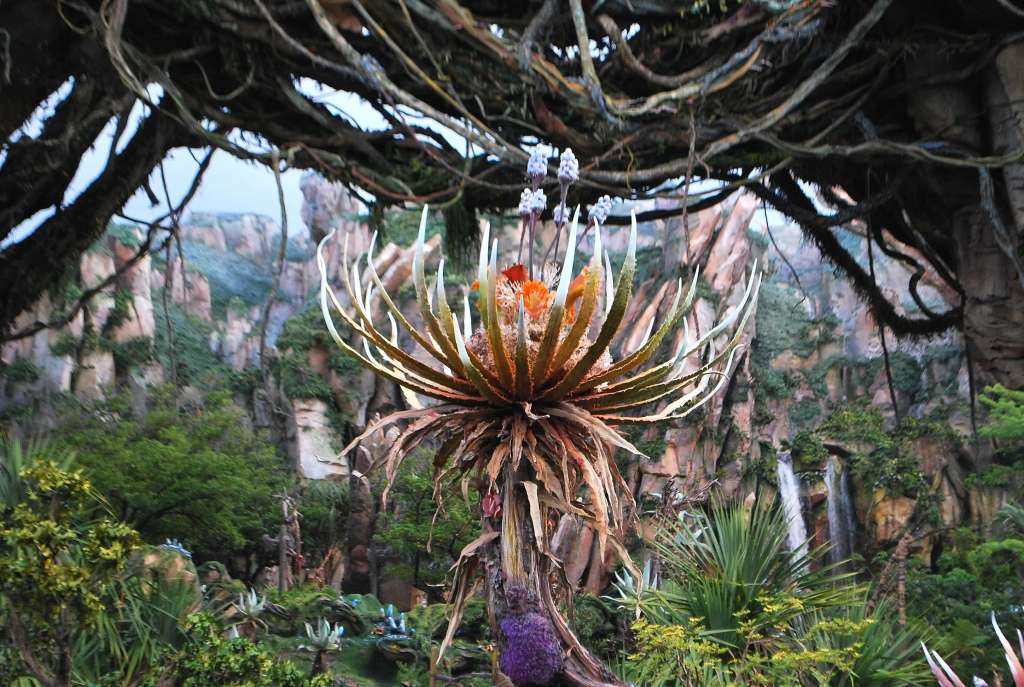
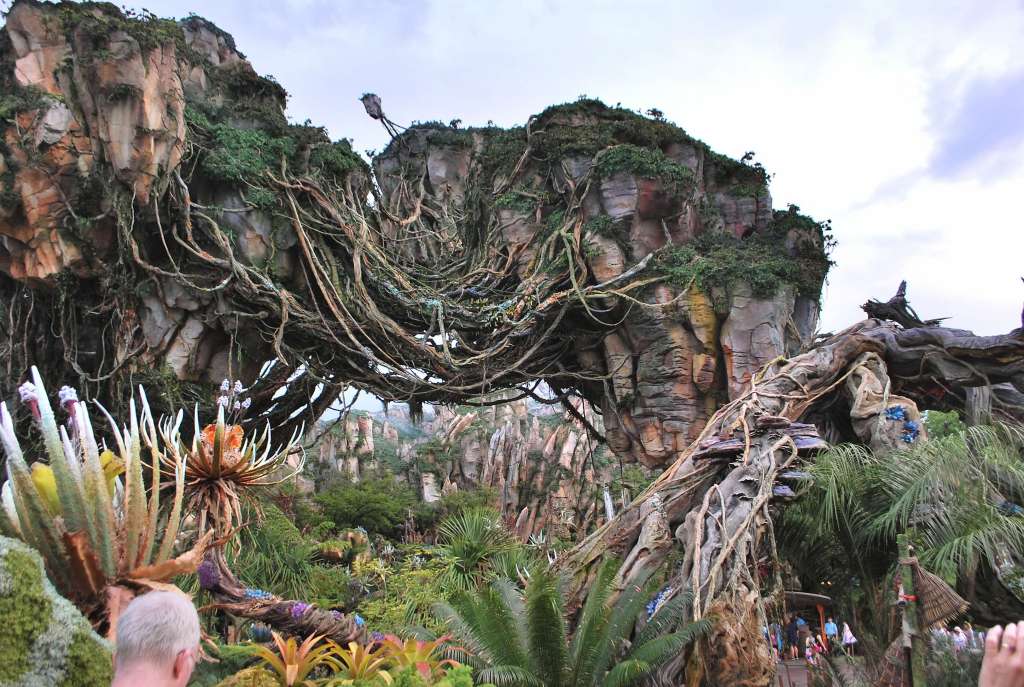
Pandora, the World of Avatar at Animal Kingdom, Orlando.
We’ve visited the parks twice before with family, for my 60th and then my 65th birthday. In 2017 Pandora-the World of Avatar had just opened and we were able to experience an area that looked remarkably like the landscape from the movie Avatar, as if the movie set had been brought to stunning life. When we visited again this year, the wait time to ride either experience (Flight of Passage or Na’vi River Journey) was two hours. We had dinner in the canteen, shopped the offerings in Windtraders store.
I have seen and read so much about the Star Wars-themed area in DW Hollywood Studios (Star Wars: Galaxy’s Edge) and the new Galactic Cruiser immersive experience (hotel) I was really excited to see them. However, Magic Kingdom and Hollywood Studios remain their two most popular theme parks and reservations were not available during our stay. Just as well: when I saw the cost of staying in the Galactic Cruiser for two days, I was pretty shocked. It seems like it would be a fun place to bring the grandchildren, very immersive experience. But as I talked it over with my friend Dave later, the family could spend a week at a “fully immersive” Dude Ranch in Colorado for half the cost. Something to think about when planning our next adventure. Galaxy’s Edge, or riding the range in the mountains of the Old West? Got plans for the summer?
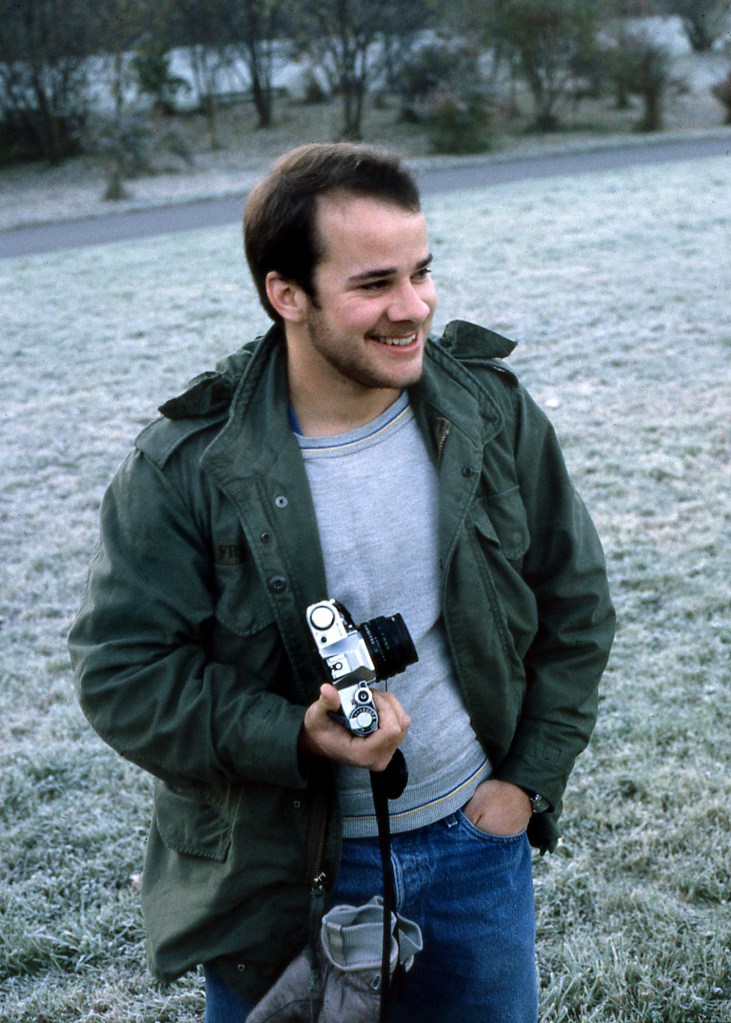
Mark asked me why I took so many photos of places, landscapes, trees, buildings: was I planning on being a professional photographer when I got out of the Army? Really. I hadn’t really given it that much thought. “Why do you take so many pictures of people?” I asked him. Thirty plus years later, I think I am beginning to know why.
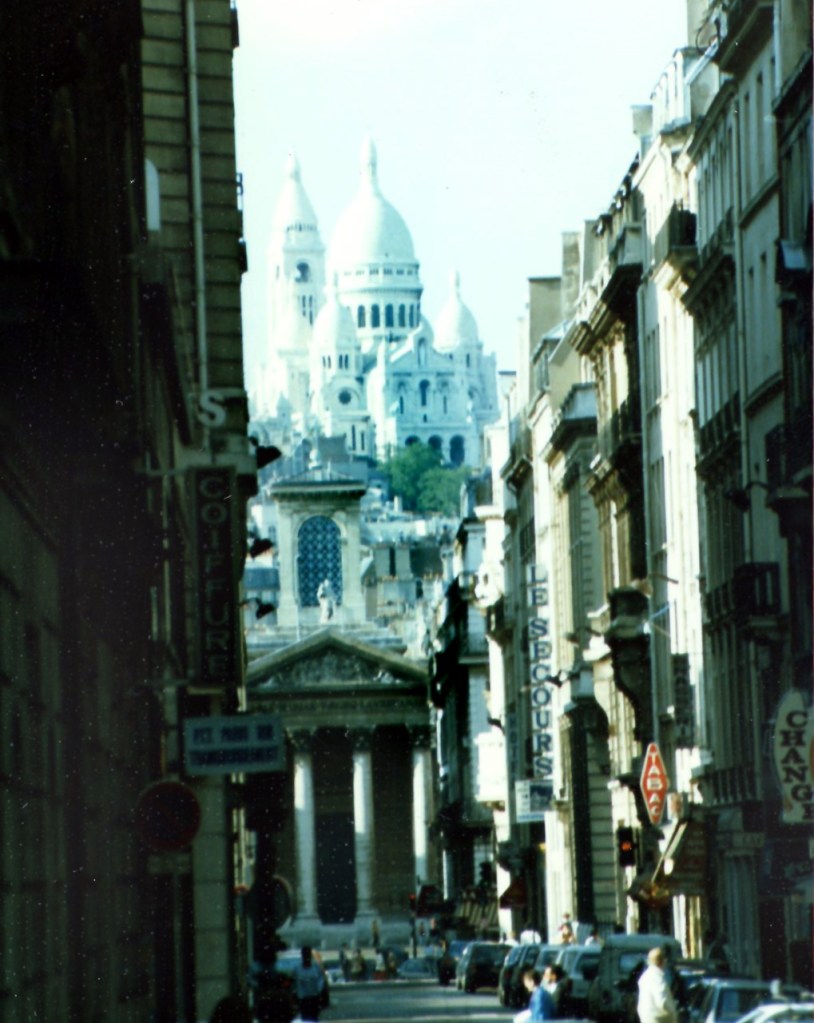
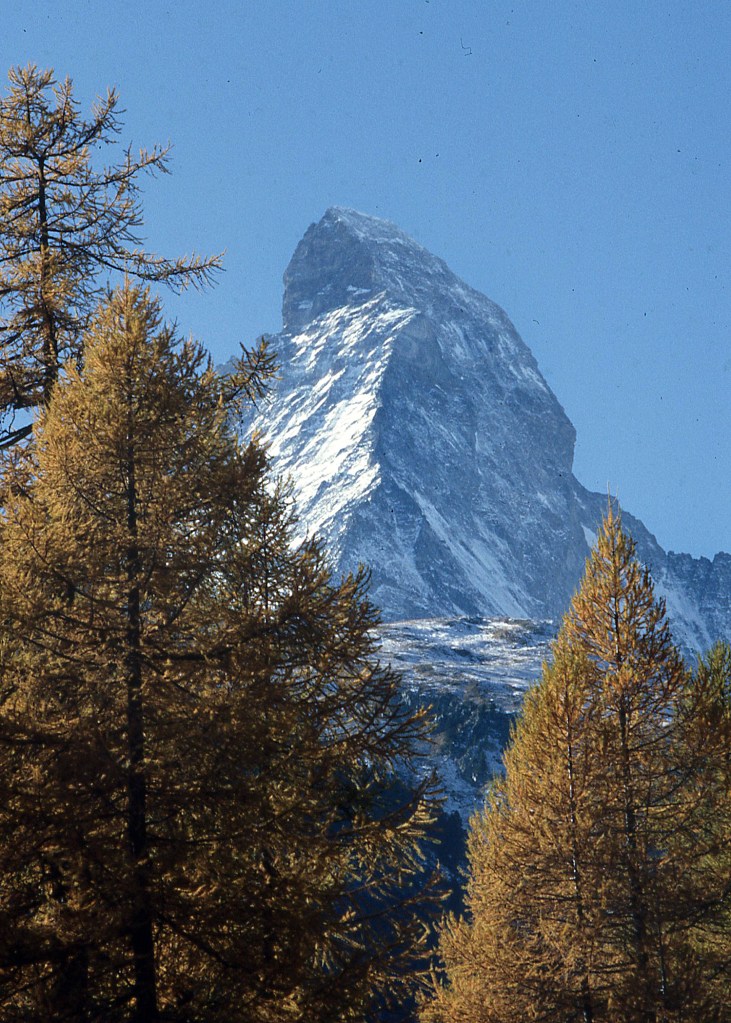
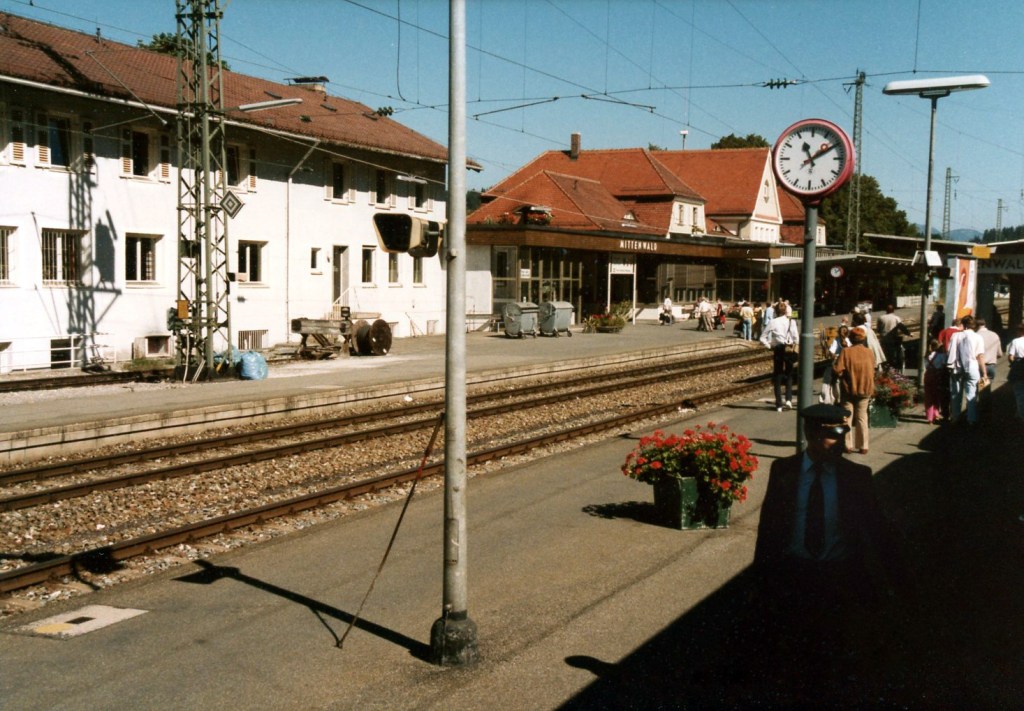
A Baroque church somewhere in GermanyMontmartre in ParisMatterhorn Zermatt SwitzerlandMittenwald train station
My time as an enlisted soldier stationed in Heidelberg, Germany during the mid-80s was a great time to get out, see the world. Who knew if I would ever be back there again? As circumstances have played out, I haven’t returned. But my brief two years there were filled with work and travel. England, France, Belgium, Austria, Switzerland, and Lichtenstein: these were all a bus tour or train ride away for a weekend visit or a four-day vacation.
Fading away. It’s not just the photo prints that are beginning to fade. Mark convinced me to switch from print film to slide film. The slides from that time still look bright and crisp; the prints have begun to fade, the colors blending towards yellow. Scanning and a bit of photo editing has brought back much of their original color, I think, but I’m not sure.
Trier AmphitheaterMarkGasthof in AustriaWho are all these people?
No, it isn’t just the colors that have begun to fade. It seems I never was one to label things or write on the back of photos (thank you Mom for the photos you captioned years ago!) Looking back, younger Me must have thought he would always remember the names of places he went and the people he went with. And certainly he would have remembered those dates! Not so, not so.
Since the advent of the iPhone, I have used its prodigious data collecting capabilities to help me remember where and when my photos were taken. With facial recognition it helps me search for pictures of my granddaughter or other family members, even geocoding where the picture was taken.
Like many people, I upload quite a lot of photos to a third party site “in the Cloud.” I have been using Shutterfly not primarily for photo storage but to print out photo books of our trips and family events. For me they have replaced the ancient slide carousel (remember those?) and the boxes of prints that seemed to never make it into a photo album. The books are piling up on a shelf, and I know the children will likely throw them out when I’m gone, but for now they help to stave off the effects of fading memory. Our trip to Spain is up there on the shelf as is my 60th birthday celebration at DisneyWorld. Well, my 70th birthday is also up there, but who is counting birthdays anymore?!
Old photos fade, memories fade, events recede in time and eventually fade from our recollection.
“The grass withers, the flower fades, But the word of our God stands forever.” Isaiah 40:8
We lived in several houses growing up in Reno. Until my parents divorced we lived near Wooster High School. Later after my Dad remarried, we lived in a small home off Peckham Lane in the Smithridge area.
In the living room of both homes we had a fireplace and over the fireplace hung a painting. George Carter painted many Nevada scenes during his lifetime, some of which may have been inspired by Nevada magazine covers. The view of desert and mountains that we have was purchased from him in 1964 while Mom worked at Brundidge’s in downtown Reno. It now hangs in our guestroom and of all the paintings, photos, and memorabilia—this painting most reminds me of Nevada. The dark layering clouds over snow-covered mountains, mountain peaks catching the light, the scent of sagebrush in the dry air.
In my Dad’s home we had a different painting hanging over the mantle. Painted by my stepmother’s sister, Maxine Randall Peters, it depicts a red barn surrounded by gold-leafed trees in autumn, snuggled up against the foothills of Mount Rose. It’s a readily identifiable location in Washoe Valley. It appears Maxine had painted a lake or pond up close to the building in order to reflect the brilliant yellow trees and that gorgeous red color.
The two paintings capture two very different views of Northern Nevada, one looking possibly towards the Sierra in the West, the other a view of the foothills from Washoe Valley, both areas I was familiar with growing up.
Though I now live in Virginia, my wife and I return often to visit family in Reno. I’ve joined a number of Reno and Nevada-interest Facebook groups, most of which feature photos of the amazing landscapes for which the state is known. Some of the sights are new to me (wild horses seem to be everywhere now, rarely seen when I was growing up there); other photos are of familiar areas such as Pyramid Lake, the Truckee River, or Lake Tahoe.
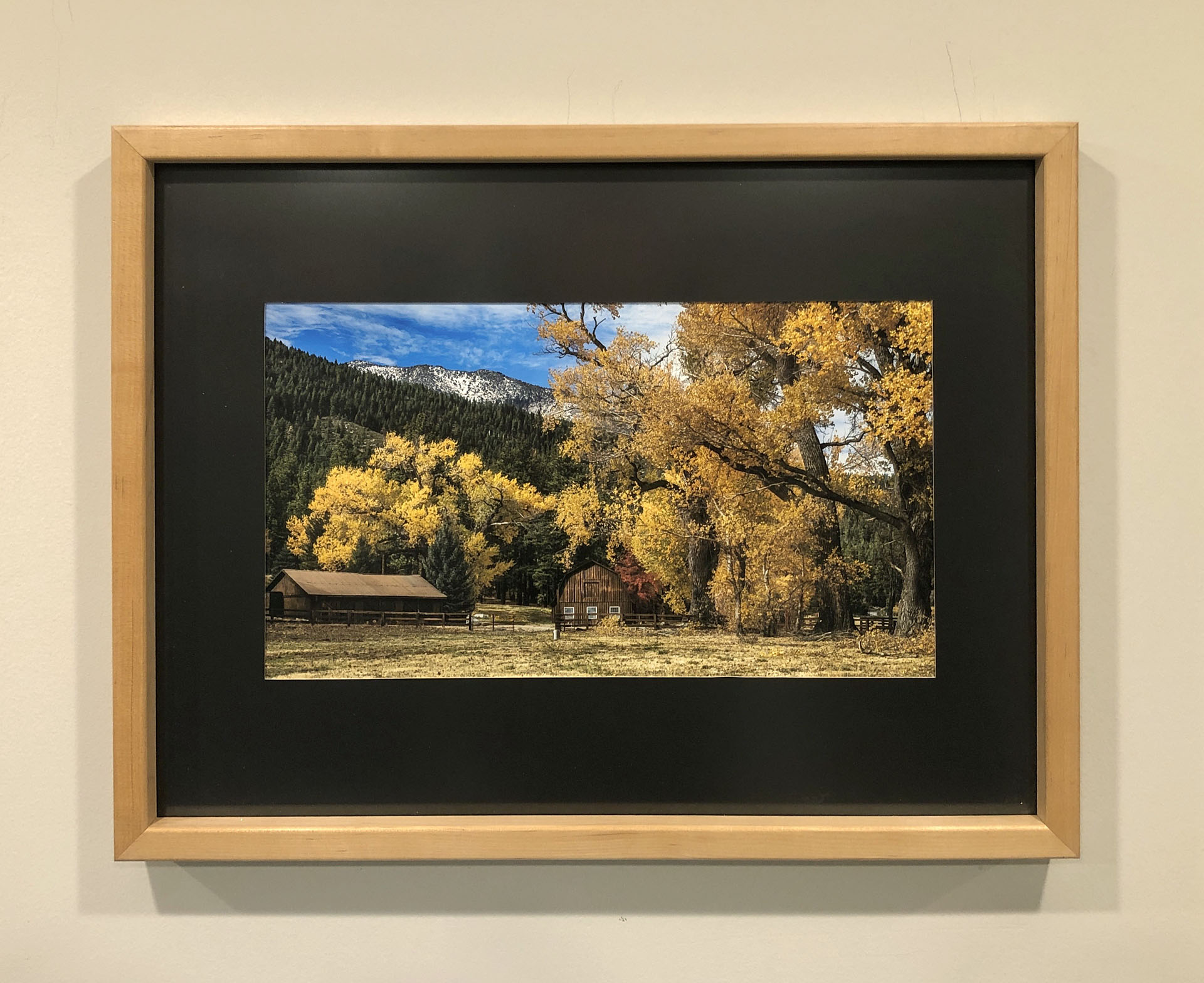
But I stopped immediately when I came across a familiar image on Facebook last month. Incredible! The red barn from my aunt’s painting, pictured in all the golden glory of fall, in a group of photos by an FB group member. Impossible! Maxine had created her oil painting back in the 60s. The barn was old then, how could it still be standing?! I’ve framed the photo and it now hangs in my Nevada-themed guestroom. It’s a brighter version of the scene Maxine painted years ago; the cottonwood trees dominate the image and nearly obscure the barn at the center of the photo. The barn isn’t red like our painting; perhaps it never was, maybe that was just another embellishment of the artist. I like it.
While I was searching online for more photos by Lee Molof, I came across another painting by George Carter dated sometime during the early 1960s. And then another. A third and now a fourth.
All five images bear striking similarities: the pyramid-shaped mountain in the middle ground, mountains to the left of the image, sagebrush in the lower right foreground. All of them are overshadowed by immense cumulonimbus clouds. Of the four, I prefer the overall coloring in ours: the coral-tinged mountains are a little closer to the viewer; the arroyo or dirt road in the center has a slate grey that mimics the snow covered mountains in the distance. Orange flowers dot the foreground and place the image as perhaps early spring, snow hasn’t yet receded from the mountain peaks.
I’m curious to find the original location that Carter used as reference material. If it is indeed from a Nevada magazine I would like to get a copy of it, perhaps a nicely framed photo to go with our painting. If civilization and the expansion of Northern Nevada suburbs haven’t destroyed the view, I think it would be great to pair the photo and the painting in the same room. It’s a bit of Double Vision, a nod to the past as well as the present. I like it.
Just to be clear, I don’t own the four paintings in the collage above. All of them were found on online art auction sites. In most cases, Carter oil paintings sell in the mid $500-800 range. Mom says she paid $30 for ours and bought it directly from George Carter when he would come in to Brundidge’s for art supplies or to have paintings framed.
I was in 10th grade when I first started to make hand-lettered signs. Professionally that is; before that I had been your go-to guy for all types of posters and blackboard art in school. But it was in high school that my career, as it was at the time, really took off.
My journalism teacher at that time and her husband helped out at the local Little League baseball field. He may have been a coach though I don’t really recall much other than boxes of sporting equipment in their garage and station wagon. My job however, was hand lettering the many advertising signs that were mounted to the fence surrounding the playing field. 4ft x 8ft plywood signs, mostly painted white, hand lettered with your business name, perhaps a logo, and a phone number and an address. Occasionally we would put two businesses on one board and the text got a bit smaller, but overall it wasn’t a difficult job making four inch letters look legible from the outfield.
Signpainter
That skill helped me quite a bit when I took a job after college in San Diego. Working at Robert Keith Giant Inflatables, I was part of a team of artists who hand painted logos on twenty foot tall vinyl beer bottles and cans. (I wrote about that previously here.)
However most of my graphics career was spent in the screenprinting industry. The billboard posters I printed had a handshake relationship with old-school lettering in that the projected image of text was drawn by hand and then a stencil was cut by hand using an exacto blade. Those paper stencils were used to produce hundreds of identical prints, whether they were yard signs for elections or 30 ft billboards for casinos in my hometown of Reno. The screenprint produced a much cleaner, sharper image of text than my admittedly shaky brushwork ever could.
All of which brings me to our recent visit to Tennessee and the opportunity to enjoy two vastly different exhibit experiences which showcased basically the same material.
The Museum of Appalachia twenty miles north of Knoxville in Norris, TN is a wonderful collection of relocated early American frontier buildings, from one-room log cabins to sheds and barns filled with memorabilia. Several larger new structures are jam-packed with an overwhelming assortment of photographs, personal items, home goods and cottage industry crafts, guitars, banjos, dulcimers and small exhibits devoted to favorite sons such as SGT Alvin C. York (WW1).
Much of the collection appears to be pre-industrial revolution items or shortly thereafter. But what captured my attention wasn’t the time period or the quality of craftsmanship displayed: it was the sheer quantity of materials they had on display! And nearly everything came with a simple hand-lettered caption label. So much stuff! All labeled! Beautiful, shaky, fading-to-grey black ink on sepia colored cardboard labels. Admittedly they were hard to read, but they looked like letters or postcards from a forgotten era.
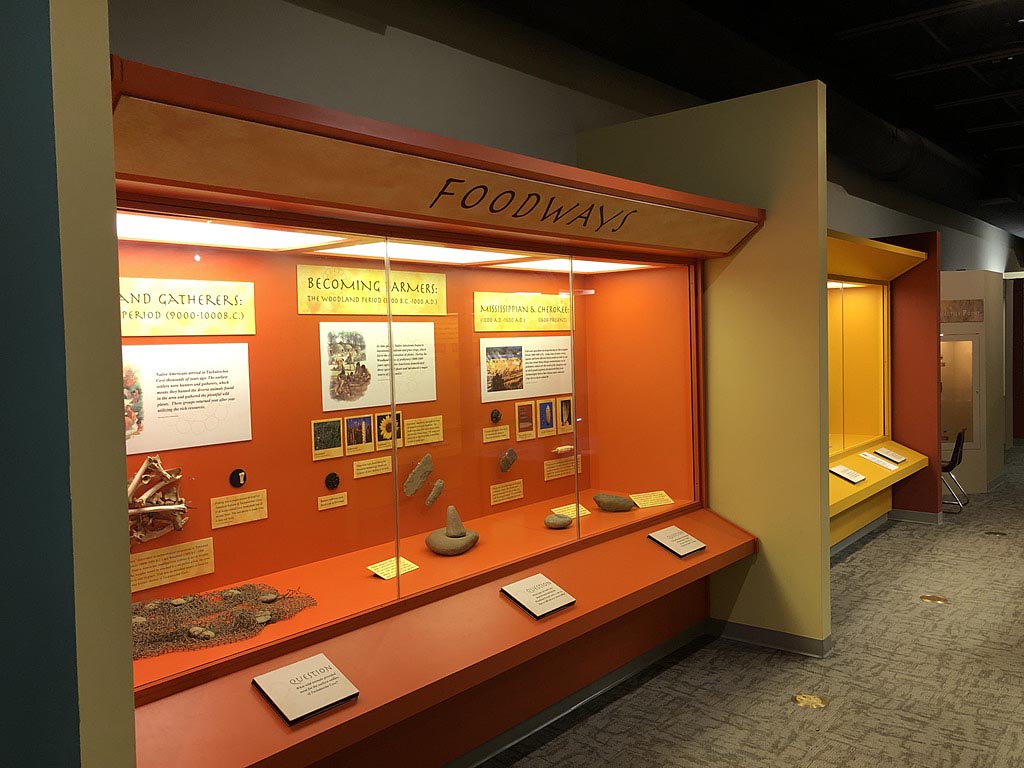
The next day we toured the Great Smoky Mountains Heritage Center in Townsend TN. A beautiful structure with engaging exhibits, the Center appears to be well funded. The exhibit casework is new and reflects our current design trend of color-coordinated thematic divisions. Essentially a book-on-the-wall exhibit experience, it is clean minimalist design. All the body text and object labels are printed (likely off a digital printer, those having superceded screenprinting technology) and there is a curated sense of purposeful arrangement to the items on display. The overall sense here is one of Story, what do these objects tell us about the past and the people who lived here.
The two locations are only 50 miles apart. They couldn’t be farther apart in their differing approaches to presenting and helping us to understand the past and how we are related to it. For all the years I spent in the museum exhibit design and production industry, I have a built in bias towards the clean uncluttered presentation style of the Great Smokies Visitor Center.
But I have to say, those hand-lettered display signs and labels on all that stuff at the Museum of Appalachia really have me reminiscing. And who doesn’t like the thrill of discovering something tucked away, much like going through an old trunk or your Grandmother’s photo album, only to find pictures of…you?
Virginia’s 57,867-mile state-maintained roads system is divided into these categories: Interstate – 1,118 miles of four-to-ten lane highways that connect states and major cities. Primary – 8,111 miles of two-to-six-lane roads that connect cities and towns with each other and with interstates. Secondary – 48,305 miles of local connector or county roads. Frontage – 333 miles of frontage roads. (VDOT)
And Google maps (Apple maps) has most of them readily accessible on your car’s navigation system or smart phone.
But there are just times when only an old fashioned printed map will suffice. Or save you from wandering endless backroads thru hills and hollows without internet reception.
A weekend drive to a recommended winery gave us an afternoon of exploring some of the most pastoral landscape I’ve yet seen here in Virginia. Climbing hills, green pastures outlined with white-painted fences, cattle at rest in the shade of oak trees or standing belly deep in a pond, a tiny church across from a well-tended cemetery—the type of scenery you might only come across in a Charles Wysocki 1,000 piece puzzle.
But on the way back, looking for another winery we knew to be located nearby, the road we had previously traveled seemed a little unfamiliar. Had we turned left at that intersection? Have we already gone past the farm with the two llamas out front? Did we go across this narrow bridge, I don’t remember following a stream (ooh that looks great for fly fishing!).
All the while the late afternoon sun is hidden behind a grey overcast sky and the road has continued to narrow. When the pavement turned to hard packed gravel, I knew it was time to turn around. “We’re not lost,” I thought, “just exploring the backroads of Virginia!”
I grew up with a map in my lap, calling out turns, intersections, bridges and land features as my Dad or Mom drove the family car on our family vacations. Long before an interest in aerial photography and the layed-out landscape would lead me to Army cartographic school, I was fascinated with the relationship between the constructed landscape and the natural. The patchwork of farmlands we drove thru as a youngster resolved into magnificent tapestries of colors and shapes bounded by roads or water features when I finally saw them for the first time from an airplane window. Those patterns and colors eventually found their way into my pencil drawings and water colors years later in college art courses.
Learning to drive, or rather, to navigate with the digital map on my iphone has been challenging. In the Boy Scouts and later in the Army, we were taught to orient the map to Magnetic North, then find your location and proceed. I find it confusing then to be following the moving locator on the screen’s map, it heading towards the bottom of the screen, when I am driving forward (up on the screen?). When my wife calls out a turn to the left or right, I’m tempted to ask if the map (digital screen) is oriented properly. My left? Your left? The iPhone’s left? I’m confused!
With a full tank of gas I’m not as concerned as I used to be with directions-eventually we’ll get there. Though in the case of the winery, well, we are saving that for another day. But I am concerned about my friends who drive EVs.
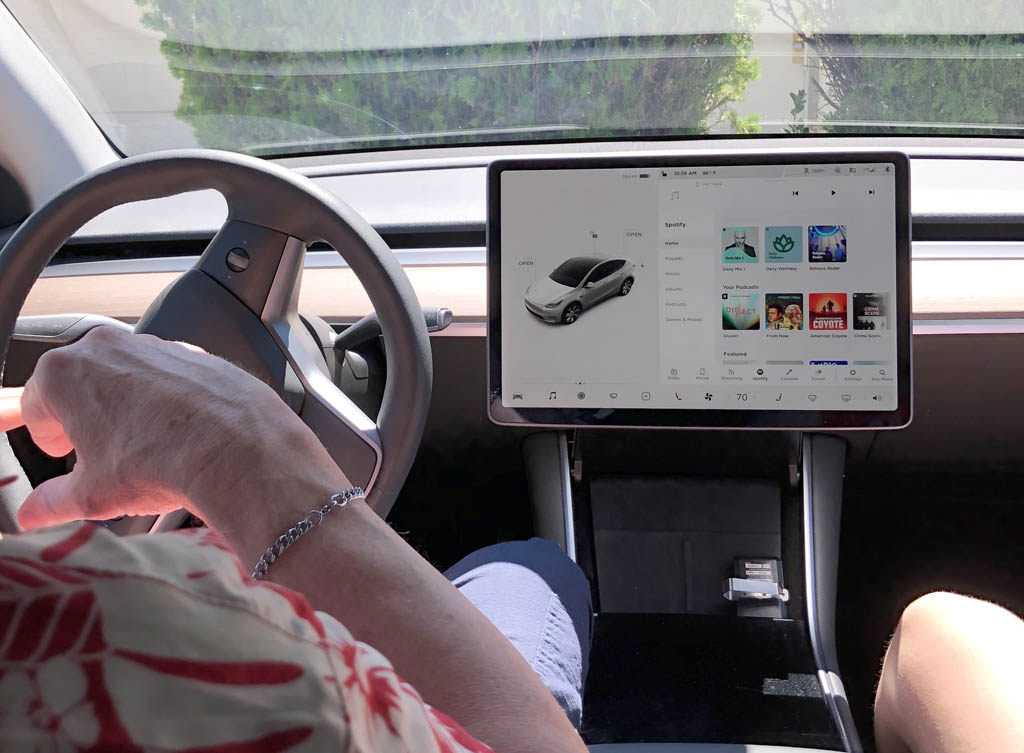
I talked on the phone to my brother the other day about his Tesla. Don’t you get Range Anxiety, I asked him? After a long discussion about batteries, the dual motor capabilities, the growing number of charging stations, and the rundown on their last bi-state road trip, he replied: No. His vehicle gets about 326 miles when charged up (nearly the same mileage as my Nissan Frontier, truthfully). Surely that’s sufficient to glide along any of the backroads of Virginia without worrying about a fill up, I thought. But still, aren’t you concerned about your onboard map/guidance system? What if the satellite coverage drops out? What if line-of-sight is obscured by mountain driving? What if, what if? From their website, I take some reassurance: As updated maps become available, they are automatically sent to Model S over Wi-Fi. To ensure you receive them, periodically connect Model S to a Wi-Fi network. OK.
Thinking about our transitioning to the new, all digital age: does anyone remember getting letters in the mail? Finding a collection of old letters carefully ribboned together and saved in shoeboxes, perhaps for generations? They were our maps and guide to the past, connecting us to people and places a text or an email never can. I’m looking at you, Major Sullivan Ballou (https://www.nps.gov/articles/-my-very-dear-wife-the-last-letter-of-major-sullivan-ballou.htm)
I wonder what we will leave behind in the way of ephemera, love letters, birthday cards, train stubs and such. Or will our future be one of the now, driving along our digital highways and not looking back. Never lost, always here.
If you are a map or data junky, Virginia Roads website has an amazing set of tools designed to create apps, or maps which incorporate their data. Again from their website: Build exciting new apps with no code. Story Maps are a great way to share your message interactively. Quickly combine your maps, analysis and data int a purposeful app – with no code!
That’s pretty exciting for me to see, the cartographic world was just beginning the transition to digital environment when I left the Army in 1986.
The holidays bring no end of opportunities for musical and dramatic presentations. Charles Dickens’ A Christmas Carol seems to never run out of venues, whether performed at community theaters or touring companies. So it is also with The Nutcracker, or holiday sing-alongs to Hansel’s Messiah.
If, like many families, you have your collection of DVDs, then by now you may have already watched White Christmas or A Christmas Story. Or you may be more partial to new favorites such as Elf; How the Grinch Stole Christmas; or Home Alone. The Hallmark Channel serves up an endless supply of 25 Days of Christmas movies to get us all into the spirit!
It’s a Wonderful Life premiered in December 1946. It was not a commercial success by today’s standards (initial box office release places it near $3.5 million) and doesn’t fall anywhere near the top 50 highest-grossing Christmas films. (Dr. Seuss’ The Grinch (2018), at $512 Million takes first place, followed by 1990’s Home Alone $496 million. https://screenrant.com/christmas-movies-highest-grossing-box-office-mojo/
Yet it has taken its place on many Christmas movie lists as one of the most-loved holiday movies. Due to an oversight by the copyright holder Republic Pictures, It’s A Wonderful Life came into the public domain in 1974 and was shown repeatedly on television for many years. For many of us “boomers” WhiteChristmas and It’s a Wonderful Life are the definitive holiday movies.
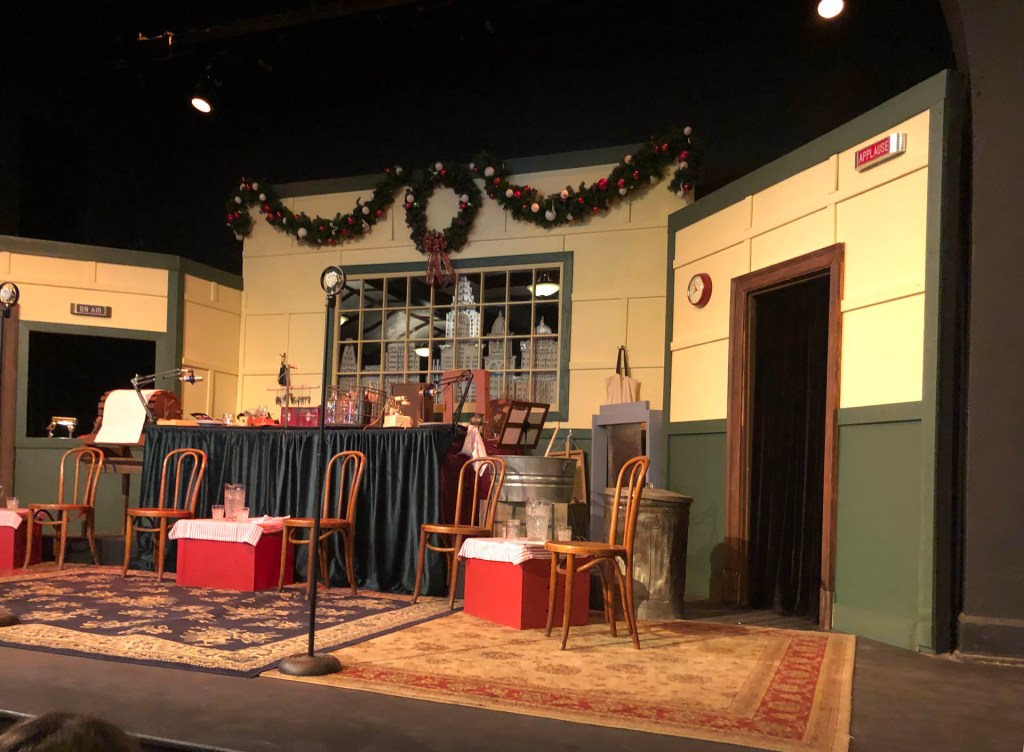
It’s a Wonderful Life: A Live Radio Play (full-length version) It’s a Wonderful Life is based on the story, The Greatest Gift by Philip Van Doren Stern and was adapted by Joe Landry in 1996. This past week we saw a wonderful performance of this charming holiday favorite by the Four County Players in Barboursville VA. The building is a beautiful historic school building from the 1930s filled with character. The stage of the auditorium of the Barboursville Community Center (formerly Barboursville High School) was transformed into the Manhattan radio station WBFR and side wings served as a “green room” during the play’s intermission.
The Players have been putting on a wide range of shows for over 40 years now. Looking through their website, musicals, comedy, and dramas abound and titles such as God of Carnage, The Laramie Project, and Chicago emphasize the wide variety and challenging pieces they have taken on.
It’s A Wonderful Life performed as a live radio play adds an extra depth to a story that has become very familiar over the years. The idea of watching actors, who are themselves portraying actors, who are telling a story set in the postwar 1940s makes this show both familiar and fresh. It’s as if we were being treated to a contemporary podcast, yet here the actions and expressions of the people on stage carry even more emotional weight than would a sound-only podcast.
Frank Kapra directed the movie, based on the 1943 short story The Greatest Gift by Philip Van Doren Stern, at the end of WWII. James Stewart had just gotten out of the Army Air Corps and the themes of faith and family, along with deep emotional trauma, surely resonated in his performance. It is a strange coincidence that this play takes the stage again 75 years after the movie’s premier, also at a time when the US has returned home from war.
Yet just as moving was the poigancy that Ken Wayne brought to his portrayal of the drama’s character Jake Laurents, voicing the play’s character of George Bailey. John Holdren’s portrayal of the radio show host was very impressive, switching from host to numerous characters seemingly at ease. Using only their stage scripts as props, or perhaps fussing with the fit of a garment, the cast brought multiple characters to life on stage. Very impressed by Sara Conklin and Katie Hutchins! A great delight was the onstage presence of two Foley artists producing an array of sound effects–from the sound of shoes crossing the floor; broken glass; wind effects; doors being slammed; to the swoooooshing sound of deep waters rushing under the bridge our main character finds himself standing upon.
I had expected the drama to be a bit more “staged,” the actors perhaps just sitting around their microphones in a sound booth. Director and scenic designer Kerry Moran has laid out a beautiful set with the actors front and center. The actors were on their feet at the microphones most of the time, true, but the camaraderie and playful banter exhibited by their onstage characters brought a great deal of additional life to the drama. The action moves along at a quite lively pace. Our director knows there is an audience watching these performances: subtle yet at times dramatic lighting effects coupled with musical backgrounds fill in what could have been a staid production. And those costumes! Welcome to the 1940s.
This was our first time attending a Four County Players’ performance; what a great introduction to theater in Central Virginia and a start to the holiday season.
Actors take their places on stage. Green Room during a break. Intermission, the actors remain in character while I meet new friends.Stage set with an impressive array of sound effects equipment.George Bailey returns a changed man. “Dear George, remember no man is a failure who has friends. Thanks for the wings. Love, Clarence.”
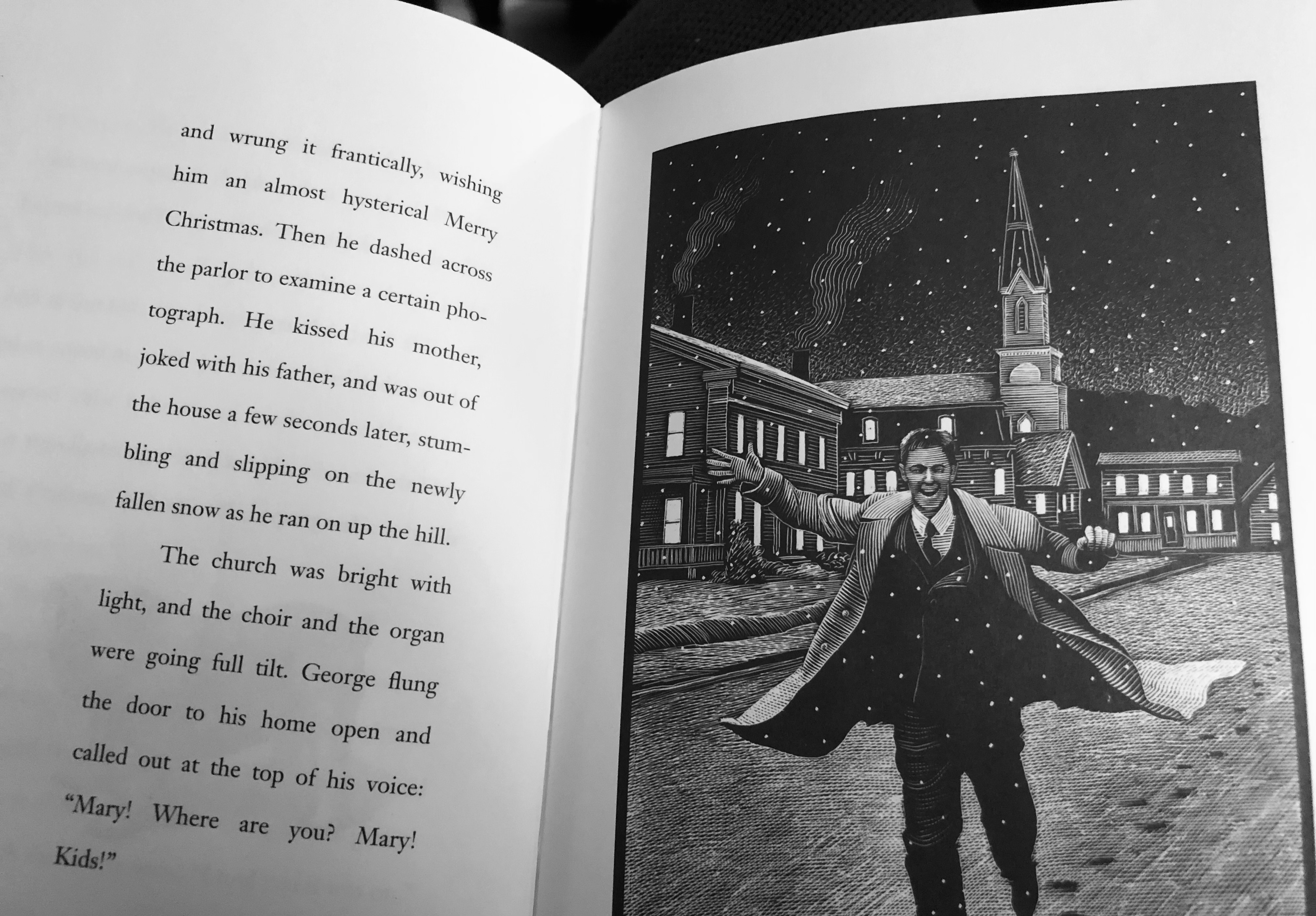
Book illustration by Scott McKowen from The Greatest Gift, published 1996 by Viking Penguin
We have found one of our favorite past-times during traveling is to stop in at antique and vintage shops and browse around. We seldom buy anything, and very often I’ll hear others comment, “Who would buy that?” Or more likely, “who would pay THAT MUCH?!” for a certain item. My wife will always give me a look, or a shush! but I’m sure it’s a common observation over what often seems to be random pricing in the second-hand retail market.
This fall we finally stopped in at a shop we have literally driven past for years. Finders Keepers is located on Main Street in Orange, Virginia and we see it nearly every time we head down to one of our favorite vineyards in Barboursville. Their website indicates they have been in business for over twenty-five years so I am surprised to see how long it took us to stop in. Needless to say, it was worth the visit.
While we browsed their extensive assortment of items, everything from furniture to lamps, prints and paintings, and home decor, I struck up a conversation with owner Bradley Toombs. We talked about how Covid has rapidly changed the face of retail, especially small businesses. During our conversation he mentioned that they also run an estate sale business and gave us his card to check it out later. Acorn Estate Liquidators offers online and in-person estate sales providing their clients with options to liquidate their personal possessions. It turns out, as many people are contemplating downsizing or moving away from the area, one of their greatest concerns is what to do with all of our stuff.
More out of curiosity than a need for anything, I checked out one of their online auctions.
WHAT A SURPRISE!
Here’s a brief list of some of the things that were available to bid on:
Antique furniture and lighting
Clocks, collectibles, paintings and prints
China and crystal, silver, pottery
Linens, quilts, and rugs
There were hundreds of items to bid on, most of which listed had an initial bid of $2. In some cases they increased by as little as $1 per bid. I’m struck by how little some of these items eventually sold for. There was a vintage Leica camera complete with additional lenses and a gorgeous leather camera bag that topped the bidding at $3,500. But that seemed to be the exception. Most of the lots closed at prices under $50.
So I jumped right in and started bidding! I lost the auction on most of listings I bid on, in some cases by as little as that $2 increment. But a couple of things that I bid on, I won.
While I’m quite pleased with having won the bidding on this sofa for $10, I think I might have gotten carried away bidding on this vintage children’s wagon. It looks great in the garden, I plan on filling it with potted plants in the spring, but the $27 that I paid for it was probably a little high. I am surprised at how many winning bids came in under $10. I suppose with an opening bid of only $2, it can take some time to reach a respectable bid offer. Yet there are always a few items that fetch commanding prices such as estate jewelry, fine art, or some of the antique furniture. Right now I have my eye on a beautiful wingback chair in great condition ($10) and an antique Victorian walnut marble-top washstand (my bid so far: $5).
But much of what’s offered looks like will bring in far less to the family than perhaps what they were anticipating. And that’s what really has me intrigued. When I look around our own living room, for instance, and contemplate what we paid for things like sofas, side tables and lamps, and all the decorative pieces that fill our rooms, and start adding up what I think they will get at auction, I begin to get a sense of real value versus cost.
Do not store up for yourselves treasures on earth, where moth and rust destroy, and where thieves break in and steal. But store up for yourselves treasures in heaven, where moth and rust do not destroy, and where thieves do not break in and steal. For where your treasure is, there your heart will be also. Matthew 6:19-20