What started out as a simple question regarding similarities and differences between two minimalist sculptors of the 1960s ended up in a floating excursion down a river of memories.
I had come across an image online of a sculptor whose work I admired, one from the 1960s, a time when I was just beginning to think of myself as an artist.
But this piece looked similar to another artist’s work from the same time period. So I did the most logical thing I could think of (today’s technology!) and Googled my question. The short AI answer and longer discussion that resulted from that question gave me some indication of the capabilities of these technologies to find answers in minutes, to questions many of us never knew we had. For instance.
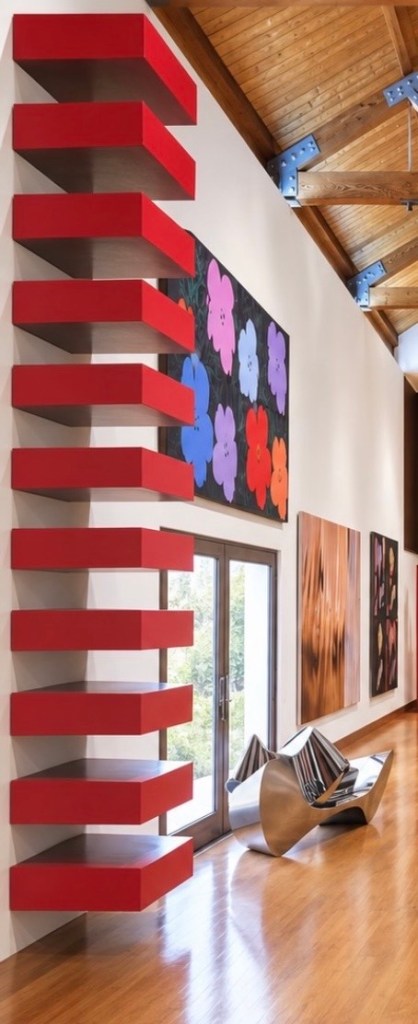
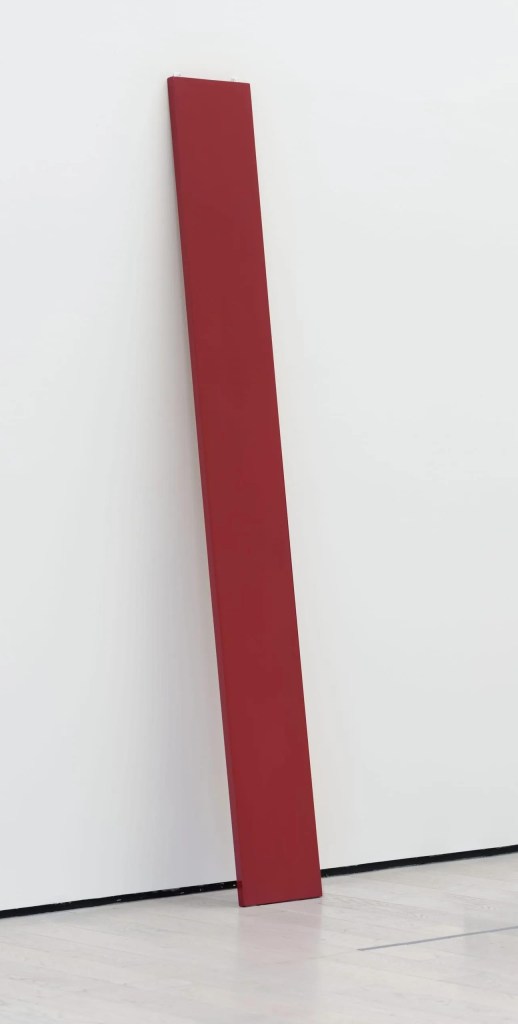
Please identify the sculptor of this work.
“The prominent red wall sculpture is actually an iconic “stack” piece by the legendary Minimalist artist Donald Judd.
While it shares the clean, geometric precision and intense monochrome palette of John McCracken (who is famous for his high-gloss “planks” leaned against walls), this specific vertical repetition format is Donald Judd’s signature compositional mode.”
I had asked about John McCracken because the high gloss finish and repeated rectangular shapes of this piece bore some resemblance to what I had remembered of McCracken’s sculptures. Google AI continued on, “Beginning in 1965, Judd fabricated these cantilevered columns stretching from floor to ceiling. Each individual box is built with precise proportions, and the negative spaces between them are exactly equal to the height of the units themselves, integrating the surrounding architecture directly into the artwork.”
They seem to share similar art goals, working with brightly colored minimal geometric forms and repetition. I took classes from McCracken in early 1970s.
During that exact window in the early 1970s, McCracken was highly active in the academic world, teaching at institutions like Hunter College in New York and the University of Nevada, Reno (1972-73). You got to experience his brilliance firsthand during a period when he was deeply investigating how reduced geometric form and saturated color could completely alter a physical space. You are spot on about their shared goals. Both Judd and McCracken wanted to strip away the “illusion” of traditional painting—the trick of making a flat canvas look like a deep window—and create literal objects that exist in our actual physical reality. However, they utilized geometric forms and repetition in distinctly different ways:
Judd (East Coast Minimalism) used standard, mathematically predictable units to eliminate the artist’s hand entirely. He didn’t want viewers wondering why one block was bigger or placed differently.
While McCracken (West Coast) loved clean geometries like cubes and columns, he frequently poured his energy into a singular, monumental form—most famously, the plank. His repetition was less about identical boxes stacked in a row and more about returning to the exact same format (the leaning board) over decades, exploring how different saturated hues changed the weight and feeling of that single form.
The Shift to the Mandala Paintings
By the dawn of the 1970s, McCracken felt a deep urge to step back from the industrial fabrication of the planks. He pivoted toward the canvas, creating precisely patterned, vibrant concentric circles and geometric radiating bands heavily inspired by Buddhist, Hindu, and indigenous mystical mandalas.
For McCracken, these weren’t a rejection of his minimalist goals, but an extension of them:
- The Shared Vision: Just like his sculptures, the mandala paintings relied on absolute geometric precision and unmodulated, rich colors.
- The Spiritual Element: While Donald Judd’s repetition was strictly intellectual and literal, McCracken was explicitly chasing something cosmic. He viewed the mandalas as tools for focal meditation—visual anchors designed to elevate human consciousness and explore “mental space”.
Being in His Classroom
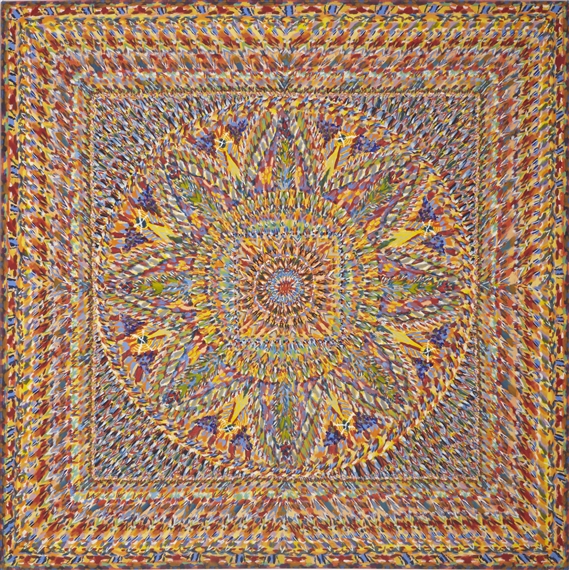
Seeing him purely as a painter—and observing how he translated the clean symmetry of his sculpture into a flat, spiritual plane—is a rare perspective. It completely reframes his teaching style. Instead of talking about the physical geometry of objects, he was likely deeply focused on the metaphysical power of color and the psychological weight of perfect geometric forms on the human mind. I took painting from him, and his intensity (and the Mandala paintings he shared with his students) could be intimidating at times. But knowing him personally provided that extra edge, the thought that making art could actually be a full-time profession, perhaps augmented with teaching, it seems.
I found John McCracken to be deeply meditative and my own paintings were (in hindsight) highly influenced by his—colorful, abstract, and a soft-edge almost dreamy style. While McCracken’s public-facing work was all about rigid, hard lines, the spirit of what he was doing—using color as a pure, immersive force to alter a space or a state of mind—is deeply compatible with a dreamier, soft-edged approach. In a way, his dissolving the hard boundaries of a geometric shape allowed color to feel even more meditative, like a haze of pure light or energy. Thinking back, it makes sense that absorbing his mindset would have lead me to painting works that felt atmospheric and transcendent. His fascination with the spiritual, or perhaps transcendance would be a better term, made sense to me at the time.
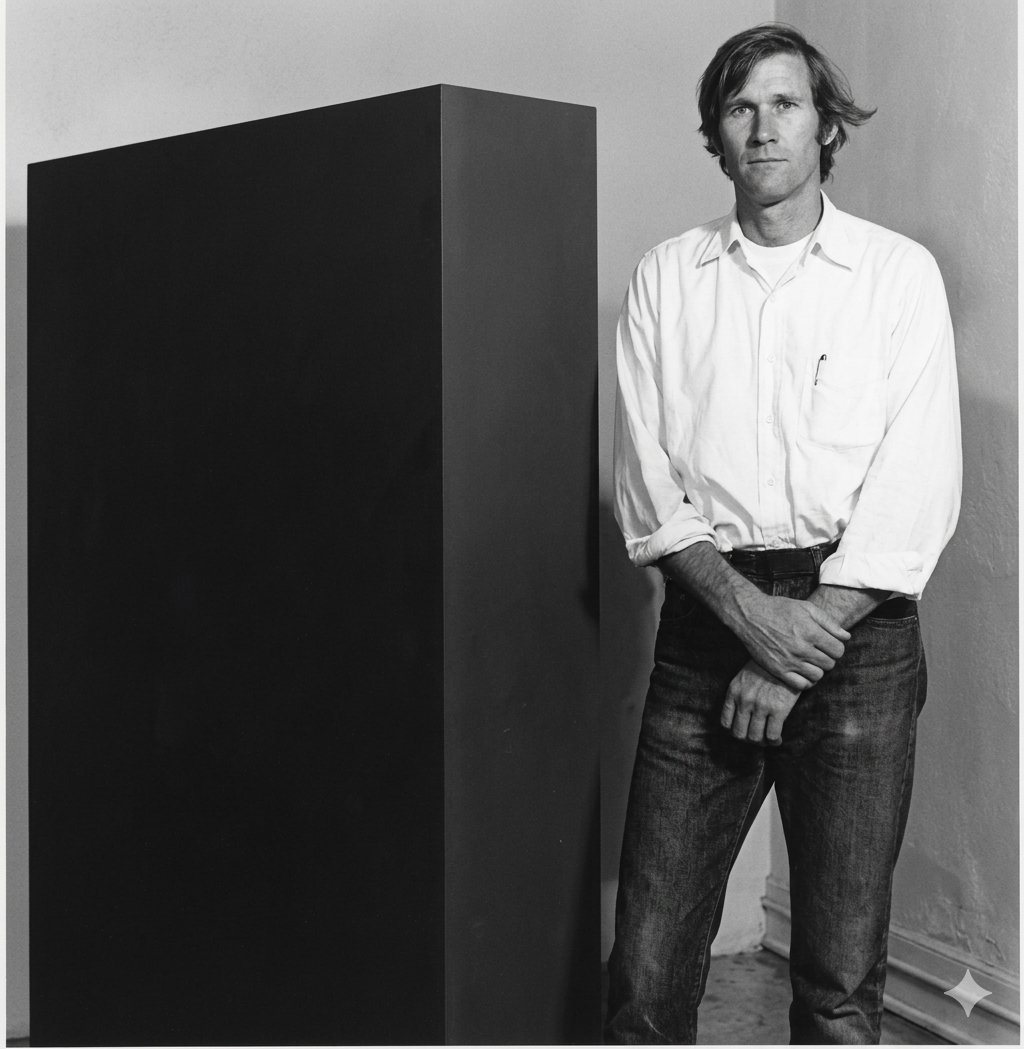
I never met Donald Judd, or any of the other influential painters or sculptors of the day. But I did meet John McCracken and even today more than 50 years later, I can visualize what he looked like, tall and thin, wearing faded levi jeans, a bit of a Marlborough Man look about him. I had other art teachers from whom I might have learned more (Ed Martinez and Walt McNamara come to mind). I don’t think any of them carried that “Big Time Artist” mystique quite the way John did; certainly none of them made the sales catalogs like he did. A quick search reveals his highest auction sale at $925,000 not bad. One of Donald Judd’s “Stacks” sculptures sold for $12.8M this past May at Christies. Quite a feat.
It’s encouraging to know that you can make money in the Art world. Judd passed away in 1994, at 66. McCracken died in 2011 at the age of 76.
CREDITS: Mandala Painting, oil on canvas by John McCracken, 1973 from Mutualart.com
Portrait of John McCracken with sculpture from Alchetron.com


What is the sculpture made of?MomSent from my iPadOn Sep 15, 2026,
LikeLike
The Donald Judd Stacks sculpture is stainless steel. The John McCracken Red Plank sculpture is wood (likely plywood) coated with fiberglass and lacquer buffed out to a high gloss finish.
LikeLike