Take Highway 29 south of Charlottesville. The broad four-lane highway rolls gently away from the crowded streets of this college town, climbing into the wooded ridges of Nelson County. Mountains? Having lived in Nevada, I still think of these as hills. Beautiful, forested hills—but hills nonetheless.
The road passes wineries, cideries, and bed-and-breakfast inns that seem perfectly at home in Virginia’s countryside. As pleasant as they are, I found myself wondering what this landscape looked like during the 1930s.
Twenty-four miles south, turn left onto Route 6—Irish Road. A few minutes later you’ll arrive at the Walton’s Mountain Museum in Schuyler, Virginia.

That’s how I drove home.
Getting there was another matter.
From Somerset, Virginia, I followed State Route 20, where road construction narrowed an already winding highway. Cars crept through one lane at a time, each of us patiently following the next toward destinations that, in my case, were entirely unfamiliar.
July in Virginia is predictably hot and humid. But on this particular day another visitor had arrived first: smoke from the Canadian wildfires, nearly 900 miles to the north. I had hoped that by climbing into the mountains I might outrun the haze—or at least rise above it. Instead, the smoky air that blanketed our valley had settled over Schuyler as well. The destination proved both new and strangely familiar, but the clear mountain air I had imagined never appeared.
Housed in the former Schuyler High School, the Waltons Mountain Museum features carefully recreated sets from the television series, including John-Boy’s bedroom, the family kitchen, and Ike Godsey’s store. Opened in 1992, the museum has become an important part of the local economy, drawing fans from across the country and around the world. During my visit, guests had come from nearby Charlottesville, North Carolina, and much farther away. A glance through the visitor log confirmed that the appeal of The Waltons extends well beyond Virginia.


The television series ran for nine seasons and 221 episodes before concluding in 1981, followed by a number of reunion movies through 1997. Nearly three decades after the last of those specials aired, visitors are still making the pilgrimage to experience the world of a family who, though inspired by real people, largely lived in fiction.
The museum occupies an interesting space somewhere between celebration and remembrance. Visitors come to relive the lives of the fictional Walton family, but the museum never lets them forget the real family behind the stories. Earl Hamner Jr., whose childhood inspired the series, grew up here with his parents and seven siblings. Throughout the exhibits, photographs place members of the Hamner family beside the actors who portrayed them, gently reminding visitors where fact ends and storytelling begins. The Hamners first became a novel, then a film, and eventually one of television’s most beloved series. Yet behind it all remained a very real family from a very real Virginia town.

The museum’s caretaker that afternoon had grown up in Schuyler. She was old enough to have known many members of the Hamner family personally, although I never quite sorted out exactly who or when. What mattered was that she transformed the exhibits from static displays into living history. She shared firsthand stories, local memories, and bits of background that never appeared on the exhibit labels. More than anything I read on the walls, she brought both the people and the town to life. I found myself disappointed when she excused herself for a break.
Earl Hamner Jr. was born in 1923 and died in 2016. He was only three years older than my father, one of five children, and five years older than my mother, who grew up with six siblings of her own. Like the Hamners, my parents lived through the Great Depression. Yet standing in Schuyler, it was easy to imagine that those difficult years were considerably harder in the hills of rural Virginia than they had been for my parents in Southern California.
Still, hardship has a way of producing stories worth telling. In this case, those stories have endured for more than fifty years, continuing to draw people who long for a glimpse of a simpler world—or perhaps simply a kinder one.
I spent an unhurried afternoon wandering through the museum, complimenting the caretaker on the thoughtful exhibits. I lingered longest in John-Boy’s recreated bedroom, which somehow felt exactly as I had imagined it. Before leaving, I picked up a few jars of Waltons Mountain jam from the gift shop. The Moonshine Jelly contained considerably more “moonshine” in its name than in its recipe, but it was enjoyable all the same.

After more than thirty years producing graphics and exhibits for museums and visitor centers, I’ve seen displays of every size and budget. Every exhibition hopes to honor its subject well. Could the captions have been more legible? Certainly. Would improved lighting and newer display cases have showcased the collection more effectively? Without question.
But they also might have polished away some of the museum’s charm.
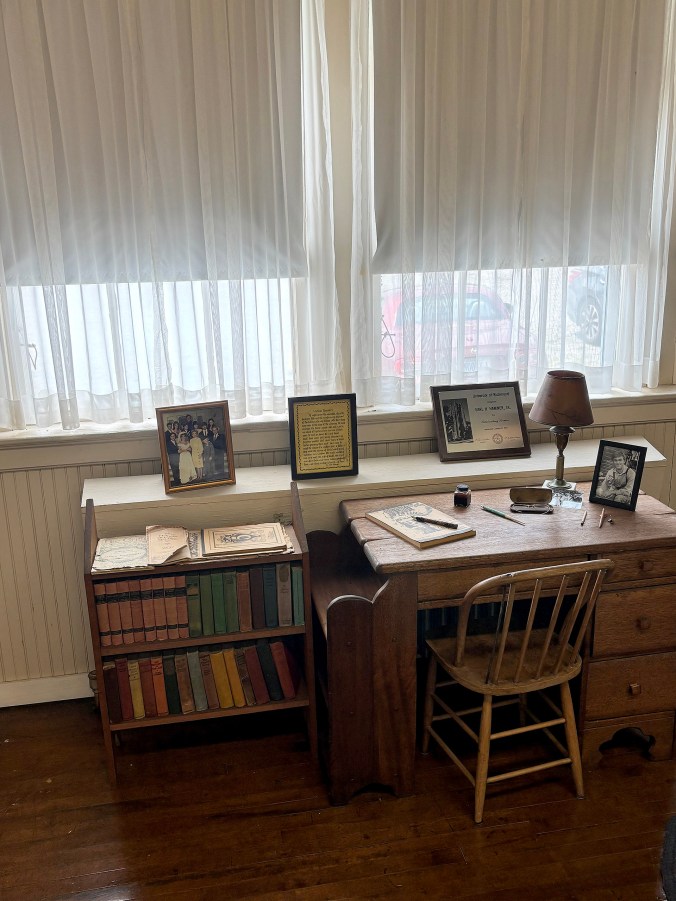


For me, the exhibits were memorable. The stories were unforgettable. And the best exhibit in the building wasn’t behind glass at all—it was the woman behind the front desk who remembered when these stories were simply the lives of her neighbors.
If you’ve been to the museum, let me know in the comments below.


Excellent! Your commentary had a bit of the laconic narration of Earl Hamner Jr; perfect. This is a great piece about the area, the family, community and the impact this show had on the many, many people that watched it weekly.
LikeLike