One of the most memorable examples of handwriting analysis appears in The Memoirs of Sherlock Holmes, in the story The Reigate Squire (also published as The Reigate Puzzle).
In that story, Sherlock Holmes examines a torn fragment of a note and performs a brilliant bit of analysis. He deduces that it was written by two different people—a younger man and an older one—based on subtle differences in pen strokes. Even more impressively, he observes that the two alternated writing individual words. From the handwriting alone, he infers personality traits and even the relationship between the writers (who turn out to be the Cunninghams, father and son).
Holmes explains his reasoning in terms both simple and elegant: the weak, irregular strokes of an elderly hand contrasted with the bold, confident lines of a younger one. The analysis becomes central to solving the crime.
The Reigate Squire is really a showcase—a kind of set piece built around handwriting as a forensic tool—and it remains one of the more scientifically intriguing episodes in the Holmes canon.
My own interest, however, is far more personal.
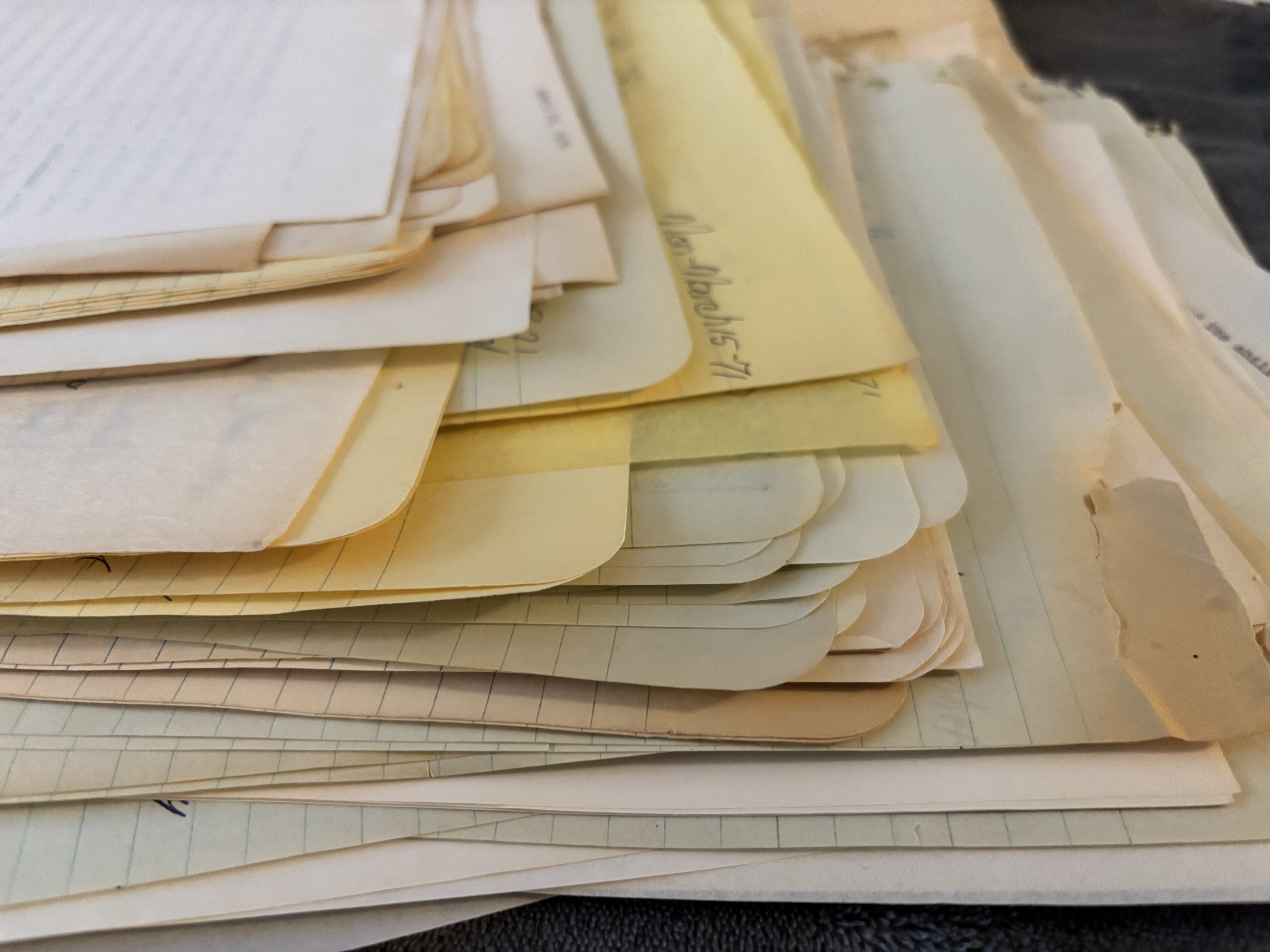
Recently, I came into possession of an envelope filled with old letters—ones I had written to my mother and stepfather more than fifty years ago. She had saved them all: along with grade school photos, birthday cards, and other bits of life that somehow survived the decades. When she moved into a smaller apartment, the whole collection found its way back to me.
And that raised an unexpectedly difficult question: what do you do with handwritten letters from the early 1970s?
Do you throw them away?
Or do you sit down and read them—slowly—and try to rediscover your 18-year-old self?
I chose a third option.
I scanned one of the letters and submitted it for handwriting analysis, pairing it with a recent sample of my writing. If nothing else, I thought, it might create a kind of “before and after”—a small window across half a century.
The results were…interesting.
What’s especially striking is not just that the structural traits match—it’s that the movement signature matches. Handwriting, it turns out, is less about the shapes themselves and more about how the hand moves across the page. In both samples, the rhythm, the rightward momentum, the confident t-bars, and the distinctive descender curves all carry the same kinetic “accent.”
In other words: it still feels like me.
What’s changed over time feels natural—almost reassuring:
- The size is slightly reduced → more efficiency than diminished energy
- The pressure is lighter → a common effect of age, as muscles soften
- There’s a bit more angularity → often a sign of reflection and analysis
- The baseline remains steady → suggesting continued motor control and cognitive stability
That consistency across decades points to something deeper: a stable personality core—expressive, engaged, structured in thought, and purposeful in communication.
And there’s one subtle distinction I find especially meaningful. The earlier sample shows an expansiveness of life; the later one shows a depth of thought. That’s not decline—it’s development.
The analysis itself considered a wide range of characteristics: letter size, loops and lines, pressure and stroke strength, formation patterns, rhythm, flow, even emotional tone. The conclusion was clear: this is the same writer.
But not the same person. Or perhaps more accurately—the same person, continued.
The evolution tells a quiet story:
- Emotional expressiveness retained
- Increased discipline and structure
- A slight softening of stroke
- A more deliberate, measured pace
If I had to summarize it in one sentence: the later sample reads like the same voice—just seasoned, steadier, and more intentional. It’s comforting to discover that 18-year-old me and 74-year-old me still have so much in common.
We don’t often get the chance to revisit our younger selves—much less to recognize them, and feel at ease with who they’ve become. It was a fun visit, less scary than I had expected. How about you? Have you taken any trips down Memory Lane lately?
 My Retired Life