It’s now been a month since we made the move and downsized from a 1900 square foot townhouse to a 1,00 square foot, two bedroom apartment. It hasn’t been without a few challenges. Overall, however, I’m surprised at how well we have managed.
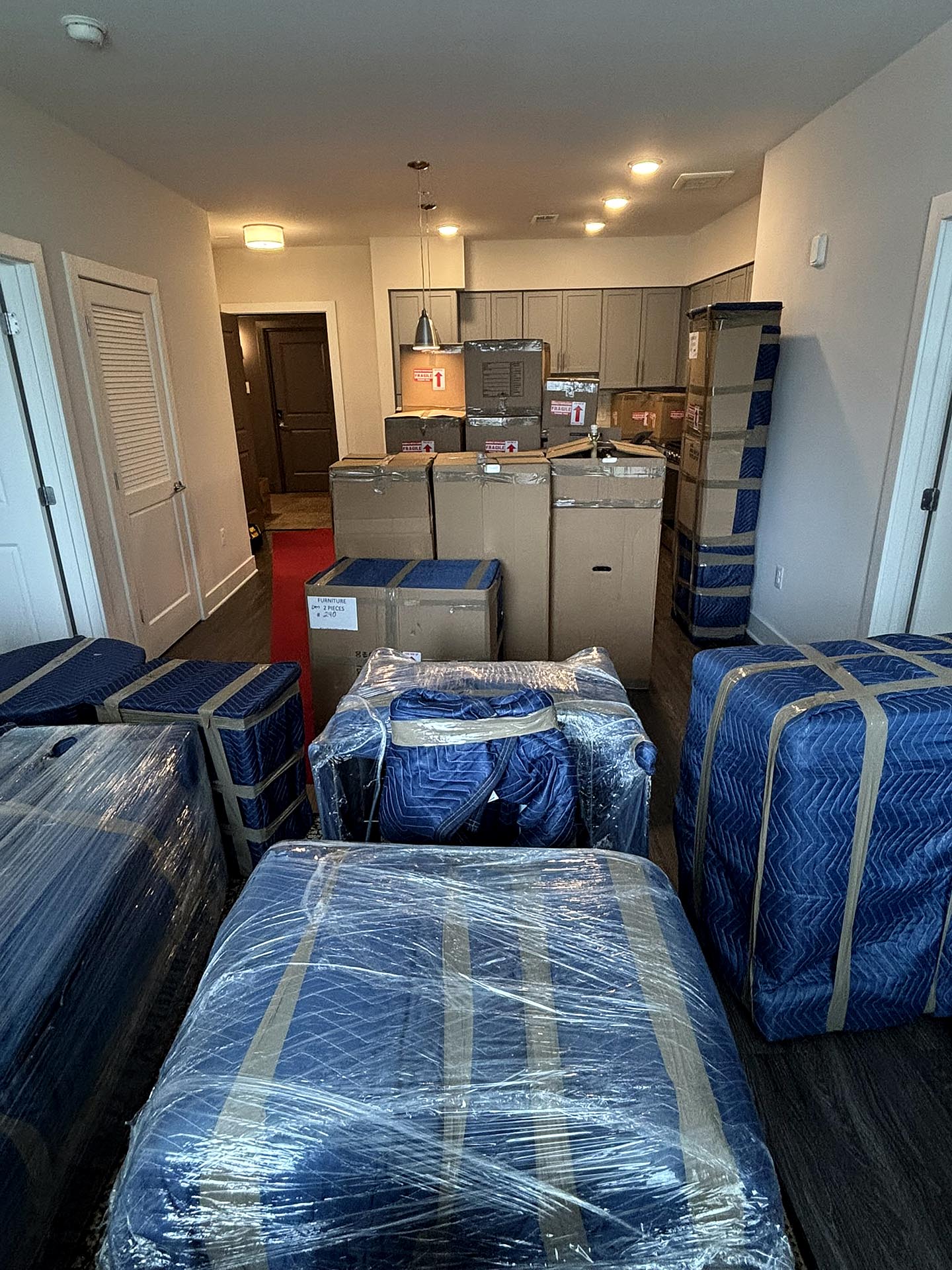
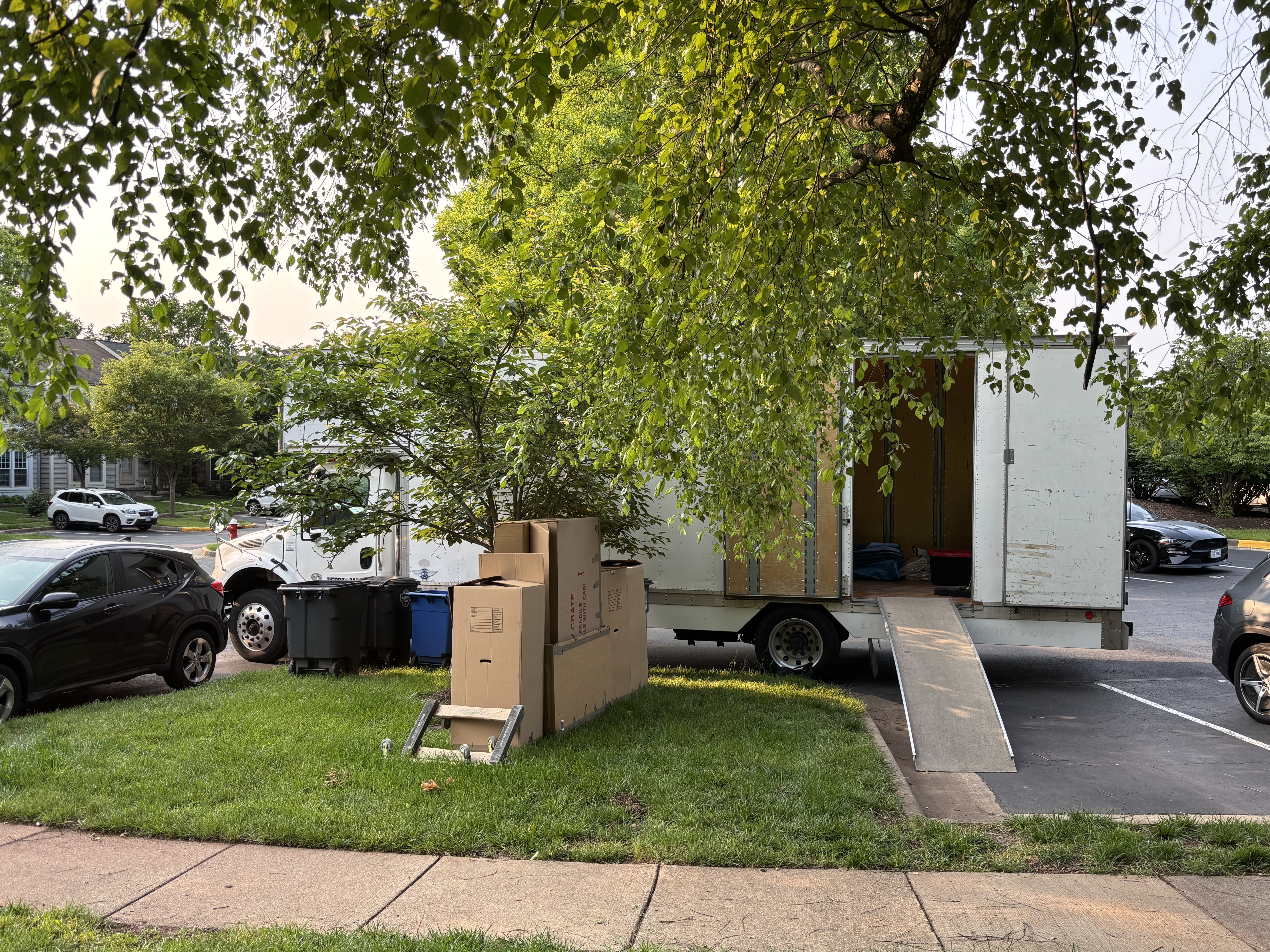
Boxing, packing, renting a storage unit, more sorting thru, donating and discarding all helped to prepare our townhouse for sale. The final move was over in a day—we had movers come in and load all the boxes and furniture and after that it was just directing where things were to go.
The pictures and family photos have now all been hung. We have fewer walls than our townhome so not everything went back up. And there has been some rearranging: the Nevada Room is now the living room, before it was the decor for the guest bedroom. The second bedroom in the apartment has been reconfigured as our Den/TV/Office. A small daybed serves double duty as a couch and a bed for future guests.
Previously we had a separate kitchen, dining room, and living room. In our new place, those are all combined in one large central room, which I thought would be too small but actually functions quite well. The big bonus for me is the extra kitchen storage and the large kitchen island. The granite countertops are an upgrade as well as the under-cabinet task lighting. Really, it’s been quite an improvement. And having the washer dryer in the kitchen is a huge blessing! No more walking down two levels to do laundry.
We are getting spoiled by a couple of amenities that the apartments offer. A covered parking garage means no more walking in the rain between house and car. “Trash Valet” picks up our trash and recycling every evening at our door. The trip from the townhouse backyard up a snow-covered slope with our trash receptacles was more adventure than I cared to repeat, especially in dark December and no walkway. Now we just set the containers out and bring them back in before 9am the following morning. Sweet!
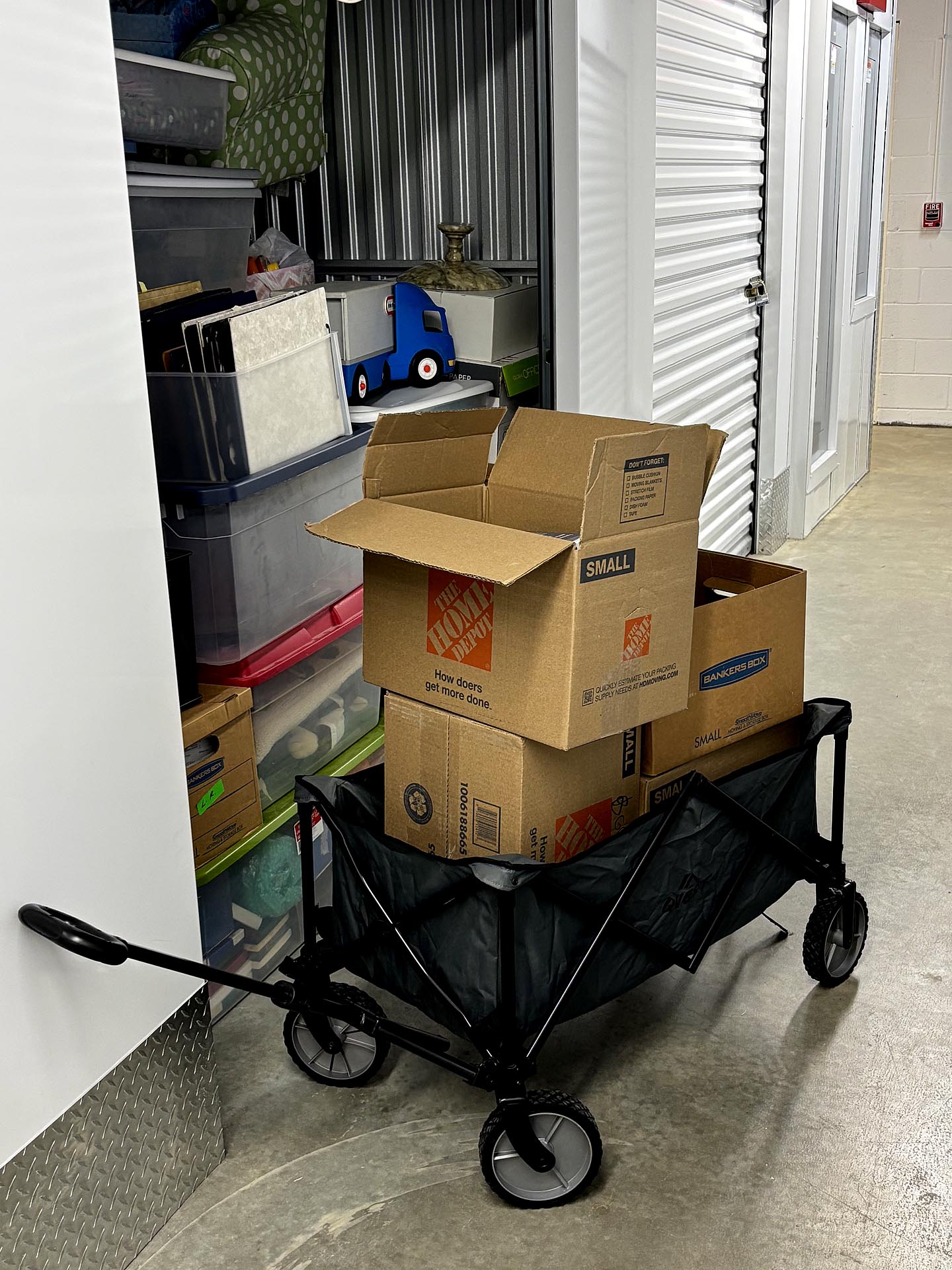
We’ve had to bring our small wheeled cart out of storage to use transporting boxes and bags from my truck, through the parking garage and down the long hallway to our apartment. I think it’s seen more action this week than in the previous four years of use. As boxes make the trip from our storage unit to the new apartment, I’m struck by how many we have. I had packed boxes and moved them to storage over the course of many weeks, stacking them until I couldn’t reach the top of the pile. Everything got packed. Now, as we unpack and try to find room for what we have, we are continuing the process of sorting, donating, and trashing, looking at every memento, book, or CD with a more discerning eye. Out it goes!
The 424-acre Kincora site has 180 acres of natural area with scenic nature trails bordering the Broad Run River, a tributary of the Potomac. I hope to get out and start walking some of them once the heat of summer begins to fade, right now the humidity is oppressive (typical Virginia summer!). There is quite a bit of construction activity in the to-be-developed area here at Kincora. More apartments, townhouses and retail will join the Northern Virginia Science Center under development. We had looked at moving here back in 2019; as we begin this new chapter in our lives, it looks like we picked a great time to relocate!
It has been a week! Which started roughly six months ago, but finished up today.
When we first moved to Ashburn, it was the beginning of a rather long and protracted downsizing. I had recently retired, we were in a house which over the years had begun to feel too large for us, and my wife had just a few years left in her then-current job when she would have to decide, “what’s next?” Moving from Fairfax, we expected that the townhouse we had bought in Ashburn would be an interim step for us as we downsized, expecting it to last us for perhaps five years. We ended up staying six before selling and moving this spring, downsizing again.
The process of getting ready to sell our home began in earnest back in January. While we debated the pros and cons of buying or renting another place (we eventually decided to rent), we knew a lot had to go to squeeze the contents of a 1,900 square foot townhouse into a 1,000 square foot apartment. Here’s a great hack: get a storage unit close to where you will be moving: those hard decisions about what to purge can be made later when you aren’t under pressure to pack up everything and go.
So it’s been six months of preparing followed by a long day of movers wrapping and packing and moving us into an apartment. Most of our boxes have now been unpacked, newspaper and bubblewrap cleared out. I’ve run the dishwasher once; we have trash valet service which means no more trips with trash cans up an icy or snow-covered hill to the street. We’ve run a load of wash in the new full-size stackable washer/dryer and tonight I’m planning on using both the gas range and the stove to make dinner. Big steps!
We had two assigned parking spots at our townhouse, here we have a parking garage with open parking. An elevator provides a quick ride downstairs to the apartment lobby and the mail room, the gym is on the ground floor level and a rooftop deck is great for viewing the sunset.
Already I miss our bit of yard and common area green space from the old home even though the deer here in Ashburn ate almost everything I ever planted. I have to say, all-in-all it’s been a good experience. Deb has never lived in an apartment and it’s been nearly 40 years since I have. The times we’ve moved as a married couple can be counted on one hand, not all that bad for boomers. My Mom wrote recently that she had moved ten times in the seven years after she had graduated high school in 1946. I’m not complaining! It’s another My Retired Life Adventure.
The effort to rid the city of vice brings to mind the Batman movies and Gotham City except that here, there wasn’t a caped crusader fighting the sinister dark elements of the criminal underworld. But much like watching a movie for the second time, reading back through events that have already transpired, in this case more than 90 years ago, we can know the ending from the beginning. And the ending in this particular story was very interesting.
While my grandfather may have been just one of many individuals caught up in local efforts to control vice, there were other factions involved that eventually took center stage. The long list of names covered in the newspaper at the time also included one of the arresting officers, along with the recently elected mayor and his appointed Chief of Police. There were others as well, including the county sheriff, but the mayor, police chief, and deputy police chief were at the center of the investigation.
Mayor Seccombe had been elected in April with a substantial plurality of votes out of a field of six candidates for mayor. He had been a city councilman running against several other businessmen, a lawyer, and others who all vowed to “cleanup the city”.
Upon election, the new mayor chose for his chief of police Dan Murdock, a deputy sheriff in the county. Speculation at the time had him choosing another individual and the choice eventually came down to Murdock or another San Bernardino policeman, C. Lawrence Jordan. With Murdock as Chief, Jordan was named the night Chief of Police.
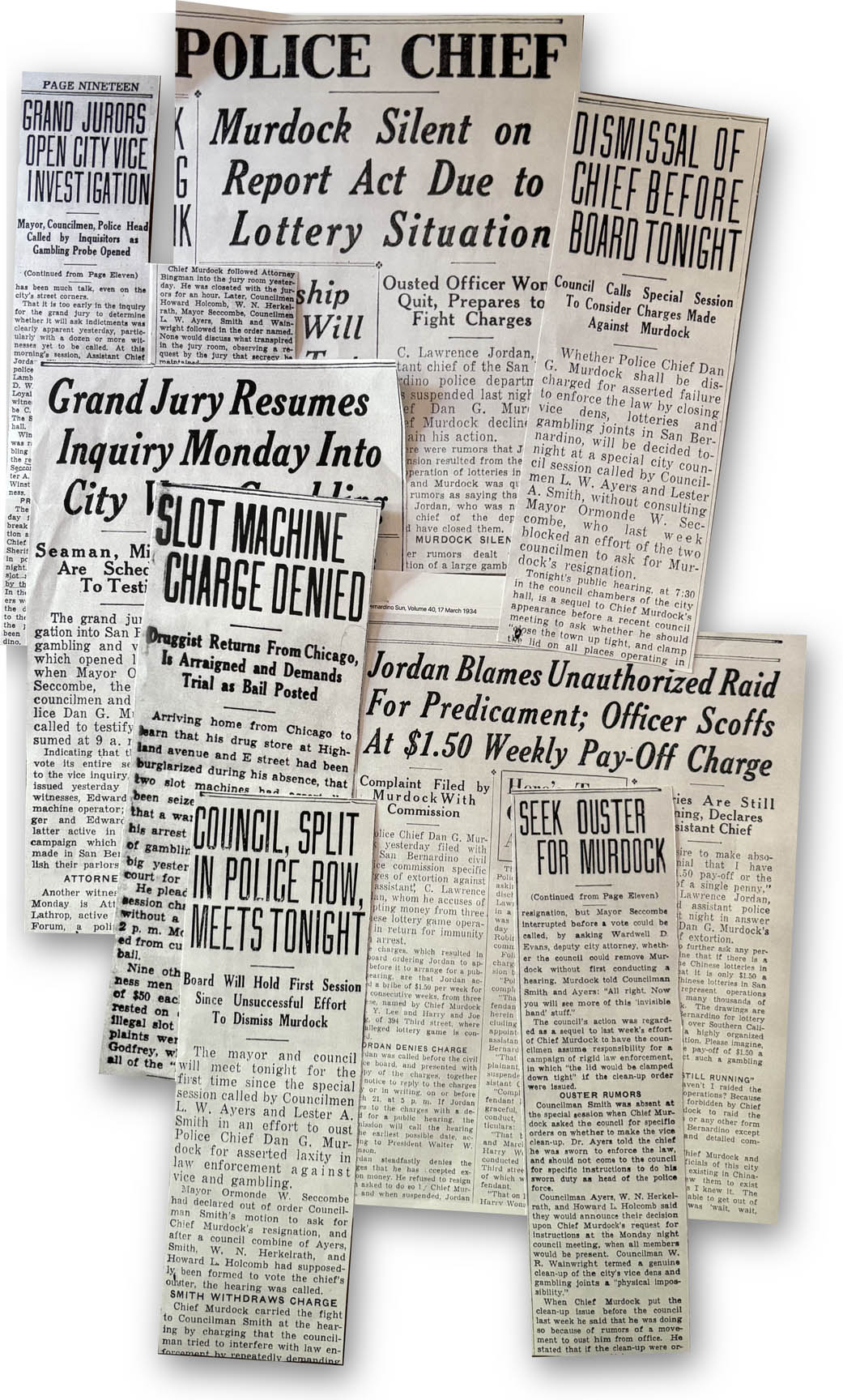
By December of 1933 a grand jury was conducting an inquiry into city vice and gambling during which Mayor Seccombe, Murdock, Jordan and others were called to testify.
At the heart of the investigation were allegations that the police department, or some individuals therein, had been operating a “pay-off” system in regards to gambling in the city, which perhaps had related to the low number of raids and arrests conducted that year. Surprisingly, or perhaps not, no indictments were returned as a result of their investigation.
In March 1934 assistant chief Jordan was suspended by Chief Murdock over accusations of receiving kickbacks regarding the operation of lotteries in Chinatown. Jordan did not resign and the Chief ended up filing charges with the civil service commission which would eventually call both men, and others, to testify regarding the accusations.
The police chief filed charges of extortion against his assistant in what must have felt like a bit of payback in that, the previous year, both had been considered for the position of Chief of Police. Awkward! The extortion charges relied on testimony from three lottery game owners who basically stated that assistant chief Jordan had accepted money from them in exchange for immunity from arrest. How much was he accused of having received in consideration for allowing their operations to continue unabated? $1.50 per week. Well then.
In answering the allegations, assistant chief Jordan maintained that $1.50 per week payoff for a gambling operation that reportedly netted thousands of dollars a week was absurd. He also maintained that it was the chief of police who “expressly forbid” him to raid those or any other form of vice in the city “except under his direct and detailed command.” So then, now we have a very awkward situation! Whom to believe?
So then it seems that the individual responsible could be the police chief and not his deputy. But wait! After the civil service commission hearing regarding his suspension, Jordan was exonerated and his job reinstated. He was however reprimanded for “frequenting of questionable places other than in the performance of his duty as an officer and the intimated purchase by him of lottery tickets.” Result? Suspension without pay for thirty days.
Several weeks later, two members of the city council sought to have the chief of police removed from office; the move was blocked by the mayor but taken up a week later at a special session. During that session, one of the councilmen who had voiced opposition to the chief changed his position. The inquiry ending up with yet another exoneration, this time for the police chief who ended up retaining his job. Following his exoneration, the city councilman who had spearheaded the drive to have the police chief removed was himself facing a recall effort by voters in his own ward. Those efforts proved to be short lived and the councilman not only kept his seat but shook hands with (forgive and forget) with the police chief he had attempted to have removed.
It seems with that last city council session, the dust-up involving the assistant chief, the chief of police, and the city council had come to an end. Chief Murdock continued to make periodic arrests for gambling and other forms of vice within the city; assistant chief Jordan was reinstated though not at his previous position; and the councilman who was at the center of the police chief recall movement managed to retain his seat. Arrests continued to result in hefty fines being added to the city’s treasury. All-in-all, it reads like another episode of Law and Order in Gotham City. Admittedly my grandfather’s part in all of this was quite small, but in researching him I did get a very up-close look at small town politics, intrigue, and the way public morals have shifted over time here in the US. Ninety years ago but it sounds like today.
*UPDATE*
In a surprising, somewhat ironic note, my Mom wrote this to me: “When your dad and I got married, the former mayor’s grand daughter, Evelyn Seccombe, was my maid of honor. Her mother and my mother had been close friends in San Bernardino High. They were both in the very first graduating class…1918, of the new High School.” Lora Lea (Willis) Chamberlin 9/10/2024
It started with an election, as these things often do, and a new mayor promising to “clean up the city.” The election in April of the that year brought in a new mayor and with him, a new chief of police with a renewed emphasis on curbing vice in the city. And so they took action: 60 people were arrested in a series of raids in July, 1933. While 60 doesn’t seem to be such an extraordinary number to us today, in 1933 there were only 39,000 people living in San Bernardino, California. That seems like quite an effort.
In a campaign to “rid the city of vice and lawlessness”, the mayor added two additional police members to the vice task force, “and the drive will include gambling establishments, houses of ill repute, boot legging places, and other similar dens of vice in our community.”
In December of 1933, Police Chief Murdock reported that he had made an initial survey of gambling establishments in the city after he first took office in April and found 20 of them. So something was going on that needed looking into.
A postcard from the 1933 Chicago World Fair
A chatty social article in the San Bernardino Sun mentioned that Mr. and Mrs. Ralph A. Hilbig left in late June, driving out to Chicago. It was understood that they would be visiting the Century of Progress Fair (Chicago World Fair) and later visit with relatives in Michigan where Ralph Hilbig grew up.
On the 8th of July nine San Bernardino business men were placed under technical arrest during a slot machine war. The District Attorney had issued 10 complaints at the request of a private citizen who attested that the machines were gambling devices as he had played all of them. Arrested were a bar owner, cigar store owner, several cafe owners and a billiard hall owner. My grandfather Ralph A. Hilbig, who was out of the city at the time (the Chicago trip) could not be brought in. All the men were fined $25. While the police had raided 11 establishments, they only seized 9 slot machines, two of which were at my grandfather’s pharmacy. I can only imagine now why he would “assertedly” have gambling devices in his drug store (what could they possibly pay off in 1933?!). But later news articles never indicate the eventual disposition of the seized machines.
When my grandparents returned from Chicago on the 14th of July, they assumed that the drug store had been burglarized while they were away; however two slot machines had been seized from his drug store and a warrant had been issued for his arrest on charges of possession of gambling devices. He pleaded not guilty to the possession charge and was released on $50 bail with a trial set for the following Monday.
An article from December 12, 1933 has Ralph A. Hilbig listed again with a group defendants who were charged with possession of slot machines and released. Additionally, there were arrests for running a poker game, a domino gambling game in chinatown, penny ante games—all in all 48 individuals arrested. He forfeited the $50 bail when he failed to appear in court. Nine other businessmen forfeited their bail as well for the same offense in a series of gambling and vice raids which had netted almost 60 individuals. Looking back, it seems my grandfather took the fine and bail forfeiture rather than the trial.
That seems to have been my grandfather’s last close brush with the legal system. In 1934 his name appeared in a rather long list of individuals who had been selected to serve in a jury pool and indeed, he ended up serving on two juries.
But the story doesn’t end here; what was happening behind the scenes is often more interesting than the actual drama. And next week we will finish up this three-part story with a look at the police officer, the chief of police, and the new mayor. Oh! And their appearance before the grand jury. That’s when things really get interesting.
In 1895 a German immigrant in San Francisco by the name of Charles Fey invented a mechanical device consisting of several metal cylinders which, when activated by a coin, would spin in random sequence until they stopped and an image displayed on the cylinders would appear in a window. Whether the original five cylinders or the later three, when two or more of the same image appeared inline, you were a winner. The slot machine had humble beginnings but would eventually make a huge impact on the California and neighboring state of Nevada’s economy and later, much of the world.
Fey pioneered many innovations of coin operated gaming devices in his San Francisco workshop at 406 Market Street, including the original three-reel bell slot machine in 1898. The international popularity of the bell slot machines attests to Fey’s ingenuity as an enterprising inventor whose basic design of the three reel slot machine continues to be used in mechanical gaming devices today. (Winkslots)
Fey’s workshop is no longer standing. The Liberty Belle Saloon and Restaurant owned by Mr. Fey’s grandsons, Marshall and Franklin in Reno, Nevada, had many slot machines, including the first three-reels, the first draw poker machine and the first three-reel dollar slot on display. Sadly the Liberty Bell is no longer standing either, torn down to make room for a parking lot for the convention center. The slot machines were moved to the Nevada State Museum in Carson City.
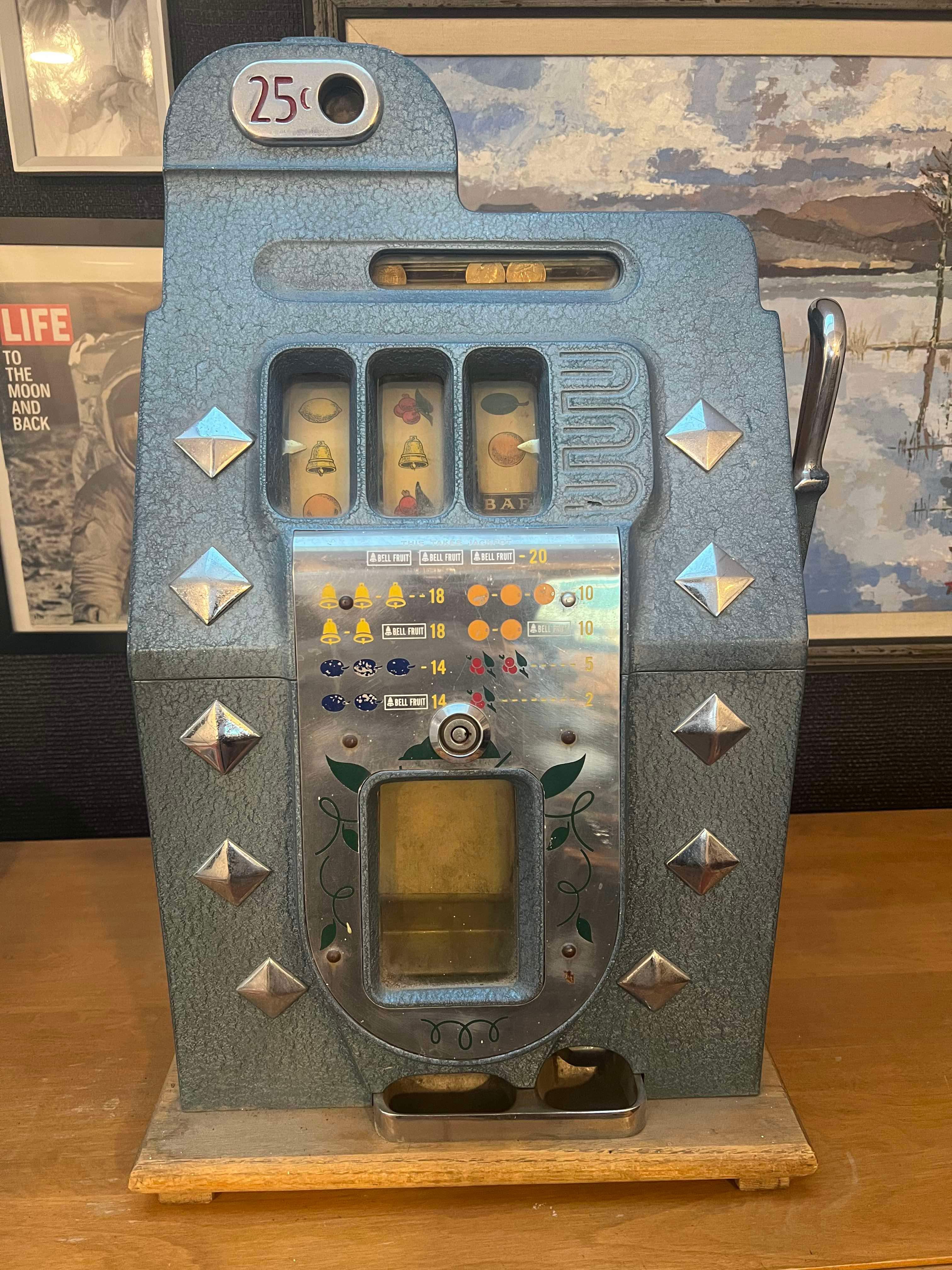
California the “Golden State” is the US’s largest Indian gaming state, with yearly casino earnings of around $9 billion. California has 76 Indian casinos and five mini-casinos, owned mainly by its 109 tribes. (playtoday.com) Today nearly everyone is familiar with slot machines, the original “One-Armed Bandit” and they can be found in many states which now have legalized gambling of one type or another. Below is a machine from the collection of a family member, an early 1940’s Mills Diamond Front Slot Machine, originally produced in 1933 by the Mills Novelty Company of Chicago. Mills was one of the few companies which manufactured both gambling and vending machines.
But their rapid adoption also became the key to their eventual downfall. In 1911, 16 years after the invention of the slot machine, slots were outlawed in California.
The first few decades of the 20th century saw rapid social changes as well as industrial and technological ones. The proliferation of gambling devices, though regulated to some extent, saw them popping up “everywhere,” along with lotteries and card games. And gambling was considered to be one of the chief vices, often found in proximity with alcoholic beverages and prostitution, numbers rackets, off track betting and other “vices.” Reformers managed to get laws passed to control if not outlaw many of these. But whether legal or illegal, many of these activities simply went underground, available but not “too” visible.
Due to the ban, cash prizes would not be distributed any longer, but the fruit machine found a way to work around the ban. To emphasize that they were vending machines, not gambling machines, fruit symbols–cherry, orange, lemon–replaced the poker symbols and then the prizes were given out as sweets and chewing gum according to the corresponding slot flavor.
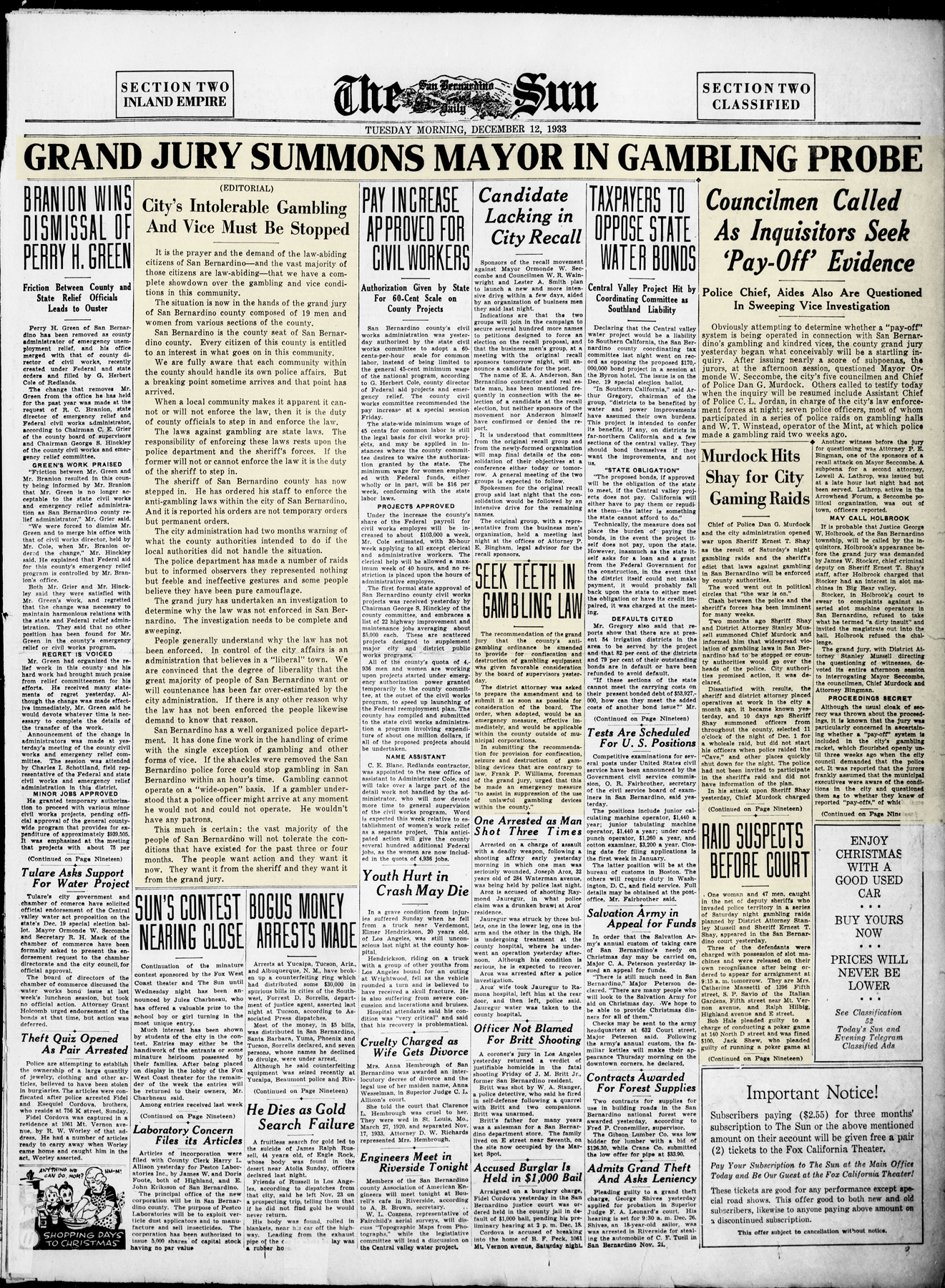
The headline couldn’t get any more graphic: “Grand Jury Summons Mayor in Gambling Probe.” The date of the newspaper, December 12, 1933. That attention-grabbing headline overshadowed three other articles on the same page. The editorial, “City’s Intolerable Gambling and Vice Must be Stopped,” gave some indication of what was going on in the city of San Bernardino that year. A smaller headline read “Seek Teeth in Gambling Law”. But the one that caught my attention simply stated “Raid Suspects Before Court”. And there in the second paragraph, in the last sentence, was my grandfather’s name. Ralph Hilbig, Highland Avenue and E Street.
What on earth is going on here?
Caught up in the sweep to rid the town of vice, gambling, and lotteries were any number of small business owners in possession of slot machines which were paying out in coin, not sweets or candies. With the legalization of gambling in the neighboring state of Nevada in March 1931, Californians may have felt emboldened, expecting their state too would take up the cause. Or perhaps just thinking that gambling, in small venues or as a side hustle, would be overlooked, tolerated even in communities that prided themselves on being “progressive.” After all, with the repeal of Prohibition in 1933, the cultural climate did seem to be changing dramatically.
With gambling being illegal at the time throughout the US, one wonders how, or why there were so many slot machines in use. According to Nevada Magazine several California novelty companies made their own versions of the slot machine. Shortly after the slot machine’s invention California law banned cash payouts. For a time winners were paid in redeemable trade checks, chewing gum, candies, and sometimes cigars.
My grandfather’s pharmacy was one of several small businesses in San Bernardino, California during the 1930s which had a slot machine on their premises. The Mills Diamond Front machine introduced in 1939 which is pictured above and owned by a family member, is an example of the slots in use at the time. This beautiful Mills Gooseneck Silent, also known as a Mills Skyscraper machine, was produced by Mills beginning in 1932 (below). It is available on eBay from a vendor who lives in Escondido, California (ironically, my grandparents’ home city).
An article from the 1904 edition of the Hanford Weekly Sentinel spoke to public opinion at that time. Slot machines had been abolished in nearly every California city by that time, though still legal in California. The Hanford notes that “the contrivances were the outgrowth of the gambling spirit which abounds among the people, not only here, but everywhere. The machines were robbers, not doubt; all gambling schemes are robberies.” (Thursday, June 2, 1904)
It wasn’t until February of 1911 that a bill would be introduced to the California State Legislature which would criminalize possession or operation of slot machines. The bill was signed by Governor Johnson in April after having been amended, reducing the penalty of possession from a felony to a misdemeanor.
One would think that all of these laws would have been sufficient to shutdown gambling for good. Yet 12 years later, my grandfather was one of many who were arrested in his home town of San Bernardino for possession of two slot machines. What happened? Stay tuned! We will take a deeper look next week.
One hundred years ago, just four years into what would eventually become 13 years of Prohibition, my grandfather came into direct conflict with the Volstead Act.
In 1933 Congress adopted a resolution that, once passed by two-thirds of the states as the 21st amendment, repealed the 18th amendment. Prohibition, which had ruled the nation from 1920 thru 1933, had come to an end. All of this would have remained an abstract history lesson for me (Elliot Ness! The Untouchables! Al Capone! Bonnie and Clyde!) except for a recent online search which revealed a bit of hidden family history.
The National Prohibition Act, known informally as the Volstead Act, was an act of the 66th United States Congress designed to execute the 18th Amendment (ratified January 1919) which established the prohibition of alcoholic drinks. Long title: An Act to prohibit intoxicating beverages, and to regulate the manufacture, production, use, and sale of high-proof spirits for other than beverage purposes, and to ensure an ample supply of alcohol and promote its use in scientific research and in the development of fuel, dye, and other lawful industries.
Form 1403: The standard alcohol prescription used during the prohibition era. Courtesy of smithsonianmag.com
“However, many are unaware that alcohol was actually being distributed legally in one specific place: the community drug store. Under the guidance of the U.S. Treasury Department, physicians were granted the authority to prescribe medicinal alcohol. The notion of alcohol prescriptions or ingestion for medicinal benefit may seem astounding today, but in years past this was not the case.”
“Beyond the requirements of the prescription form, there were still other restrictions. First, patients could only receive a pint or less of liquor every ten days (clearly, this was not often enforced if 1 fluidounce was recommended every 2-3 hours for some conditions). Second, records had to be maintained by both the physician and the pharmacy.” https://aihp.org/remembering-pharmacys-past-prohibition-era-medicinal-liquors/
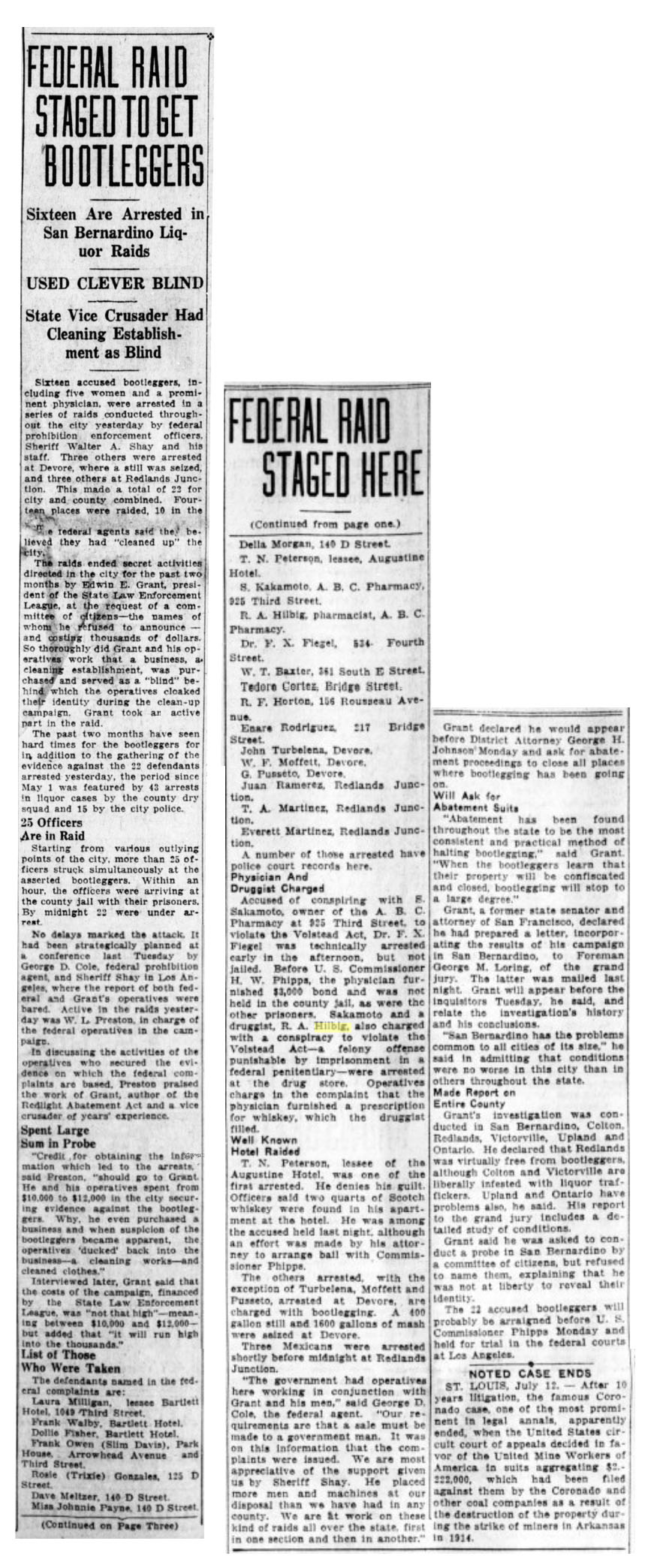
And here is where the story of my grandfather and Prohibition intersect. According to the July 13, 1924 edition of the San Bernardino Sun, my grandfather Ralph A. Hilbig was one of 16 individuals arrested for breaking prohibition. At that time he was working as a pharmacist at A.B.C .Pharmacy in San Bernardino, California.
In the July 13th article, 25 officers struck simultaneously across the city of San Bernardino after a two month investigation, arresting sixteen accused bootleggers and an additional six from two nearby localities. S. Sakamoto, owner of the A.B.C. Pharmacy, along with my grandfather who worked as a druggist at that location, were charged with conspiracy to violate the Volstead Act–a felony offense which would result in imprisonment in a federal penitentiary if convicted. The complaint charged that the physician (Dr. FR.X. Fiegel) furnished a prescription for whiskey which the druggist (R.A. Hilbig) filled. Along with the others arrested, a 400 gallon still and 1600 gallons of mash were also seized in the raids at a nearby town. The raids were directed by Edwin E. Grant, president of the State Law Enforcement League at the request of an anonymous committee of concerned citizens.
Ralph HIlbig had just married Emma May Hargrave, my grandmother, on 29 June 1924. His arrest only two weeks later must have been quite a shock to a woman I had always known as very provincial, as straight-laced as one could imagine. What a way to begin their life together!
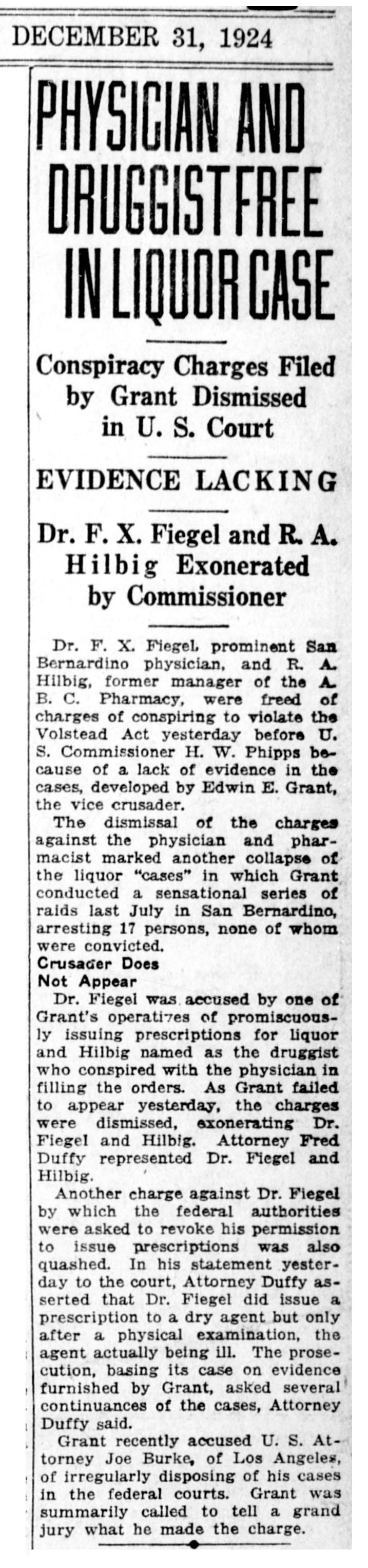
At the end of December the San Bernardino Sun reported that the case had been dropped due to lack of evidence. In their reporting, The Sun wrote at the time: “The dismissal of the charges against the physician and pharmacist marked another collapse of the liquor ‘cases’ in which Grant conducted a sensational series of raids last July in San Bernardino, arresting 17 persons, none of whom were convicted.”
My grandfather passed away nearly 50 years ago, in 1975. He and my grandmother, who was also a pharmacist, had owned several drugstores in the San Bernardino area, eventually working with their son Ralph W. Hilbig who was also a pharmacist. It’s quite surprising to read of this close brush with law enforcement. My grandfather was 31 years old in 1924, the same year J. Edgar Hoover was appointed Acting Director of the national Bureau of Investigation at 29 years old.
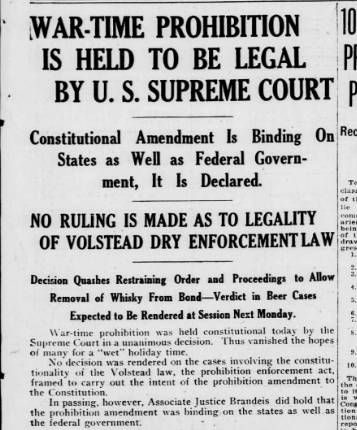
PDF “Wartime Prohibition Is Held to be Legal” December 15, 1919, Evening Star PDF “Every Dry Law Upheld” June 7, 1920, Evening World
She was born July 6, 1899. Today she would have been 125 years old; as it was, she outlived my grandfather by 24 years and was just shy of her 100th birthday by two months when she died in May 1999.
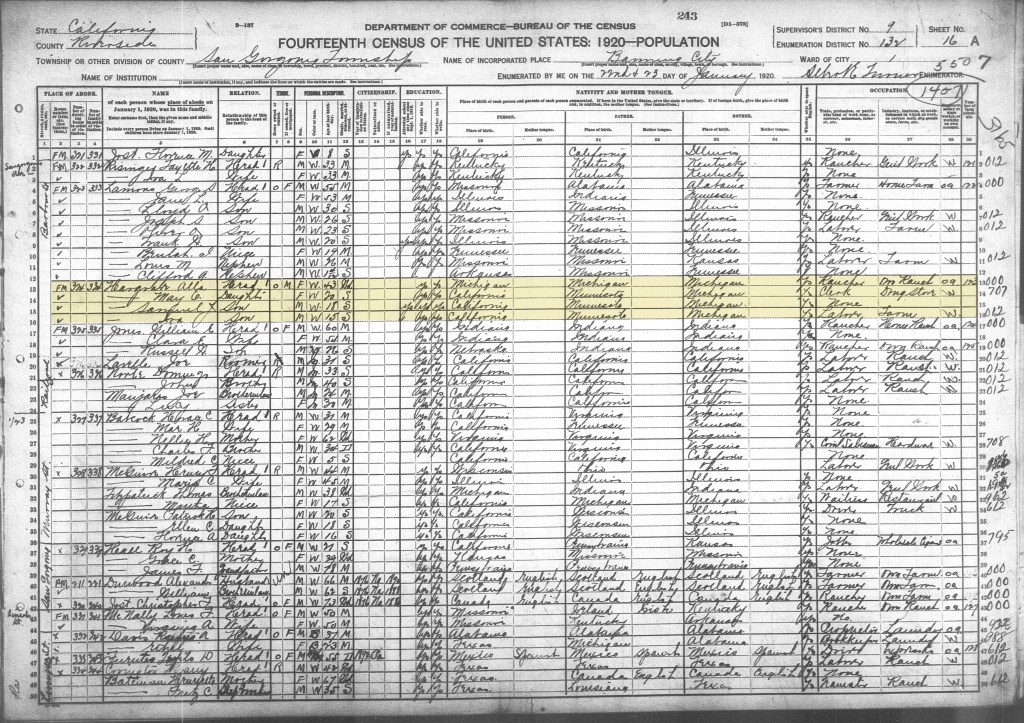
Ira Hargrave was a fruit farmer in San Gorgonio Township, Riverside County, California according to the 1900 Census record. He died Christmas Eve in 1903. The 1910 US Census lists my grandmother then ten years old and her brothers Jay and Ira, eight and six years old. Her mother Betsy Alavander “Alla” Blackburn is listed as head of household in 1910, a fruit farmer. Later years her occupation would be rancher. Youngest brother Ira was born January 13, 1904, three weeks after his father had died (24 Dec, 1903).
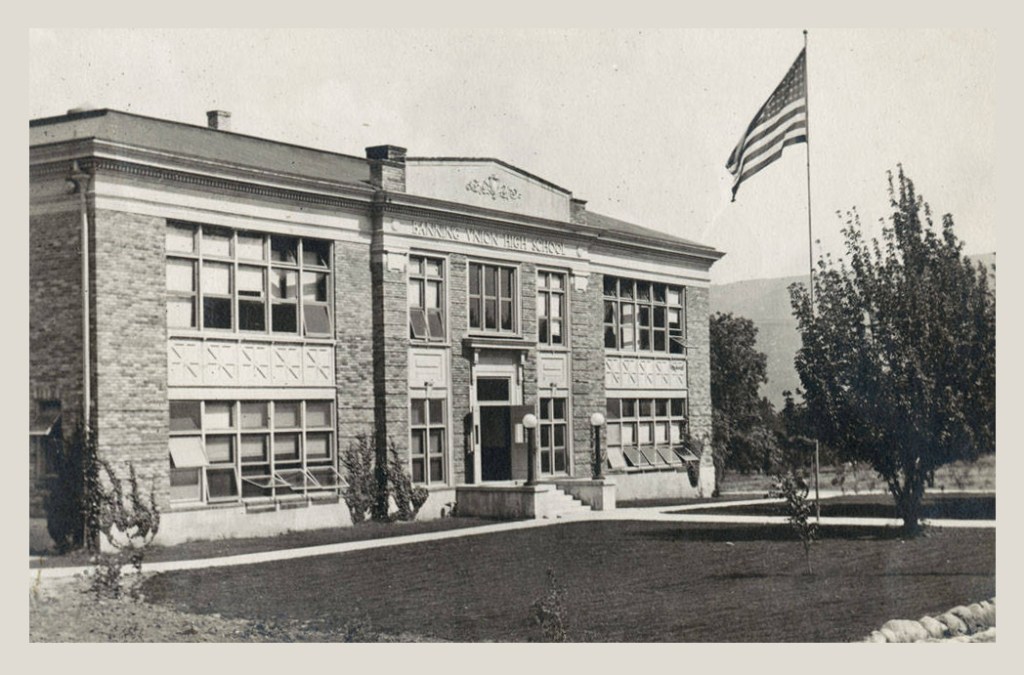
San Gorgonio township in Southern California which included Banning had a population of 356 in 1900. By 1920 the population had risen to 2,507 (US Census documents). It’s hard to picture how a young woman from such a small agricultural community was able to attend the University of Southern California in that time period: our preconceptions of the era might have us believe that “a woman’s place was in the home.” Never-the-less, Emma May Hargrave managed to graduate high school and was awarded a degree from USC School of Pharmacy in 1924.
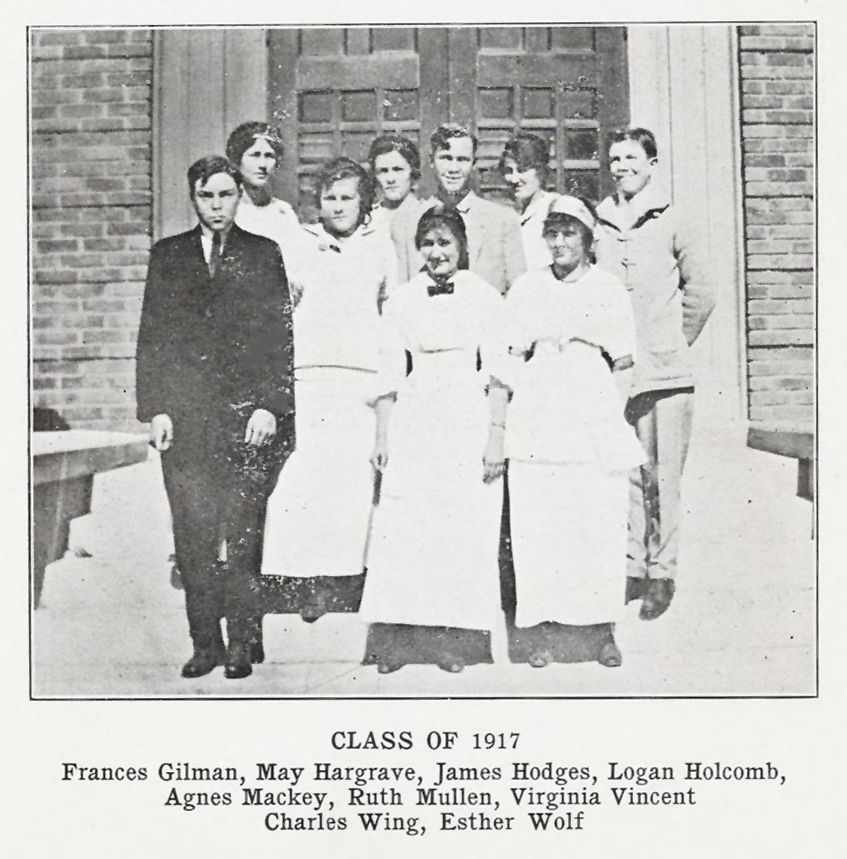
1917 was a small graduating class in Banning Union High School. In the photo above, Emma May stands in the backrow, one of six women in a class of nine. (photos from Calisphere). Three years later, in 1920, Emma was working as a clerk in a drugstore. My grandfather Ralph Allan Hilbig is listed in the 1923 Redlands City Directory; Ralph was working at DH Frazer Pharmacy at that time, some 20 miles northeast of Banning. This might have been where he met Emma after his first wife passed away in 1922.
Emma May (Hargrave) Hilbig graduated with a degree of Graduate in Pharmacy from USC in 1924, married my grandfather that same year and became stepmother to his two children from an earlier marriage. Two years later my father Floyd Allan was born, and then the twins. By 1933 the San Bernardino, California City Directory has them listed along with their son Ralph with Hilbig’s Pharmacy which would service the surrounding area for many years. Emma Hargrave Hilbig grew up as a daughter of a single mother. They were pioneers, I tell you.
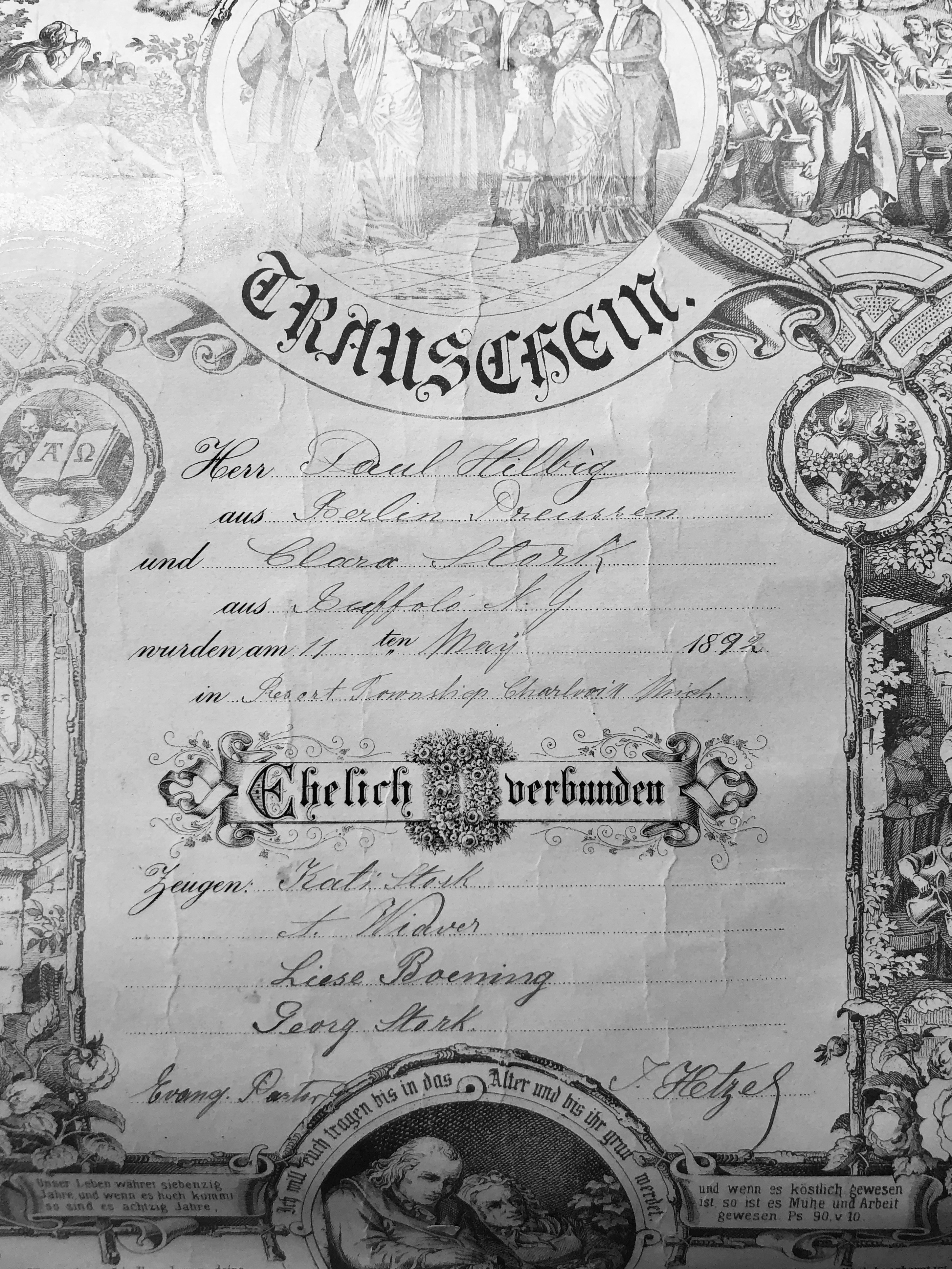
It started with a name on an antique document, well two names actually. The document is the German-language wedding certificate of my great grandfather and grandmother, Paul and Clara (Stork) Hilbig from 1892. There are the usual witness signatures and the pastor’s name as well: J Hetzel. And a second name I couldn’t quite make out: who was this Leisa Boening? Why was she included on the certificate? A bridesmaid or cousin of the bride perhaps? And who was the pastor, J Hetzel? The name of the church wasn’t included in the document but since I had a timeframe and approximate location, I had enough to begin my research.
The document indicates the wedding was performed in Resort Township, Charlevoix, Michigan. A quick Google search and it turns out that Resort Township is next to Petoskey Michigan which is where my relatives originated. Family legend was correct in that regard, though Resort Township is now included in neighboring Emmet County, no longer a part of Charlevoix.
My family name is German, again family lore has us coming from Berlin, Prussia sometime in the late 19th century with the great wave of German immigrants. We’ve never had a year for that though it had to be between 1893 when my grandfather was born here in the States, and 1870 when his father was born in Prussia.
Many of the German immigrants were Lutheran and so it seemed like a safe assumption that my great grandparents were married in a Lutheran church near Petoskey. On Google maps I located Zion Lutheran Church and emailed them for any information they might have from the 1890s and if J. Hetzel could have been their pastor. It turned out he hadn’t been, but the church administrator referred me to the Petoskey Museum website which might be helpful for further research. And it was.
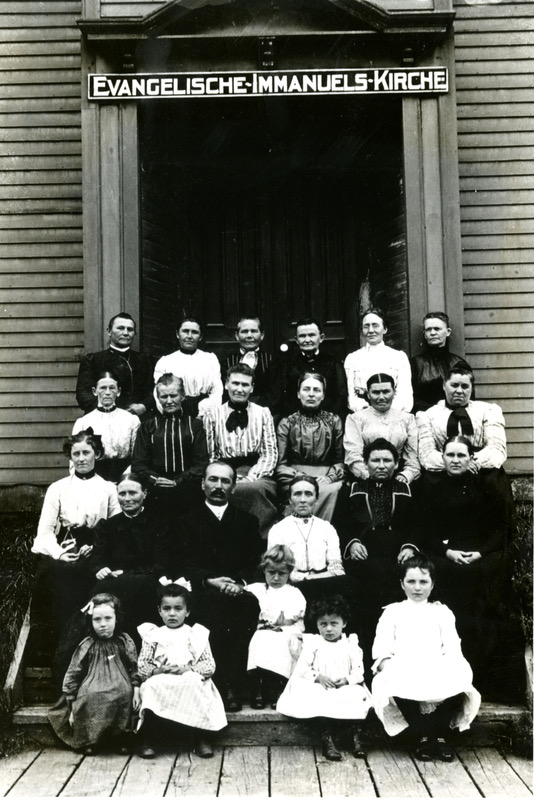
Looking through their online photo archives I found an image of a group sitting on the front steps of Evangelische Emmanuels Kirche. The caption named the individuals in the photo which included Pastor Hetzel; Mrs. Hetzel; and their daughters ; Lydia Hetzel; Frieda Hetzel.
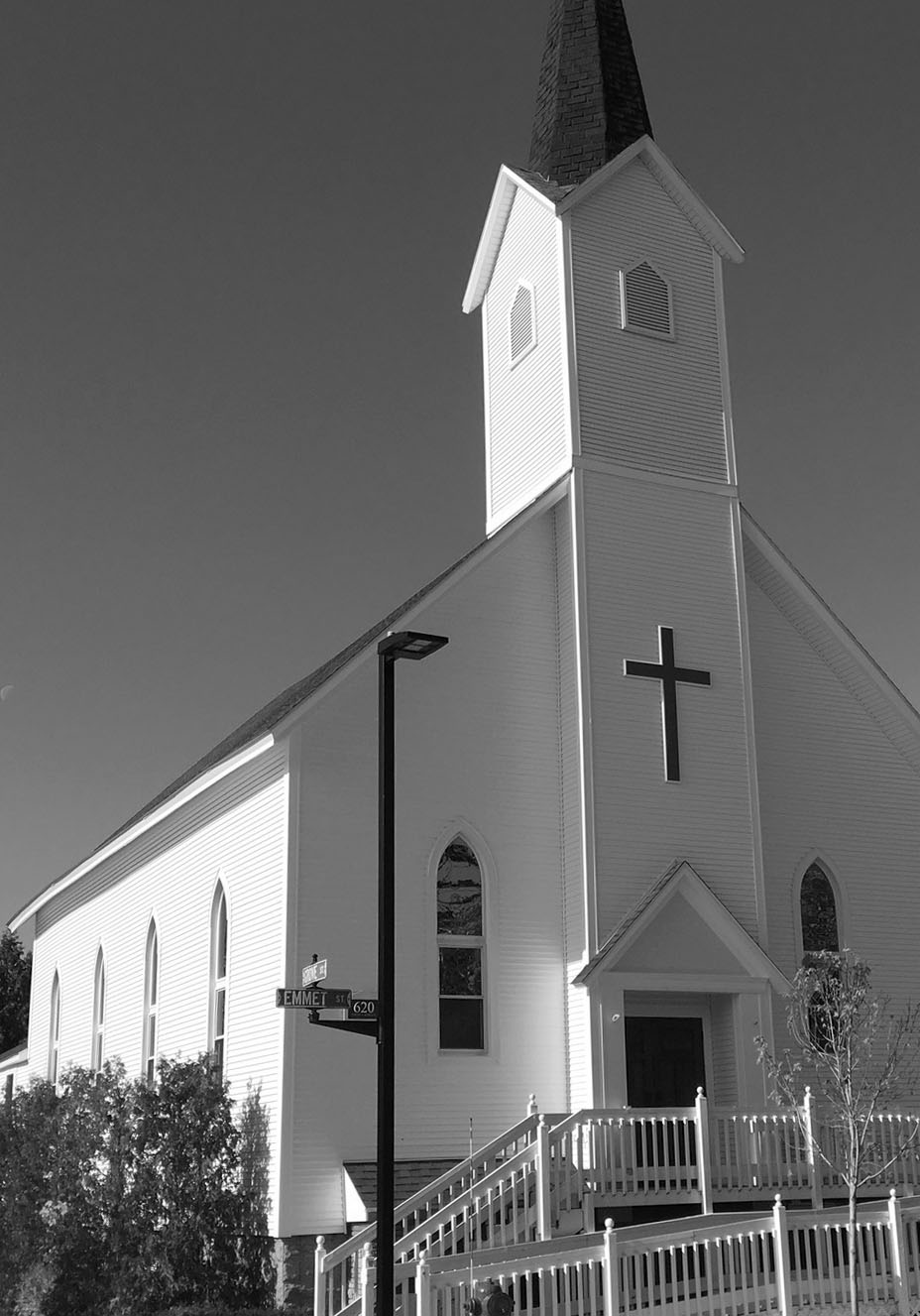
So now I knew the pastor’s first name and more importantly the name of his church. A quick Google search for that name in Petoskey revealed Emmanuel Evangelical Church. After finding their website, and reading through their history page, I was pretty confident that this was the same church from 131 years ago. Amazing. I contacted them through their website and was surprised to not only receive an email from their current pastor but a phone call as well confirming that, indeed pastor Jacob Hetzel had been their pastor during the 1890s and that today they continue to hold services in the very same building.
But what of the second mysterious name? Who was Leisa Boening? Searching through online census records, I found the Boenings living in Petoskey in 1880. Leisa was the daughter of Charles and Mary Boening, both born in Germany and having immigrated to the US in 1874. There were seven children listed on the census record, three of whom had been born in Germany and four in New York.
Surprisingly my great grandfather’s name was included as a son; even more surprising to me was the addition of a brother two years older than he, also born in Germany. And a sister, Anne born in Germany as well. My genealogy had just become more complicated! Who ARE these people? And more importantly, how and when did they come to America?
June 1880 Census, Michigan
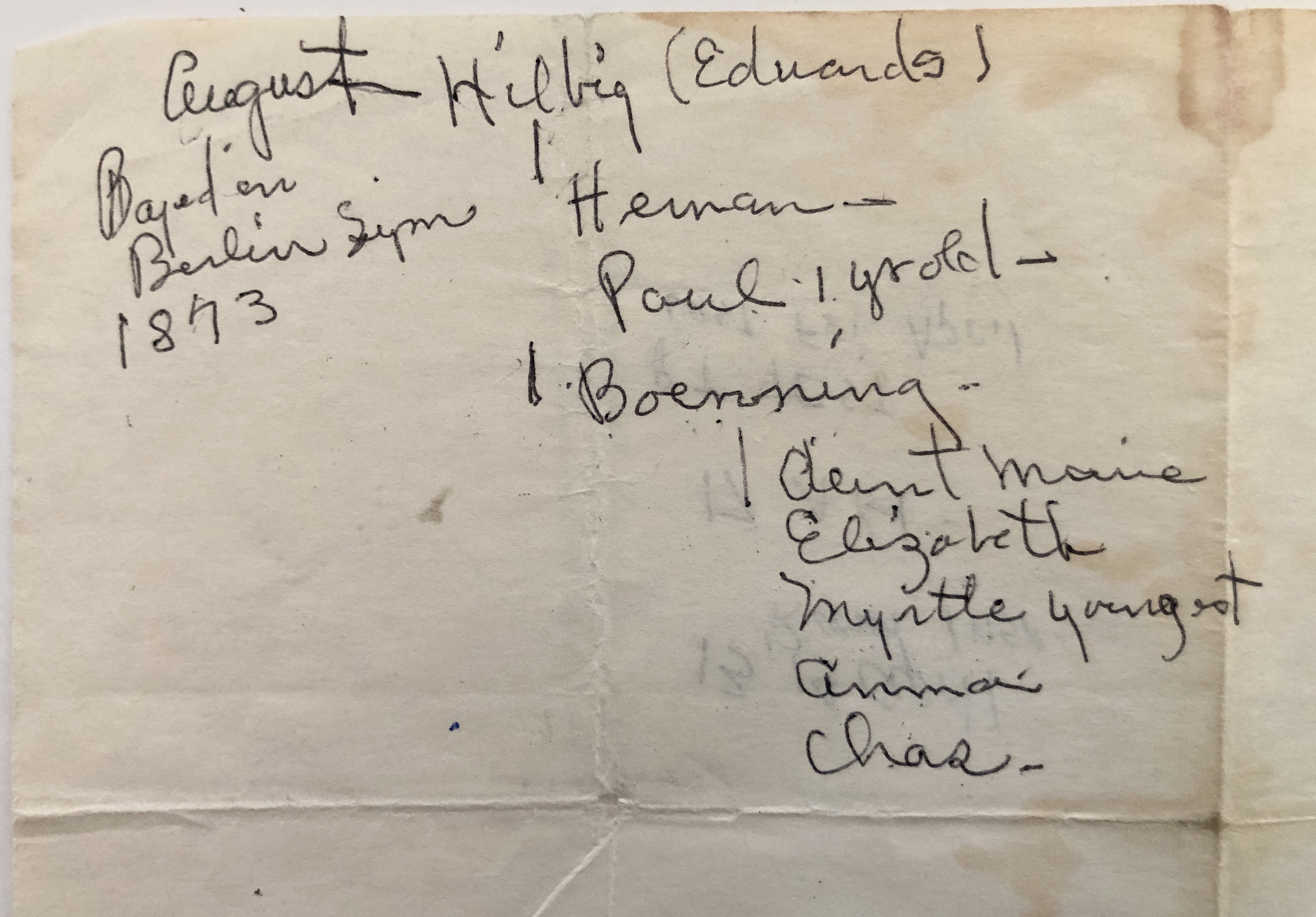
More research has yielded some surprising finds. My great great grandmother had married her husband, Carl August Hilbig, at Luisenstädtische Kirche in Berlin (which was destroyed in the Allied bombing in 1945). They had two children, Herman August and Paul Herman, born in 1868 and 1870 respectively. Carl Hilbig died in 1871 and Mary (Maria ) remarried a year later to Charles Boening. The boys’ sister was born the following year, in 1872. In 1874 the family set off for America and lived for a period in New York state before settling down in Michigan where they had four more daughters. Leisa and her twin Lizzie were born in 1874, their younger sisters in 1876 and ‘78.
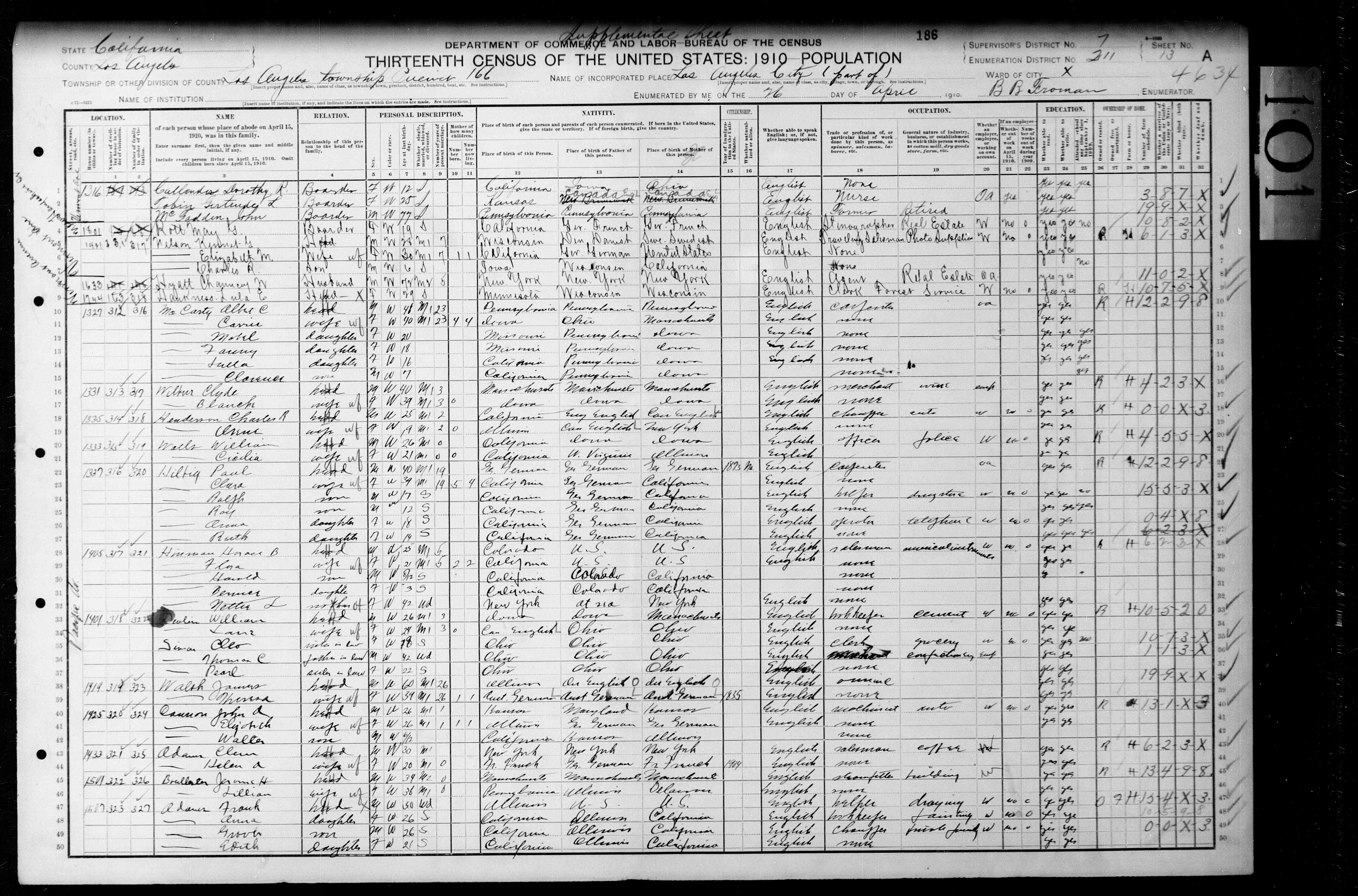
There is still much to learn about my family’s early history. Apparently they lived somewhere in New York state between 1874 and 1880, after which they relocated to Michigan. But where had they lived? And what did they do? Charles Boening is listed as a farmer on the 1880 census. Sometime before the 1910 Census, the entire family relocates to Los Angeles where we pick up the story as it relates to my Grandfather and his descendants.
1910 Census, Los Angeles
Before leaving for my Army post in Heidelberg, Germany in 1984, my Grandmother penciled a rough genealogy for me in a note which I have carried around for the past 40 years. It is only now beginning to make some sense: I know who the Herman is who is listed above my great grandfather Paul. Not sure what the date 1873 refers to as Paul was born in 1870. Regardless, it has been quite the journey of discovery as I learn more about their Coming to America story.














 My Retired Life