The effort to rid the city of vice brings to mind the Batman movies and Gotham City except that here, there wasn’t a caped crusader fighting the sinister dark elements of the criminal underworld. But much like watching a movie for the second time, reading back through events that have already transpired, in this case more than 90 years ago, we can know the ending from the beginning. And the ending in this particular story was very interesting.
While my grandfather may have been just one of many individuals caught up in local efforts to control vice, there were other factions involved that eventually took center stage. The long list of names covered in the newspaper at the time also included one of the arresting officers, along with the recently elected mayor and his appointed Chief of Police. There were others as well, including the county sheriff, but the mayor, police chief, and deputy police chief were at the center of the investigation.
Mayor Seccombe had been elected in April with a substantial plurality of votes out of a field of six candidates for mayor. He had been a city councilman running against several other businessmen, a lawyer, and others who all vowed to “cleanup the city”.
Upon election, the new mayor chose for his chief of police Dan Murdock, a deputy sheriff in the county. Speculation at the time had him choosing another individual and the choice eventually came down to Murdock or another San Bernardino policeman, C. Lawrence Jordan. With Murdock as Chief, Jordan was named the night Chief of Police.
By December of 1933 a grand jury was conducting an inquiry into city vice and gambling during which Mayor Seccombe, Murdock, Jordan and others were called to testify.
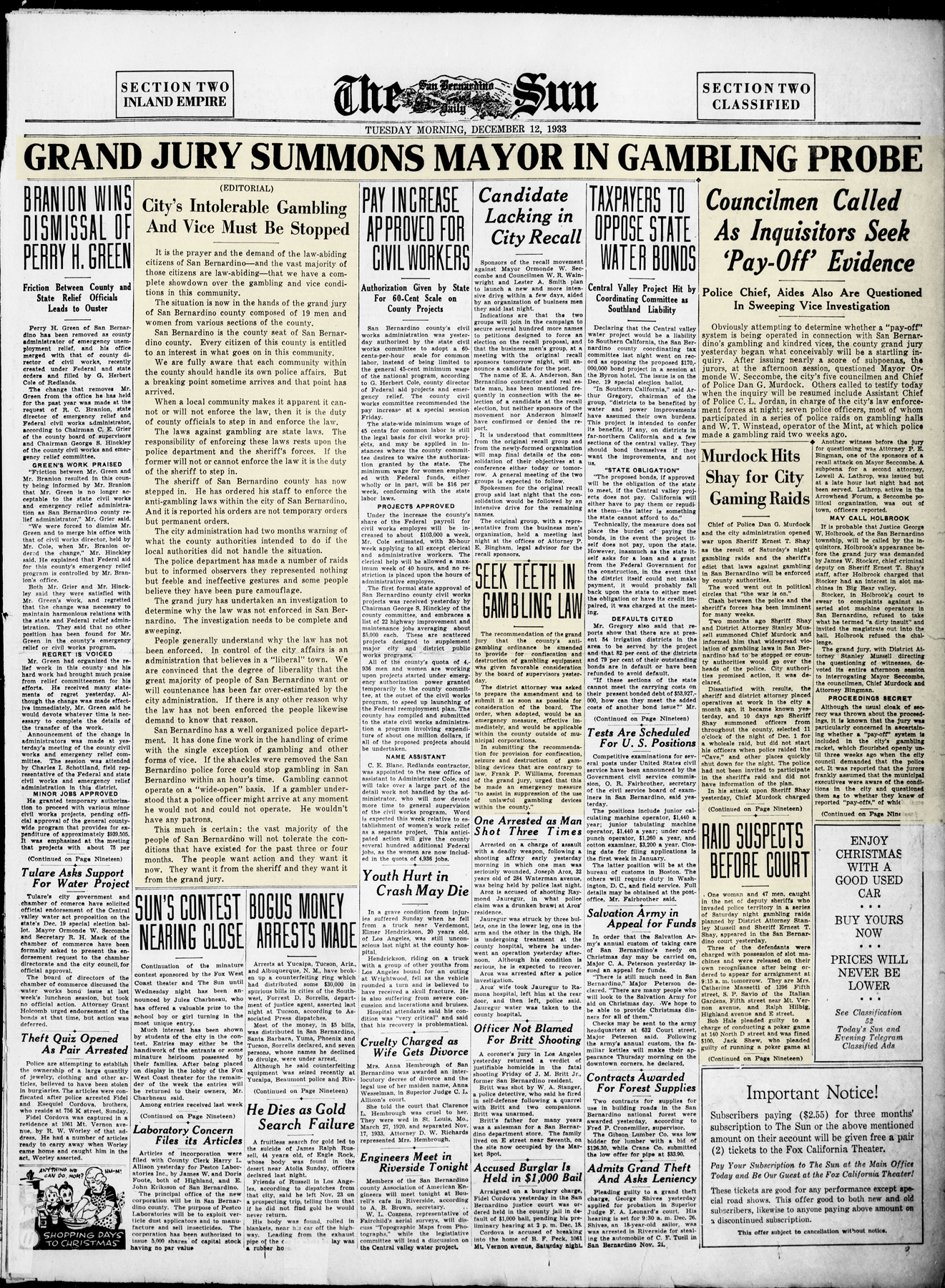
At the heart of the investigation were allegations that the police department, or some individuals therein, had been operating a “pay-off” system in regards to gambling in the city, which perhaps had related to the low number of raids and arrests conducted that year. Surprisingly, or perhaps not, no indictments were returned as a result of their investigation.
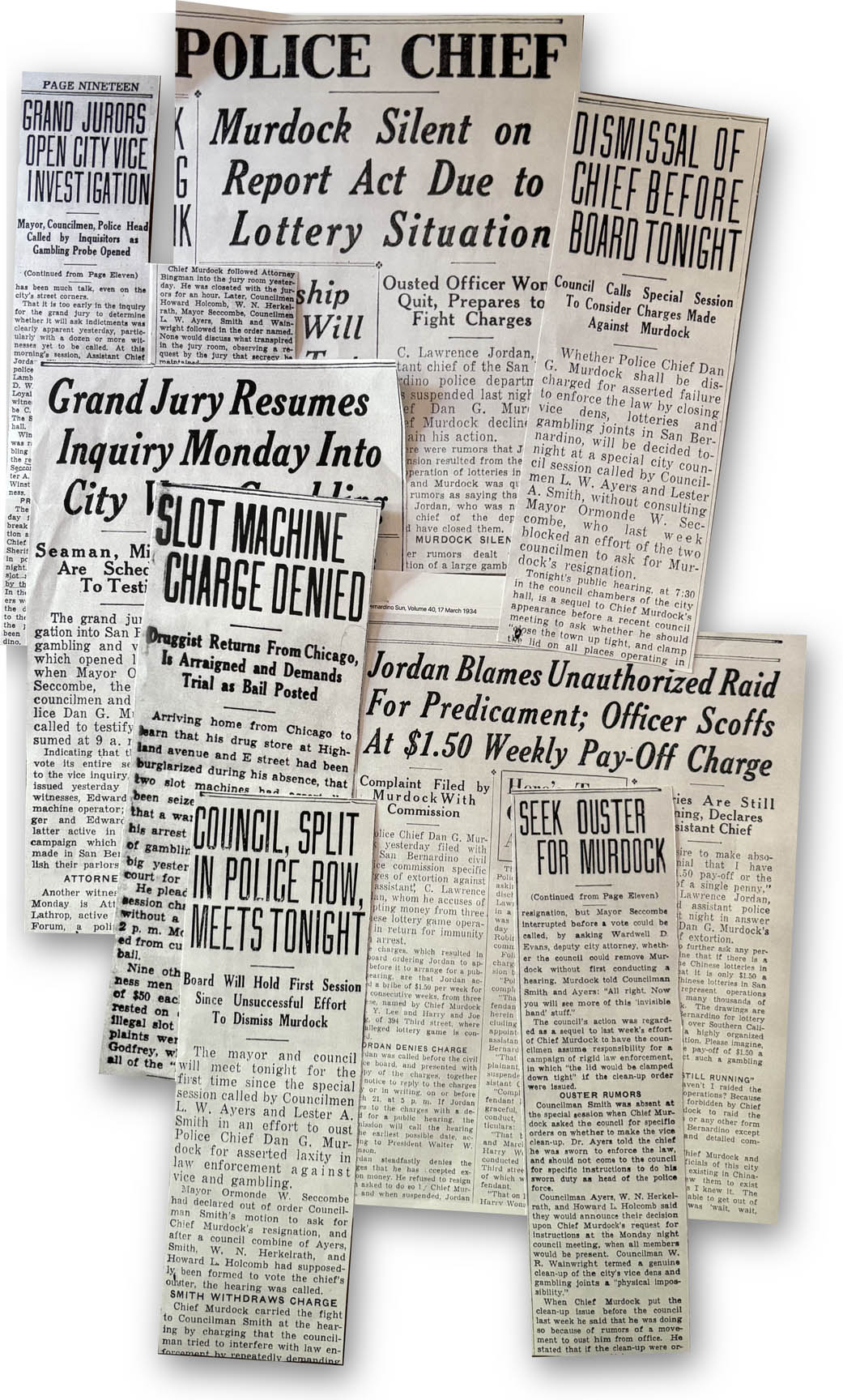
In March 1934 assistant chief Jordan was suspended by Chief Murdock over accusations of receiving kickbacks regarding the operation of lotteries in Chinatown. Jordan did not resign and the Chief ended up filing charges with the civil service commission which would eventually call both men, and others, to testify regarding the accusations.
The police chief filed charges of extortion against his assistant in what must have felt like a bit of payback in that, the previous year, both had been considered for the position of Chief of Police. Awkward! The extortion charges relied on testimony from three lottery game owners who basically stated that assistant chief Jordan had accepted money from them in exchange for immunity from arrest. How much was he accused of having received in consideration for allowing their operations to continue unabated? $1.50 per week. Well then.
In answering the allegations, assistant chief Jordan maintained that $1.50 per week payoff for a gambling operation that reportedly netted thousands of dollars a week was absurd. He also maintained that it was the chief of police who “expressly forbid” him to raid those or any other form of vice in the city “except under his direct and detailed command.” So then, now we have a very awkward situation! Whom to believe?
So then it seems that the individual responsible could be the police chief and not his deputy. But wait! After the civil service commission hearing regarding his suspension, Jordan was exonerated and his job reinstated. He was however reprimanded for “frequenting of questionable places other than in the performance of his duty as an officer and the intimated purchase by him of lottery tickets.” Result? Suspension without pay for thirty days.
Several weeks later, two members of the city council sought to have the chief of police removed from office; the move was blocked by the mayor but taken up a week later at a special session. During that session, one of the councilmen who had voiced opposition to the chief changed his position. The inquiry ending up with yet another exoneration, this time for the police chief who ended up retaining his job. Following his exoneration, the city councilman who had spearheaded the drive to have the police chief removed was himself facing a recall effort by voters in his own ward. Those efforts proved to be short lived and the councilman not only kept his seat but shook hands with (forgive and forget) with the police chief he had attempted to have removed.
It seems with that last city council session, the dust-up involving the assistant chief, the chief of police, and the city council had come to an end. Chief Murdock continued to make periodic arrests for gambling and other forms of vice within the city; assistant chief Jordan was reinstated though not at his previous position; and the councilman who was at the center of the police chief recall movement managed to retain his seat. Arrests continued to result in hefty fines being added to the city’s treasury. All-in-all, it reads like another episode of Law and Order in Gotham City. Admittedly my grandfather’s part in all of this was quite small, but in researching him I did get a very up-close look at small town politics, intrigue, and the way public morals have shifted over time here in the US. Ninety years ago but it sounds like today.
*UPDATE*
In a surprising, somewhat ironic note, my Mom wrote this to me:
“When your dad and I got married, the former mayor’s grand daughter, Evelyn Seccombe, was my maid of honor. Her mother and my mother had been close friends in San Bernardino High. They were both in the very first graduating class…1918, of the new High School.” Lora Lea (Willis) Chamberlin 9/10/2024
 My Retired Life