In 1895 a German immigrant in San Francisco by the name of Charles Fey invented a mechanical device consisting of several metal cylinders which, when activated by a coin, would spin in random sequence until they stopped and an image displayed on the cylinders would appear in a window. Whether the original five cylinders or the later three, when two or more of the same image appeared inline, you were a winner. The slot machine had humble beginnings but would eventually make a huge impact on the California and neighboring state of Nevada’s economy and later, much of the world.
Fey pioneered many innovations of coin operated gaming devices in his San Francisco workshop at 406 Market Street, including the original three-reel bell slot machine in 1898. The international popularity of the bell slot machines attests to Fey’s ingenuity as an enterprising inventor whose basic design of the three reel slot machine continues to be used in mechanical gaming devices today. (Winkslots)
Fey’s workshop is no longer standing. The Liberty Belle Saloon and Restaurant owned by Mr. Fey’s grandsons, Marshall and Franklin in Reno, Nevada, had many slot machines, including the first three-reels, the first draw poker machine and the first three-reel dollar slot on display. Sadly the Liberty Bell is no longer standing either, torn down to make room for a parking lot for the convention center. The slot machines were moved to the Nevada State Museum in Carson City.
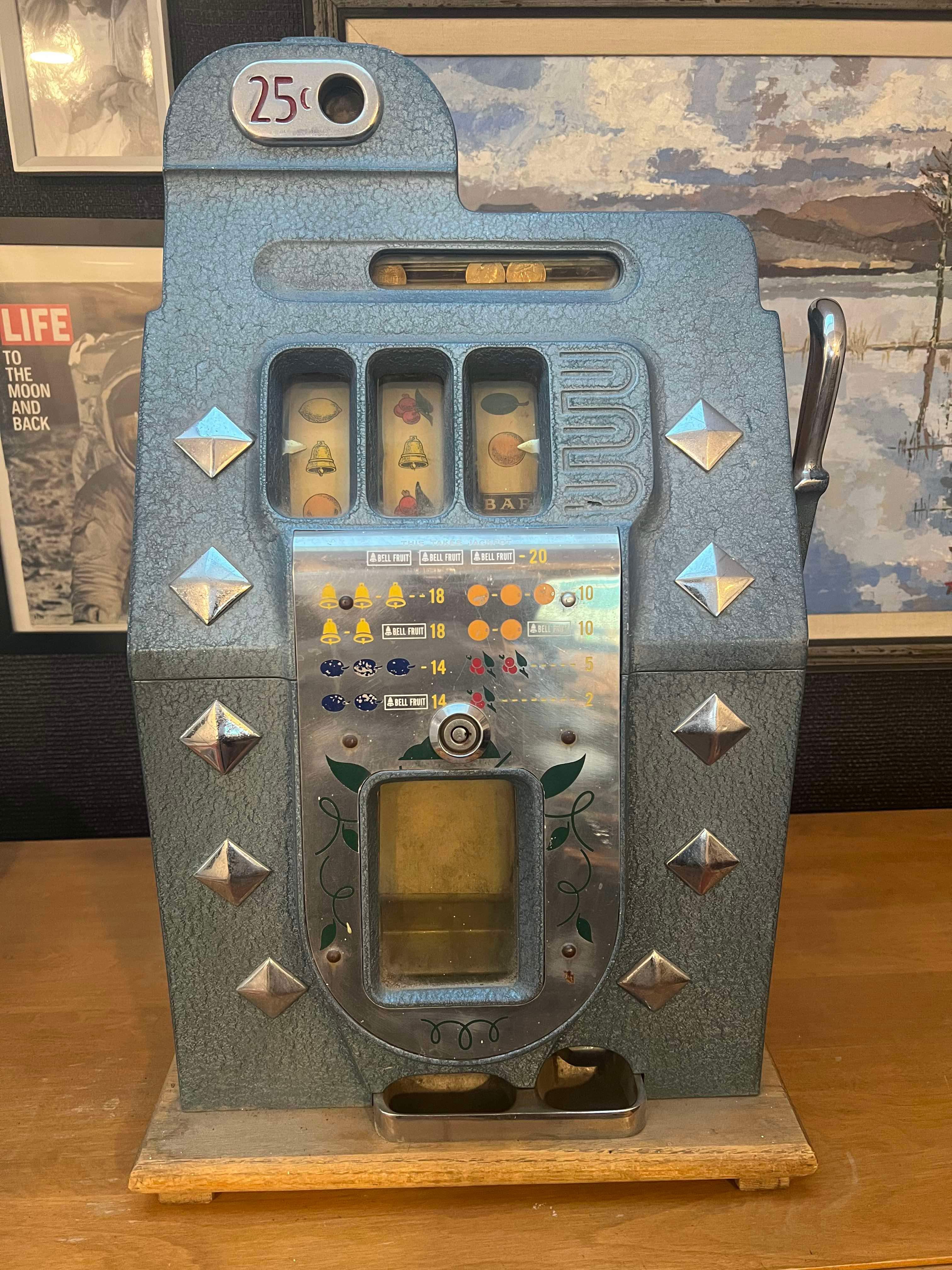
California the “Golden State” is the US’s largest Indian gaming state, with yearly casino earnings of around $9 billion. California has 76 Indian casinos and five mini-casinos, owned mainly by its 109 tribes. (playtoday.com) Today nearly everyone is familiar with slot machines, the original “One-Armed Bandit” and they can be found in many states which now have legalized gambling of one type or another. Below is a machine from the collection of a family member, an early 1940’s Mills Diamond Front Slot Machine, originally produced in 1933 by the Mills Novelty Company of Chicago. Mills was one of the few companies which manufactured both gambling and vending machines.
But their rapid adoption also became the key to their eventual downfall. In 1911, 16 years after the invention of the slot machine, slots were outlawed in California.
The first few decades of the 20th century saw rapid social changes as well as industrial and technological ones. The proliferation of gambling devices, though regulated to some extent, saw them popping up “everywhere,” along with lotteries and card games. And gambling was considered to be one of the chief vices, often found in proximity with alcoholic beverages and prostitution, numbers rackets, off track betting and other “vices.” Reformers managed to get laws passed to control if not outlaw many of these. But whether legal or illegal, many of these activities simply went underground, available but not “too” visible.
Due to the ban, cash prizes would not be distributed any longer, but the fruit machine found a way to work around the ban. To emphasize that they were vending machines, not gambling machines, fruit symbols–cherry, orange, lemon–replaced the poker symbols and then the prizes were given out as sweets and chewing gum according to the corresponding slot flavor.

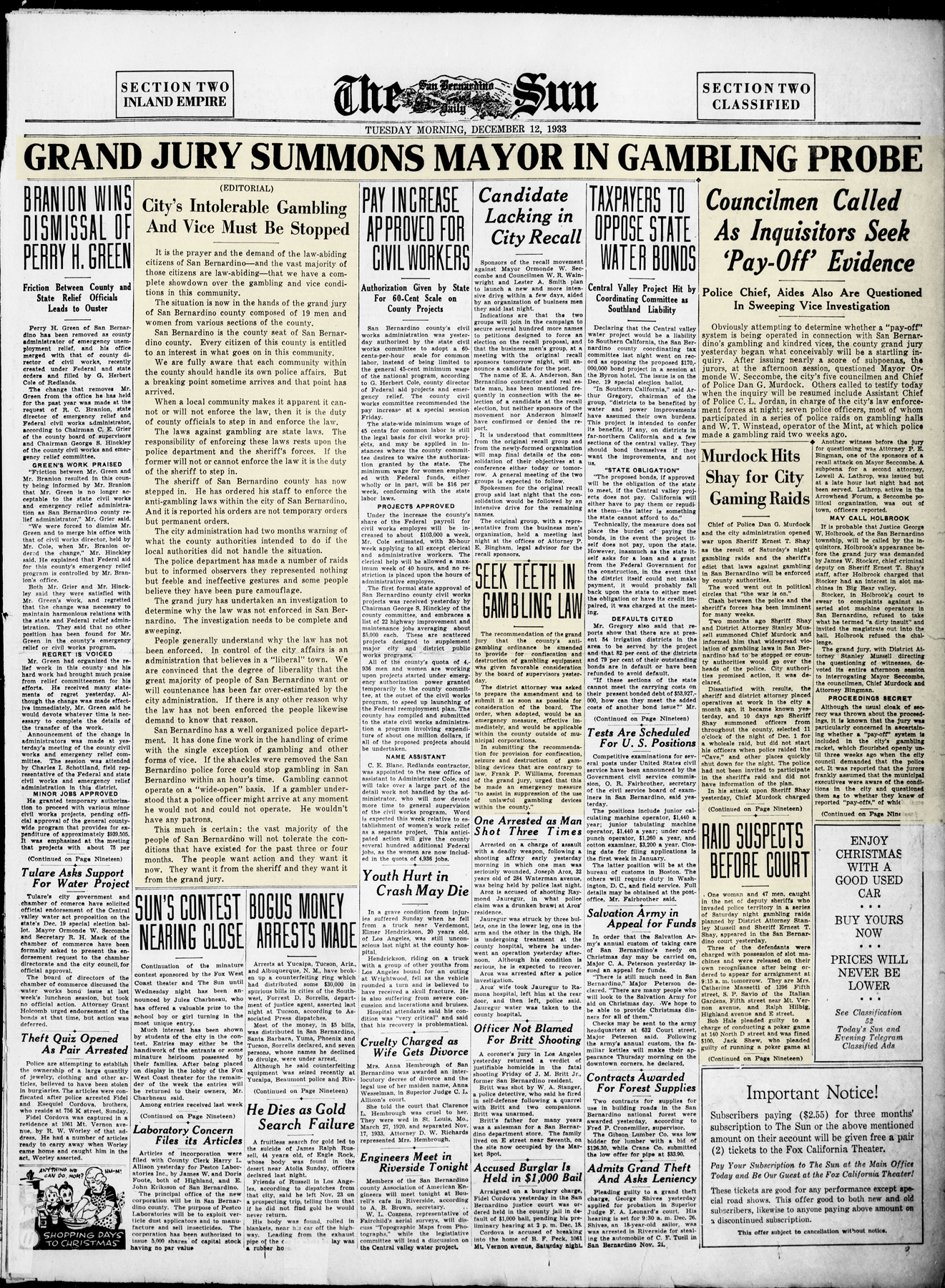
The headline couldn’t get any more graphic: “Grand Jury Summons Mayor in Gambling Probe.” The date of the newspaper, December 12, 1933. That attention-grabbing headline overshadowed three other articles on the same page. The editorial, “City’s Intolerable Gambling and Vice Must be Stopped,” gave some indication of what was going on in the city of San Bernardino that year. A smaller headline read “Seek Teeth in Gambling Law”. But the one that caught my attention simply stated “Raid Suspects Before Court”. And there in the second paragraph, in the last sentence, was my grandfather’s name. Ralph Hilbig, Highland Avenue and E Street.
What on earth is going on here?
Caught up in the sweep to rid the town of vice, gambling, and lotteries were any number of small business owners in possession of slot machines which were paying out in coin, not sweets or candies. With the legalization of gambling in the neighboring state of Nevada in March 1931, Californians may have felt emboldened, expecting their state too would take up the cause. Or perhaps just thinking that gambling, in small venues or as a side hustle, would be overlooked, tolerated even in communities that prided themselves on being “progressive.” After all, with the repeal of Prohibition in 1933, the cultural climate did seem to be changing dramatically.
With gambling being illegal at the time throughout the US, one wonders how, or why there were so many slot machines in use. According to Nevada Magazine several California novelty companies made their own versions of the slot machine. Shortly after the slot machine’s invention California law banned cash payouts. For a time winners were paid in redeemable trade checks, chewing gum, candies, and sometimes cigars.
My grandfather’s pharmacy was one of several small businesses in San Bernardino, California during the 1930s which had a slot machine on their premises. The Mills Diamond Front machine introduced in 1939 which is pictured above and owned by a family member, is an example of the slots in use at the time. This beautiful Mills Gooseneck Silent, also known as a Mills Skyscraper machine, was produced by Mills beginning in 1932 (below). It is available on eBay from a vendor who lives in Escondido, California (ironically, my grandparents’ home city).

An article from the 1904 edition of the Hanford Weekly Sentinel spoke to public opinion at that time. Slot machines had been abolished in nearly every California city by that time, though still legal in California. The Hanford notes that “the contrivances were the outgrowth of the gambling spirit which abounds among the people, not only here, but everywhere. The machines were robbers, not doubt; all gambling schemes are robberies.” (Thursday, June 2, 1904)
It wasn’t until February of 1911 that a bill would be introduced to the California State Legislature which would criminalize possession or operation of slot machines. The bill was signed by Governor Johnson in April after having been amended, reducing the penalty of possession from a felony to a misdemeanor.
One would think that all of these laws would have been sufficient to shutdown gambling for good. Yet 12 years later, my grandfather was one of many who were arrested in his home town of San Bernardino for possession of two slot machines. What happened? Stay tuned! We will take a deeper look next week.
 My Retired Life
You are one impressive researcher!Not one word of this wasever mentioned
LikeLike
thanks! This is part 1 of a 3-part series. There was a lot going on in your hometown back then!
LikeLike
This makes sense of Ralph Jr. going upto San Fransisco to go to college. He would have been
LikeLike
And I had only arrived
LikeLike