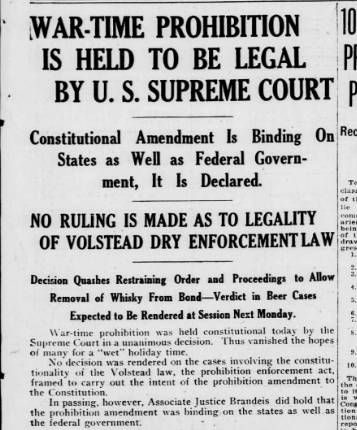
One hundred years ago, just four years into what would eventually become 13 years of Prohibition, my grandfather came into direct conflict with the Volstead Act.
In 1933 Congress adopted a resolution that, once passed by two-thirds of the states as the 21st amendment, repealed the 18th amendment. Prohibition, which had ruled the nation from 1920 thru 1933, had come to an end. All of this would have remained an abstract history lesson for me (Elliot Ness! The Untouchables! Al Capone! Bonnie and Clyde!) except for a recent online search which revealed a bit of hidden family history.
The National Prohibition Act, known informally as the Volstead Act, was an act of the 66th United States Congress designed to execute the 18th Amendment (ratified January 1919) which established the prohibition of alcoholic drinks. Long title: An Act to prohibit intoxicating beverages, and to regulate the manufacture, production, use, and sale of high-proof spirits for other than beverage purposes, and to ensure an ample supply of alcohol and promote its use in scientific research and in the development of fuel, dye, and other lawful industries.


Form 1403: The standard alcohol prescription used during the prohibition era. Courtesy of smithsonianmag.com
“However, many are unaware that alcohol was actually being distributed legally in one specific place: the community drug store. Under the guidance of the U.S. Treasury Department, physicians were granted the authority to prescribe medicinal alcohol. The notion of alcohol prescriptions or ingestion for medicinal benefit may seem astounding today, but in years past this was not the case.”
“Beyond the requirements of the prescription form, there were still other restrictions. First, patients could only receive a pint or less of liquor every ten days (clearly, this was not often enforced if 1 fluidounce was recommended every 2-3 hours for some conditions). Second, records had to be maintained by both the physician and the pharmacy.” https://aihp.org/remembering-pharmacys-past-prohibition-era-medicinal-liquors/
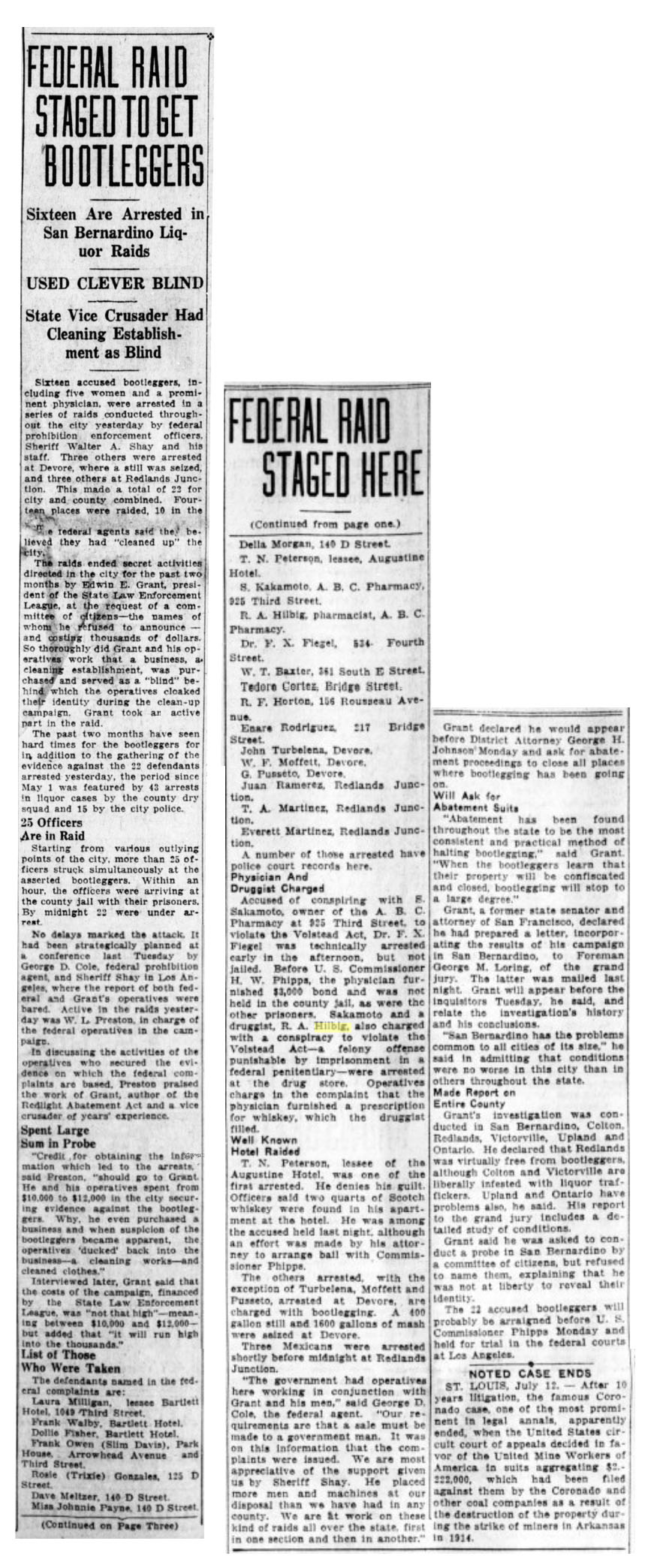
And here is where the story of my grandfather and Prohibition intersect. According to the July 13, 1924 edition of the San Bernardino Sun, my grandfather Ralph A. Hilbig was one of 16 individuals arrested for breaking prohibition. At that time he was working as a pharmacist at A.B.C .Pharmacy in San Bernardino, California.
In the July 13th article, 25 officers struck simultaneously across the city of San Bernardino after a two month investigation, arresting sixteen accused bootleggers and an additional six from two nearby localities. S. Sakamoto, owner of the A.B.C. Pharmacy, along with my grandfather who worked as a druggist at that location, were charged with conspiracy to violate the Volstead Act–a felony offense which would result in imprisonment in a federal penitentiary if convicted. The complaint charged that the physician (Dr. FR.X. Fiegel) furnished a prescription for whiskey which the druggist (R.A. Hilbig) filled. Along with the others arrested, a 400 gallon still and 1600 gallons of mash were also seized in the raids at a nearby town. The raids were directed by Edwin E. Grant, president of the State Law Enforcement League at the request of an anonymous committee of concerned citizens.
Ralph HIlbig had just married Emma May Hargrave, my grandmother, on 29 June 1924. His arrest only two weeks later must have been quite a shock to a woman I had always known as very provincial, as straight-laced as one could imagine. What a way to begin their life together!
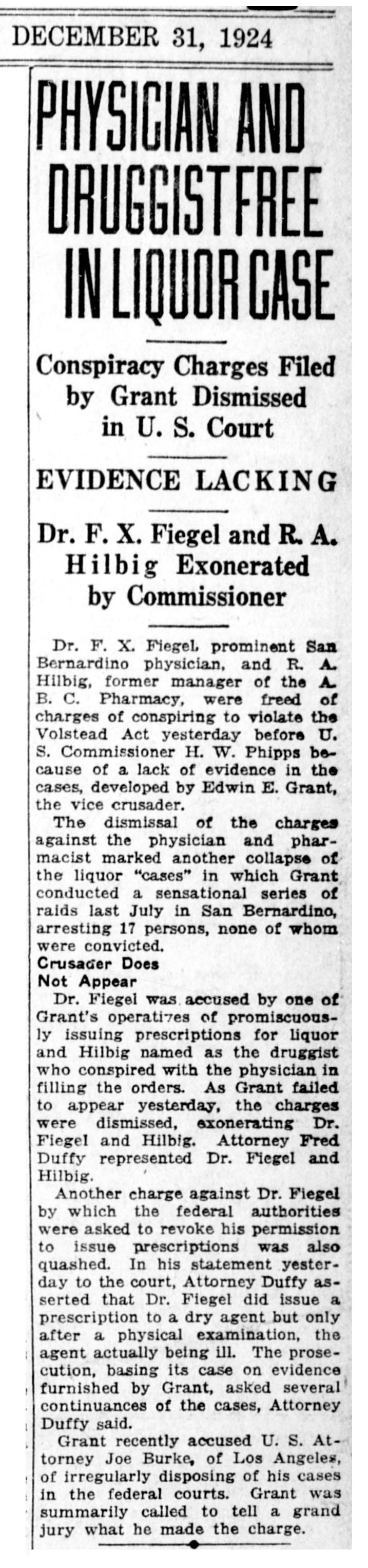
At the end of December the San Bernardino Sun reported that the case had been dropped due to lack of evidence. In their reporting, The Sun wrote at the time: “The dismissal of the charges against the physician and pharmacist marked another collapse of the liquor ‘cases’ in which Grant conducted a sensational series of raids last July in San Bernardino, arresting 17 persons, none of whom were convicted.”
My grandfather passed away nearly 50 years ago, in 1975. He and my grandmother, who was also a pharmacist, had owned several drugstores in the San Bernardino area, eventually working with their son Ralph W. Hilbig who was also a pharmacist. It’s quite surprising to read of this close brush with law enforcement. My grandfather was 31 years old in 1924, the same year J. Edgar Hoover was appointed Acting Director of the national Bureau of Investigation at 29 years old.

PDF “Wartime Prohibition Is Held to be Legal” December 15, 1919, Evening Star
PDF “Every Dry Law Upheld” June 7, 1920, Evening World
 My Retired Life