Looking Back At 50

Wooster High School Home of the Colts

June 4, 1970—It was a Thursday and the celebration that evening would be at the Centennial Coliseum, built in 1965 and the go-to venue for Reno’s large gatherings. Concerts, square dancing conventions, and high school graduations all made use of the Coliseum’s cavernous spaces.

But just a month before, on May 4 at Kent State in Ohio, the National Guard was called out to control student demonstrations. By the end of the day, four students were dead and nine others were wounded, marking the first time that students in the US had been killed during an anti-war rally. It was a shocking introduction to adulthood for us graduates.

Reno calls itself “The Biggest Little City in the World.” We might have been small, but by no means were we unaffected by events that were occurring at the end of the 60s. Looking back 50 years, I’m still surprised at what all we had seen, or participated in, during our years at Wooster High School. It’s as if our time in high school had been marked with confrontation and upheaval that we were too young to even recognize, though with lasting effects.
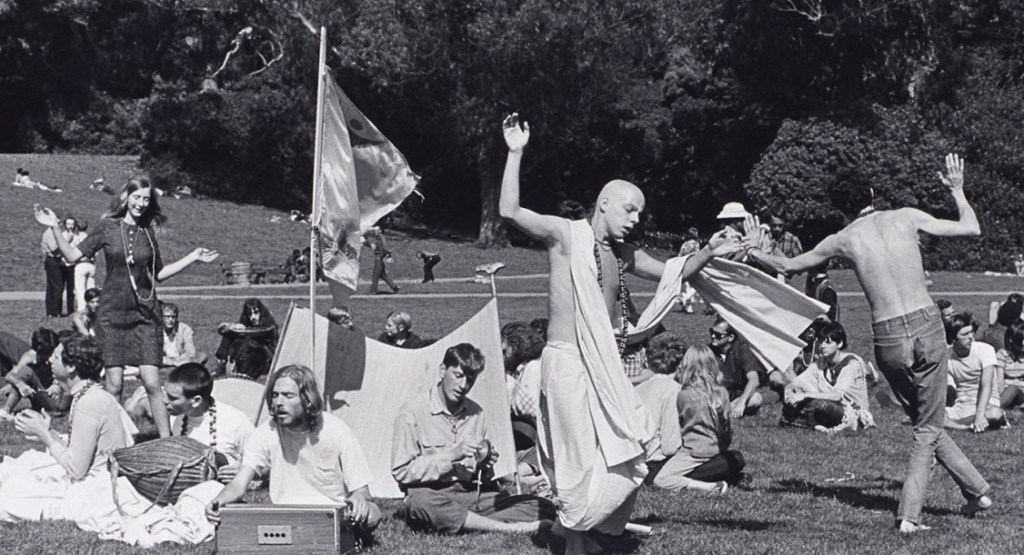
Summer of Love, dancing in the park. Image from Goldenstate.is

Express Yourself

Most of my graduating class entered school in the fall of 1967 not realizing the depth of change our country would soon embark upon. 1967 has been remembered as the “Summer of Love.” San Francisco, especially the Haight-Ashbury District, became the center of a special moment in time. Hippies and the 60’s provide plenty of material for retro parities today, and many of us look back on those embroidered bell bottoms, beaded necklaces and tie-dyed tshirts with a certain nostalgia now, I suppose. The love didn’t last long.

Our Junior Year—August 1968 the evening television was filled with video of protests in Chicago surrounding the Democratic Convention. Thousands of anti-war demonstrators took to the streets in what was to become a common occurrence. The next year, on October 15, 1969 the Moratorium to End the War in Vietnam saw students from local high schools as well as the University of Nevada join thousands of others in cities across the US, many of us protesting for the first time.

Walking on the Moon

Our time in school was not just marked by protest or social upheaval. There were other events that drew us together, celebrating triumph and accomplishment. On July 20, 1969, the world watched as Neil Armstrong stepped out onto the moon, fulfilling a promise President Kennedy had made in 1961 to safely land an American on the surface of the moon before the end of the decade. To this day, I can’t think of that moment without hearing Sting and the Police singing, “Walking on the moon.”

Astronaut Neil A. Armstrong, Mission Commander, works at the Lunar Module (LM). Image taken at Tranquility Base during the Apollo 11 Mission. https://catalog.archives.gov/id/16685088

Draft Day

Perhaps the single greatest event of our high school years, at least for the men, occurred in December 1969. A lottery drawing – the first since 1942 – was held on December 1 at Selective Service National Headquarters in Washington, D.C. Dates and numbers were called out and posted on a large board. You can watch the CBS video on YouTube here. “Mayberry RFD” was preempted to show the lottery and I’m sure many of us would rather have been watching it. A Wooster graduate whose birthday fell on September 14, number 001, was the first draftee from Reno. (https://www.sss.gov/history-and-records/vietnam-lotteries/). Not compelling reality TV by today’s standards, but it certainly had our attention.

Earth Day, April 22, 1970

Though there was plenty to divide us, many of us were brought together when we participated in the first Earth Day. On April 22 protests, rallies, and activities across America helped to bring awareness to and spearhead change in environmental practices. The Earth day website notes that “By the end of 1970, the first Earth Day led to the creation of the United States Environmental Protection Agency and the passage of other first of their kind environmental laws, including the National Environmental Education Act,  the Occupational Safety and Health Act, and the Clean Air Act.”

Having the voting age lowered to 18 by President Nixon in 1970 had huge repercussions. “To close his statement on the Voting Rights Act (of 1965) Amendments, RN turned back to the issue of the 18-year-old vote. Anticipating that the court test would rule the provision in question unconstitutional, President Nixon called for an immediate constitutional amendment lowering the voting age to 18. In July 1971, Congress passed the Twenty-Sixth Amendment to the United States Constitution, which set the minimum voting age for all Federal, State, and local elections at eighteen years of age.” Nixon Foundation

I’m not sure if there is one singular event or act that could summarize our three years in school. Certainly the deaths of Reverend Martin Luther King, Jr. and Senator Robert Kennedy shocked all of us and brought an awareness to politics and the civil rights movement that had not existed in our young lives before then. Weekends spent attending, or playing in football games, high school dances, first cars and rock concerts are seemingly shared by every graduating class, each generation. But missing out on your prom and graduation ceremony this year? Well I think that’s one that will go down in the books.
From Farmwell to Ashburn Farm

A year ago we sold our home and moved out to Loudoun County. As we have begun to learn more about our new community, I was surprised to learn that I had a connection to the area that stretched back more than a century.

Nevada, my home state, was admitted to the Union in 1864. Our first Senator from Nevada, William Morris Stewart, served for nearly thirty years and, nearing the end of his time in Congress and heeding the advice of his physician to take some time in the country, bought a dairy farm in Farmwell, Virginia. So where is this Farmwell today? For the answer to that, we need to go back nearly 124 years.

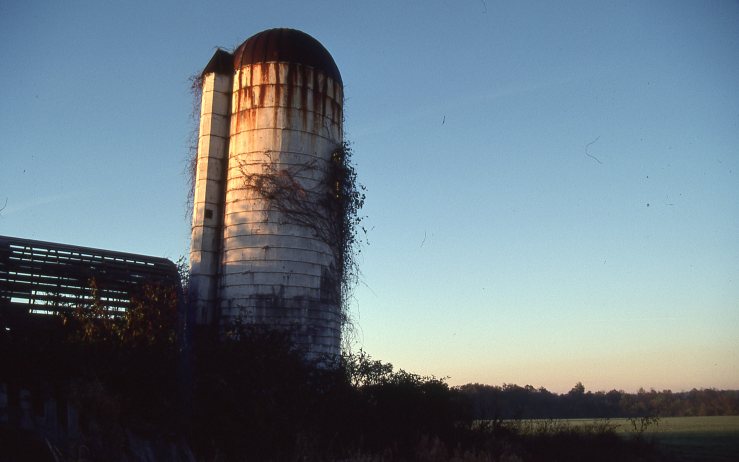
By the 1980s, dairy farms in Ashburn were being replaced by subdivisions.

When we moved out to Ashburn Farm last year, I was overwhelmed at how much the area had been developed. Ashburn, Ashburn Village, Ashburn Farm, Broadlands, Belmont: the development had vastly overtaken the dairy and turf farms I remembered from the 1990s when, for a time, I had lived in Sterling.

Senator Stewart Buys a Virginia Farm

Nevada Senator William Morris Stewart (from his biography)

Senator William M. Stewart of Nevada has bought a fine farm in Virginia, not far from Washington. The senator is largely interested in breeding fine horses, and in order to more fully carry out his plans he has purchased a fine old property near Farmville, VA. The farm consists of 586 acres of splendld land in the vicinity of the Blue Ridge Mountains, and is said to be fully equal to the Kentucky Blue Grass Region for stock raising.” November 25, 1895 The Evening Times

A Local Name Change

In the Alexandria Gazette and Virginia Advertiser, in an announcement from a page of the paper dated May 5, 1896 we read: “at the request of Senator Stewart, who has bought a farm near Farmwell, Loudoun County, Virginia, the name of the post office at that place has been changed to Ashburn. It is said that mail for Farmwell was frequently delivered to Farmville.”

Much was written about the dairy farm over the several years he owned it. Glowing reviews of the state-of-the-art machinery for milking, separating, sterilizing and cooling, along with the cleanliness of the barns, were featured in local newspapers. The descriptive language verged on paid endorsement, if that were possible.

Again from The Evening Star, December 28, 1901, the following article trumpets:

PURE MILK FOR WASHINGTON

A Thousand Families to be Supplied With Ashburn Milk
2,000 Acre Milk Farm in Virginia

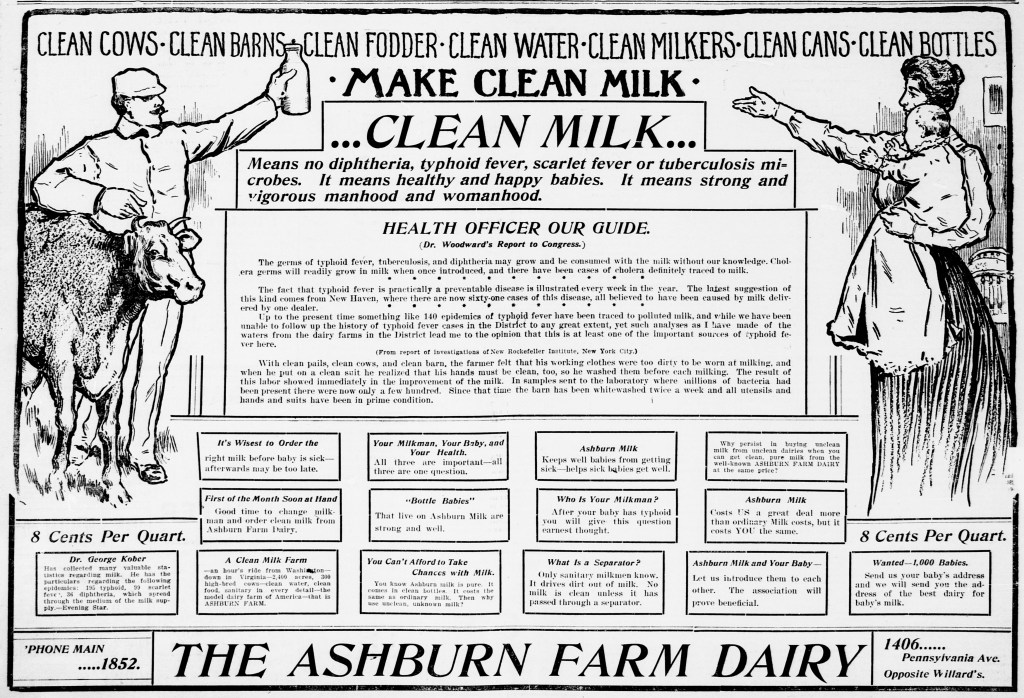
“Clean milk from clean cows, fed on clean food, drinking clean water, milked by clean men in clean barns, sent to Washington in clean cans and delivered to families in sealed bottles.”

Whew! Pretty hyperbolic language for a dairy farm!

It seems the existing farmhouse was also quite modern, boasting “an abundance of room, surrounded by spacious verandas which look out on green lawns, beyond which on all sides are rolling fields and woodland.” The Evening Star, June 4, 1900.

In a related article, the home was described as having “more bathrooms in it than most city mansions.” As the senator had a mansion in Dupont Circle (Stewart’s Castle, no longer standing), this was again high praise for the area.

Start the New Year with clean milk
Clean milk for 8 cents a quart

Speaking of milk production, the author goes on about the cleanliness of the operation, how the fresh milk was transported to the dairy via a small railroad system, where it was then separated, pasteurized, and bottled. “Every detail is expensive,” writes the author, “and the wonder is that the company should offer its milk at 8 cents a quart, the same as any other milk.”

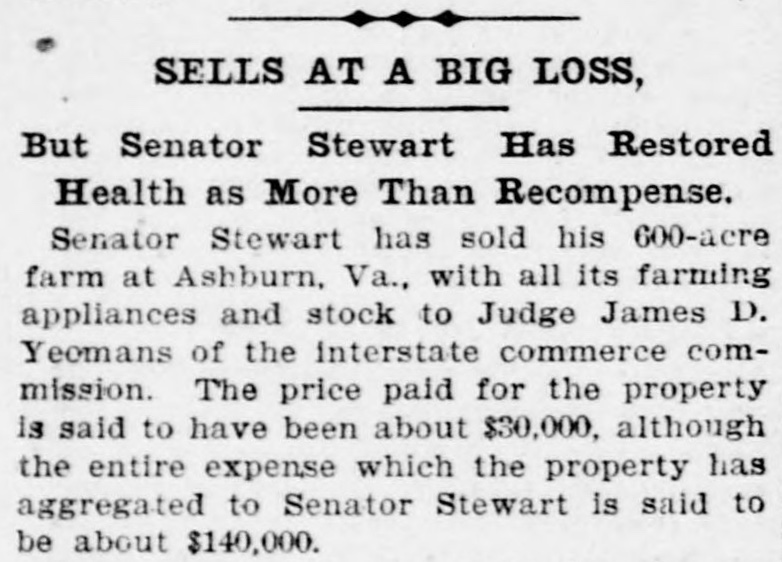
It would seem that even with all the qualities of superior milk, the Ashburn Dairy Company couldn’t make a profit. In July 1903 Stewart sold his dairy on 14th Street in Washington, DC. For sometime the farm was used to raise stock. The following year, the dairy farm in Ashburn was sold to Judge James Yeomans. At the age of 77, the senator sold the farm at a loss, having purchased and invested over $140,00, selling for $30,000. 

Senator Stewart sells his Ashburn property, The Evening Star, June 4, 1904.

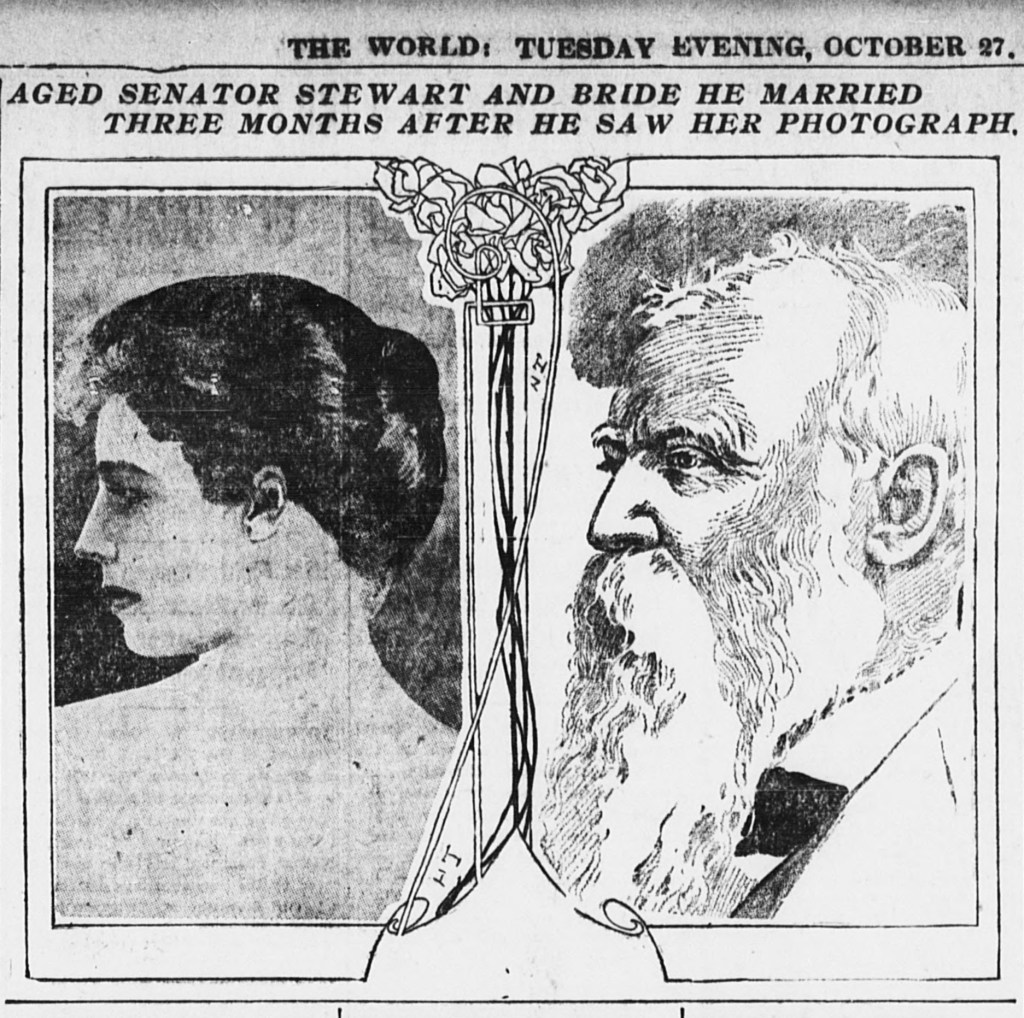
In a twist that would have sent today’s style magazines into a headspin, in 1903 the then 76-year-old widowed senator married a second time. After having seen a photograph of Mrs. May Agnes Cone, 44, Stewart invited her to be a guest at his country place, Ashburn Farm. Three months later, wedding bells. (The first Mrs. Stewart had died in an automobile accident in September 1902).

In looking back over his long and varied career, Senator Stewart writes in his 1908 memoirs, The Reminiscences of Senator William M. Stewart of Nevada,” of the many legal cases he took part in, fights won, laws passed. Nowhere does he mention his Ashburn dairy farm or the time spent in the Virginia countryside recovering his health. 

But one item he notes in passing, devoting barely eight pages to the subject, was his authorship of the Fifteenth Amendment, passed by Congress February 26, 1869, and ratified February 3, 1870. The Fifteenth Amendment granted African American men the right to vote. Rewriting a resolution offered to the Senate Judiciary Committee by Senator Henderson of Missouri ( No state shall deny or abridge the right of its citizens to vote or hold office, on account of race, color, or previous condition), Stewart offered his own reading:

“The right of citizens of the United States to vote or hold office, shall not be denied or abridged by the United States or any State on account of race, color, or previous condition of servitude.”

The final adopted language left out “or hold office.”

The Voting Rights Act of 1965, signed into law by President Lyndon B. Johnson, aimed to overcome legal barriers at the state and local levels that continued to prevent African Americans from exercising their right to vote as guaranteed under the 15th Amendment to the U.S. Constitution. Credit: https://www.history.com/topics/black-history/voting-rights-act

It’s a strange thing to be remembered for trying to bring clean milk to the citizens of Washington, DC and yet be forgotten for his efforts to ensure all citizens were represented thru their vote.

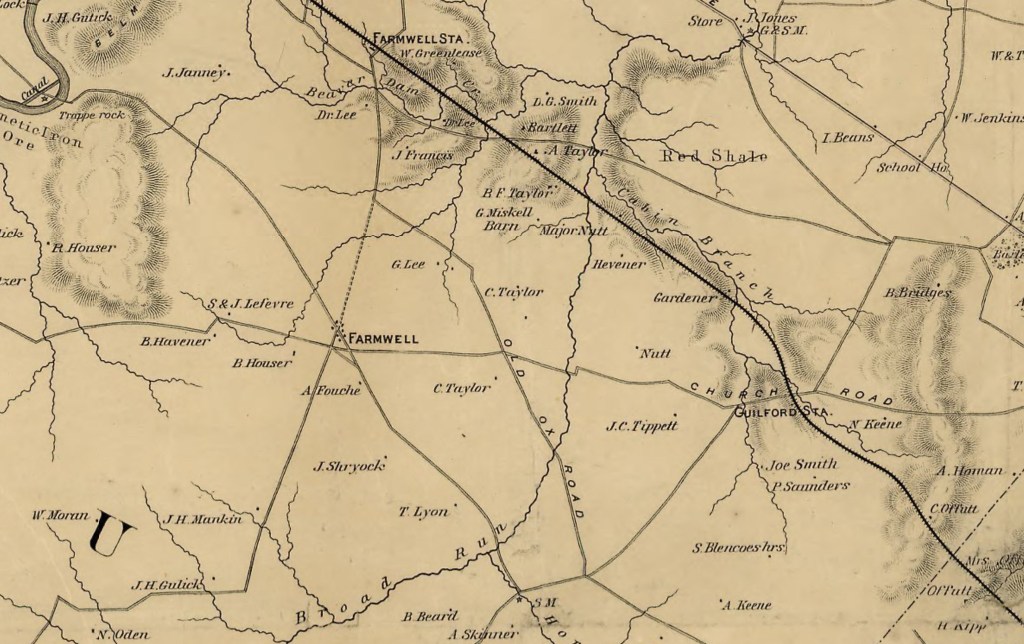
Farmwell? The name is memorialized as a one mile strip of road here in Ashburn, from Smith Switch Road to Ashburn Road. The three names for 625 to 640 (Waxpool Road, Farmwell Road, and Ashburn Farm Road) are certainly confusing!

Map of N. Eastern Virginia and Vacinity of Washington, 1862 Library of Congress
Image from “Map of N. Eastern Virginia and Vicinity of Washington, 1862” showing Farmwell. Library of Congress

Note: the Library of Congress website, Chroniclingamerica.loc.gov has a wealth of newspapers from across the US, dated 1789 to 1963 and fully searchable. Quotes and images are taken from their website.