200 Years and Looking Good

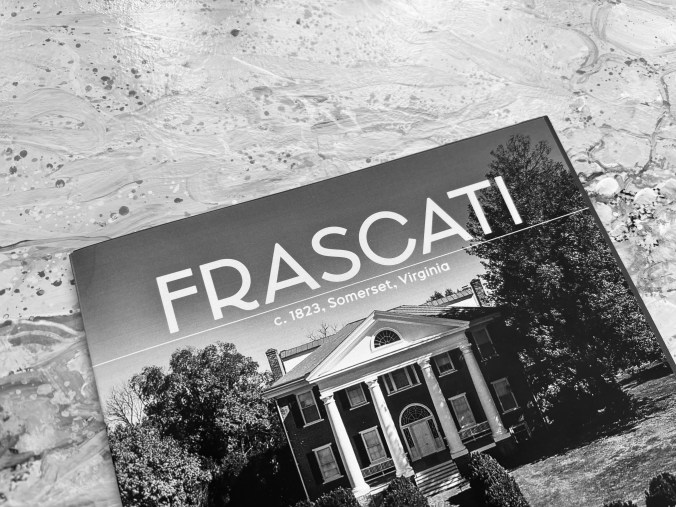
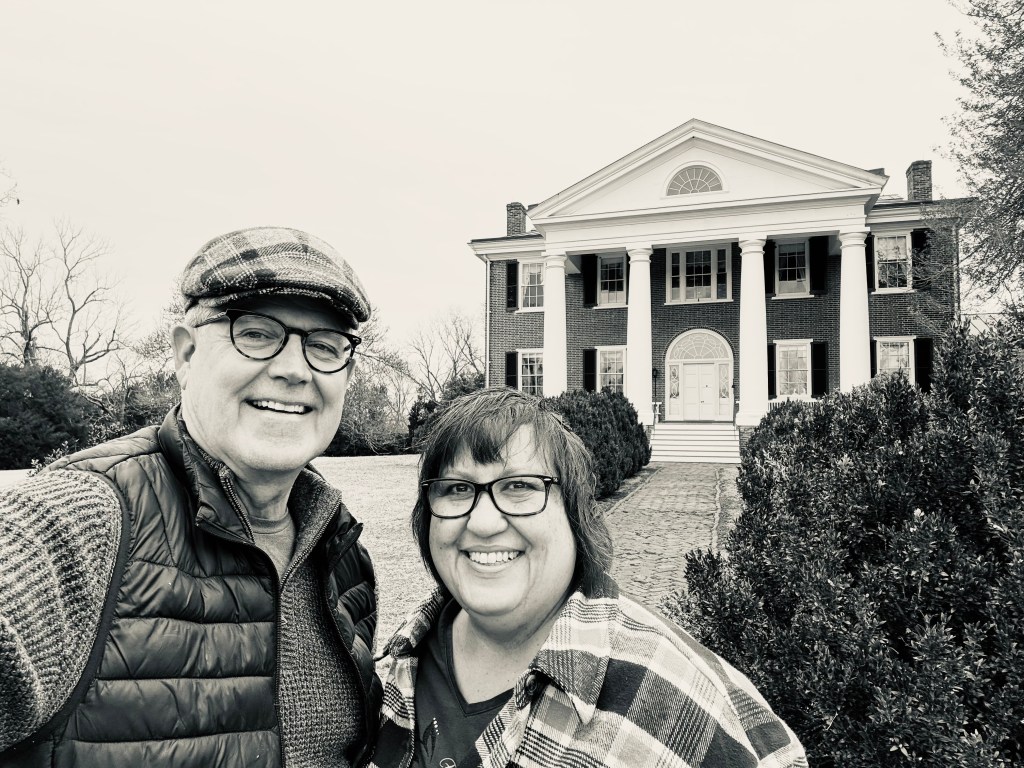
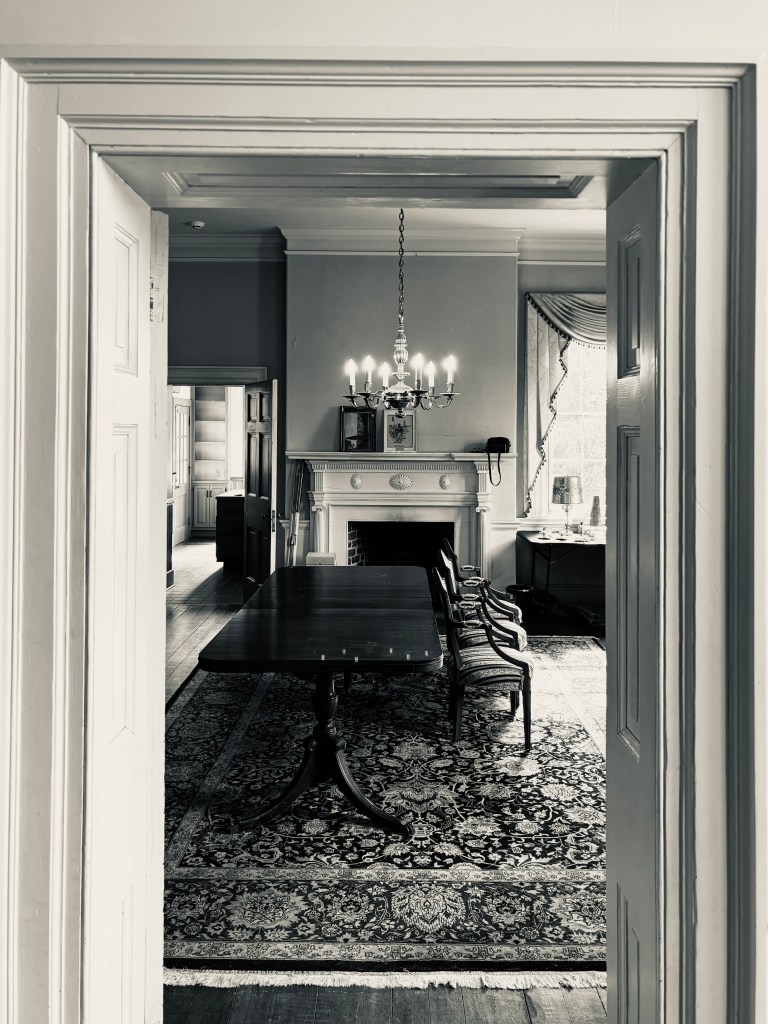
Last week we went for a preview of items to bid on from an auction at Frascasti, an 1823 brick mansion in central Virginia. Frascati was built for Philip Barbour, Associate Justice for the Supreme Court. John Perry, known for his work for Thomas Jefferson in building the University of Virginia and Monticello, oversaw construction. Frascati is on the National Register of Historic Places and is a Virginia Historic Landmark. The Federal-style brick home has a commanding view of the valley down through Somerset and on to the Blue Ridge Mountains. Hidden from the road by overgrown boxwoods, it must have been an imposing presence on the hill two centuries ago.

While the home isn’t open for tours, it was recently sold and the family, who had held the property for over four decades, released many of the furnishings in an estate auction. We went for the preview and had the opportunity to walk through the home as we marked our list of items to bid on.

The peeling paint on the first floor walls gave no indication of the grandeur the home once possessed. Entering the parlor I was surprised at the size of the room, dominated by a large chandelier set within an immense ceiling medallion. Oftentimes even the light fixtures are auctioned off—this one wasn’t and I imagine that it will be staying with the home.

We walked from front parlor to office, on through the dining room and made our way upstairs to one of the bedrooms which had items on the auction list. We had intended bidding on a pair of crystal bedroom table lamps. They were as beautiful in person as they had appeared in the online catalog though their fragile shades would need replacing. Up another flight of stairs we found a third floor lunette window at the front of the house with an amazing view over the boxwoods to the neighboring properties beyond. 

Frascati was one of four plantation homes in the area, only three of which still exist intact. A mansion designed by Thomas Jefferson, home to Governor Barbour, was built in 1820 and destroyed in a fire in 1848. Somerset Plantation, just down Rt 231 the Blue Ridge Turnpike, was built in 1821 and served as a design inspiration for Frascati. Montpelier, home to President James Madison and his wife Dolly, is now a historic site overseen by the Montpelier Foundation and owned by the National Historic Trust. 

My first impression of the mansion? What an opportunity for a grand event venue or a ballroom! The ornate plaster crown moldings and soaring interiors just speak of the Regency era in England. With examples such as Downton Abbey and Bridgerton, what a venue this could be for concerts or recitals. There is an existing deed of easement signed by the owners in 1999 with the Virginia Board of Historic Resources which guides what can be done with the buildings and the 64 acres. It remains to be seen what the new owners choose to do with this historic property. 

We ended up with a few items from the sale: a pair of crystal table lamps, three side chairs upholstered in a beautiful striped damask, two silverplate chafing dishes we hope to use for a party, a vintage illustrated book on Paris. As I was leaving, one of the daughters of the homeowner handed me a tiny green plastic house she had found while cleaning upstairs. A missing Monopoly game piece, she said, which went with the collection of games we had acquired. And then she spent several minutes telling me about each of the items we had purchased. I suppose it was her way of saying goodbye to a home she and her family had loved for more than 40 years and which had survived more than two hundred.

Come to America

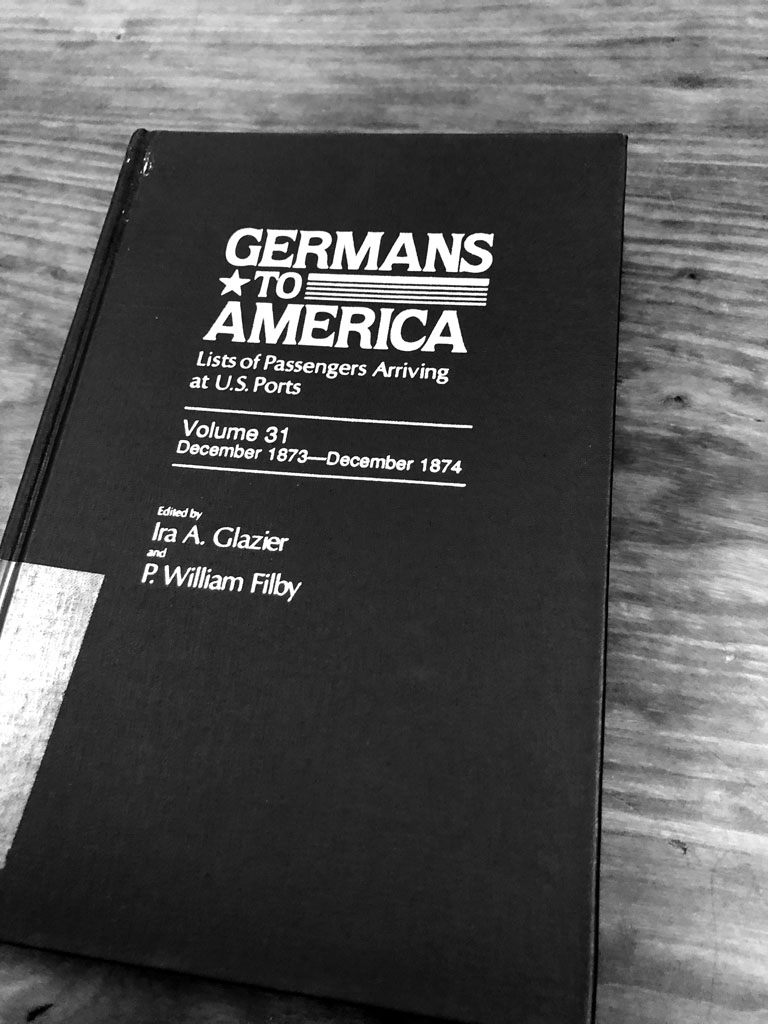
Why? Why did my distant relatives come to America? I’ve pieced together the Who and the When and also the How. Through genealogical websites, librairies, and church records I’ve managed to sketch a fairly accurate account of my great-grandfather Paul Hilbig’s journey to America beginning with his birth in Prussia in 1870, his family’s immigration in 1874 and their settling in Petoskey, Michigan. But Why? Leaving Germany in the late 19th century would have been an arduous journey to make, especially with a young family.

Considering the political and economic climate of Germany in the late 1800s, it’s not surprising that many families made the decision to leave for what they hoped would be a more prosperous, and safe future elsewhere. On 16 July 1870, the French parliament voted to declare war on Prussia; France invaded German territory on 2 August. In the final days of the war, with German victory all but assured, the German states proclaimed their union as the German Empire under the Prussian king Wilhelm I and Chancellor Bismarck. With the notable exceptions of Austria and German Switzerland, the vast majority of German-speakers were united under a nation-state for the first time. Following an armistice with France, the Treaty of Frankfurt was signed on 10 May 1871. (https://en.wikipedia.org/wiki/Franco-Prussian_War)

Meanwhile, back in Michigan, immigrants were being actively recruited from Northern Europe and especially Germany to help settle the area. Michigan was rich in mining, logging, and agricultural resources, but poor in human resources. Beginning in 1845, Michigan established an Office of Foreign Emigration in New York and published a pamphlet which promoted the virtues of the state. Between 1860 and 1900, more than 700,000 immigrants came to Michigan, and nearly 400,000 of these new arrivals were born in foreign countries.

In 1869, the governor of Michigan appointed a Commissioner of Emigration to reside in Germany “. . . for the purpose of encouraging immigration to Michigan from German States and other countries of Europe.” (A Brief History of Michigan)

Portrait of Max H Allardt, from Michigan’s Thumb, a Paradise for Saxonia Settlers

The agent, Max H. Allardt, was posted to Germany from 1870-1875 where he published a periodical and a pamphlet extolling the wonders of Michigan. Allardt was born in Germany in 1829, immigrating with his family to the US in 1833. He studied law in Cleveland, and before being appointed Commissioner, had published the Daily Review newspaper in 1861. Immigration efforts proved to be very successful and the program was closed in 1885. By 1890 an estimated 2.8 million German-born immigrants lived in the United States with a majority of the German-born living in the United States located in the “German triangle,” whose three points were Cincinnati, Milwaukee, and St. Louis.

The 1880 census lists the occupation of my great-grandfather’s stepfather as farmer. Later occupations are listed as carpenter or cabinet maker, skills he would have picked up living among the German immigrants in northern Michigan. My great-grandfather’s occupation was also listed as carpenter, the family evidently having given up on farming perhaps when they moved closer into the town of Petoskey. Whether farmer or carpenter, they exhibited skills that would have been essential in the early development of northern Michigan, at that time abundant in natural resources but lacking in manpower to develop the area. A summer of research along the Hilbig Heritage Tour has essentially answered the Who What Where When and Why questions of my ancestry. But I’m sure there are still more discoveries to be made!

You can read the first blog post about this family search on my blog here: Coming to America

Photos from Michigan’s Thumb, by U.H. Schmidt

Bandits Part 3

The effort to rid the city of vice brings to mind the Batman movies and Gotham City except that here, there wasn’t a caped crusader fighting the sinister dark elements of the criminal underworld. But much like watching a movie for the second time, reading back through events that have already transpired, in this case more than 90 years ago, we can know the ending from the beginning. And the ending in this particular story was very interesting.

While my grandfather may have been just one of many individuals caught up in local efforts to control vice, there were other factions involved that eventually took center stage. The long list of names covered in the newspaper at the time also included one of the arresting officers, along with the recently elected mayor and his appointed Chief of Police. There were others as well, including the county sheriff, but the mayor, police chief, and deputy police chief were at the center of the investigation.

Mayor Seccombe had been elected in April with a substantial plurality of votes out of a field of six candidates for mayor. He had been a city councilman running against several other businessmen, a lawyer, and others who all vowed to “cleanup the city”.

Upon election, the new mayor chose for his chief of police Dan Murdock, a deputy sheriff in the county. Speculation at the time had him choosing another individual and the choice eventually came down to Murdock or another San Bernardino policeman, C. Lawrence Jordan. With Murdock as Chief, Jordan was named the night Chief of Police.

By December of 1933 a grand jury was conducting an inquiry into city vice and gambling during which Mayor Seccombe, Murdock, Jordan and others were called to testify.

At the heart of the investigation were allegations that the police department, or some individuals therein, had been operating a “pay-off” system in regards to gambling in the city, which perhaps had related to the low number of raids and arrests conducted that year. Surprisingly, or perhaps not, no indictments were returned as a result of their investigation.

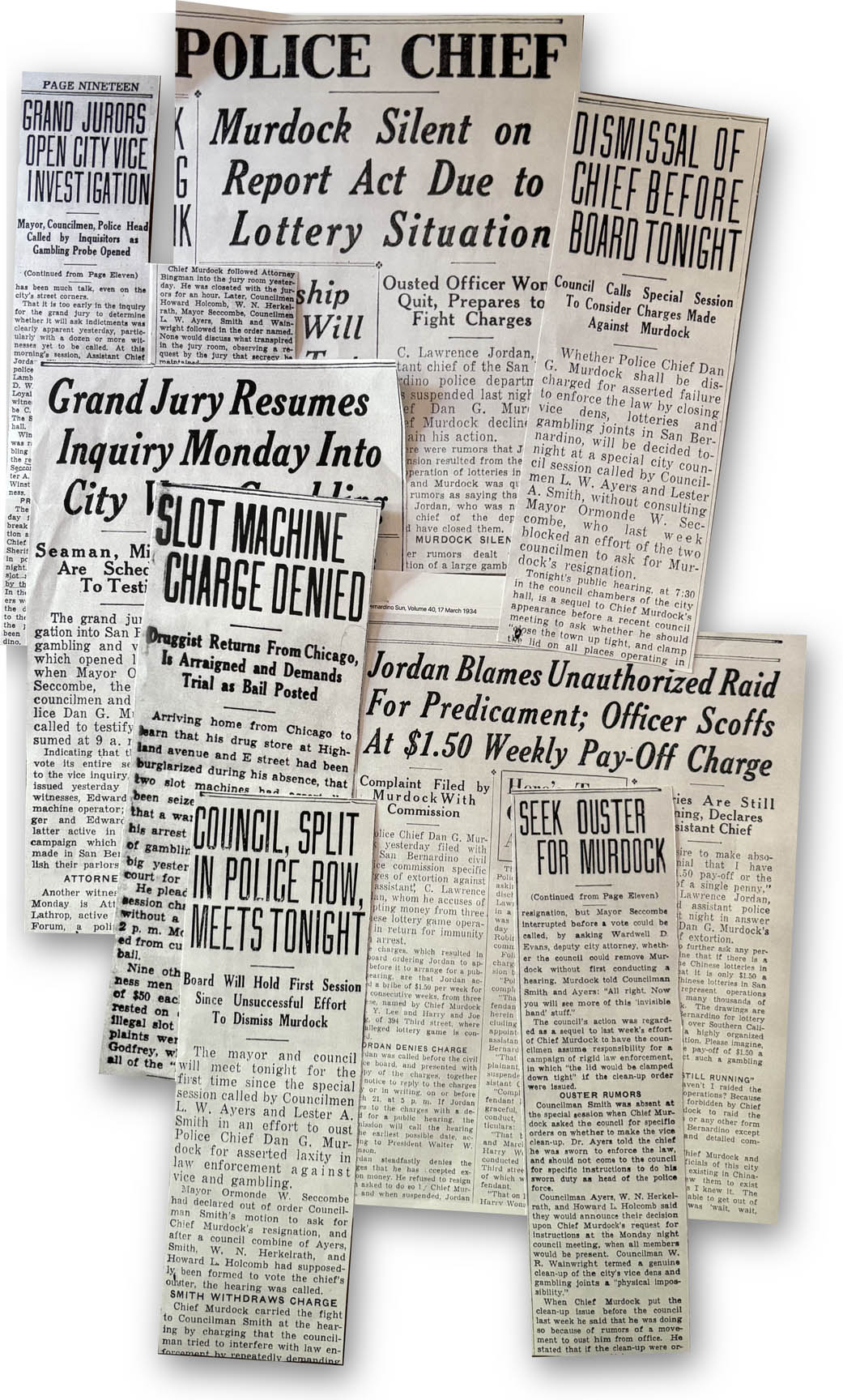
In March 1934 assistant chief Jordan was suspended by Chief Murdock over accusations of receiving kickbacks regarding the operation of lotteries in Chinatown. Jordan did not resign and the Chief ended up filing charges with the civil service commission which would eventually call both men, and others, to testify regarding the accusations.

The police chief filed charges of extortion against his assistant in what must have felt like a bit of payback in that, the previous year, both had been considered for the position of Chief of Police. Awkward! The extortion charges relied on testimony from three lottery game owners who basically stated that assistant chief Jordan had accepted money from them in exchange for immunity from arrest. How much was he accused of having received in consideration for allowing their operations to continue unabated? $1.50 per week. Well then.

In answering the allegations, assistant chief Jordan maintained that $1.50 per week payoff for a gambling operation that reportedly netted thousands of dollars a week was absurd. He also maintained that it was the chief of police who “expressly forbid” him to raid those or any other form of vice in the city “except under his direct and detailed command.” So then, now we have a very awkward situation! Whom to believe?

So then it seems that the individual responsible could be the police chief and not his deputy. But wait! After the civil service commission hearing regarding his suspension, Jordan was exonerated and his job reinstated. He was however reprimanded for “frequenting of questionable places other than in the performance of his duty as an officer and the intimated purchase by him of lottery tickets.” Result? Suspension without pay for thirty days.

Several weeks later, two members of the city council sought to have the chief of police removed from office; the move was blocked by the mayor but taken up a week later at a special session. During that session, one of the councilmen who had voiced opposition to the chief changed his position. The inquiry ending up with yet another exoneration, this time for the police chief who ended up retaining his job. Following his exoneration, the city councilman who had spearheaded the drive to have the police chief removed was himself facing a recall effort by voters in his own ward. Those efforts proved to be short lived and the councilman not only kept his seat but shook hands with (forgive and forget) with the police chief he had attempted to have removed.

It seems with that last city council session, the dust-up involving the assistant chief, the chief of police, and the city council had come to an end. Chief Murdock continued to make periodic arrests for gambling and other forms of vice within the city; assistant chief Jordan was reinstated though not at his previous position; and the councilman who was at the center of the police chief recall movement managed to retain his seat. Arrests continued to result in hefty fines being added to the city’s treasury. All-in-all, it reads like another episode of Law and Order in Gotham City. Admittedly my grandfather’s part in all of this was quite small, but in researching him I did get a very up-close look at small town politics, intrigue, and the way public morals have shifted over time here in the US. Ninety years ago but it sounds like today.


*UPDATE*

In a surprising, somewhat ironic note, my Mom wrote this to me:
“When your dad and I got married, the former mayor’s  grand daughter, Evelyn Seccombe, was my maid of honor.  Her mother and my mother had been close friends in San Bernardino High. They were both in the very first graduating class…1918, of the new High School.” Lora Lea (Willis) Chamberlin 9/10/2024

Bandits Part 2

Some Comparisons…

It started with an election, as these things often do, and a new mayor promising to “clean up the city.” The election in April of the that year brought in a new mayor and with him, a new chief of police with a renewed emphasis on curbing vice in the city. And so they took action: 60 people were arrested in a series of raids in July, 1933. While 60 doesn’t seem to be such an extraordinary number to us today, in 1933 there were only 39,000 people living in San Bernardino, California. That seems like quite an effort.

In a campaign to “rid the city of vice and lawlessness”, the mayor added two additional police members to the vice task force, “and the drive will include gambling establishments, houses of ill repute, boot legging places, and other similar dens of vice in our community.”

In December of 1933, Police Chief Murdock reported that he had made an initial survey of gambling establishments in the city after he first took office in April and found 20 of them. So something was going on that needed looking into.

A postcard from the 1933 Chicago World Fair

A chatty social article in the San Bernardino Sun mentioned that Mr. and Mrs. Ralph A. Hilbig left in late June, driving out to Chicago. It was understood that they would be visiting the Century of Progress Fair (Chicago World Fair) and later visit with relatives in Michigan where Ralph Hilbig grew up. 

On the 8th of July nine San Bernardino business men were placed under technical arrest during a slot machine war. The District Attorney had issued 10 complaints at the request of a private citizen who attested that the machines were gambling devices as he had played all of them. Arrested were a bar owner, cigar store owner, several cafe owners and a billiard hall owner. My grandfather Ralph A. Hilbig, who was out of the city at the time (the Chicago trip) could not be brought in. All the men were fined $25. While the police had raided 11 establishments, they only seized 9 slot machines, two of which were at my grandfather’s pharmacy. I can only imagine now why he would “assertedly” have gambling devices in his drug store (what could they possibly pay off in 1933?!). But later news articles never indicate the eventual disposition of the seized machines.

When my grandparents returned from Chicago on the 14th of July, they assumed that the drug store had been burglarized while they were away; however two slot machines had been seized from his drug store and a warrant had been issued for his arrest on charges of possession of gambling devices. He pleaded not guilty to the possession charge and was released on $50 bail with a trial set for the following Monday.

An article from December 12, 1933 has Ralph A. Hilbig listed again with a group defendants who were charged with possession of slot machines and released. Additionally, there were arrests for running a poker game, a domino gambling game in chinatown, penny ante games—all in all 48 individuals arrested. He forfeited the $50 bail when he failed to appear in court. Nine other businessmen forfeited their bail as well for the same offense in a series of gambling and vice raids which had netted almost 60 individuals. Looking back, it seems my grandfather took the fine and bail forfeiture rather than the trial.

That seems to have been my grandfather’s last close brush with the legal system. In 1934 his name appeared in a rather long list of individuals who had been selected to serve in a jury pool and indeed, he ended up serving on two juries.

But the story doesn’t end here; what was happening behind the scenes is often more interesting than the actual drama. And next week we will finish up this three-part story with a look at the police officer, the chief of police, and the new mayor. Oh! And their appearance before the grand jury. That’s when things really get interesting.

One-Armed Bandits

In 1895 a German immigrant in San Francisco by the name of Charles Fey invented a mechanical device consisting of several metal cylinders which, when activated by a coin, would spin in random sequence until they stopped and an image displayed on the cylinders would appear in a window. Whether the original five cylinders or the later three, when two or more of the same image appeared inline, you were a winner. The slot machine had humble beginnings but would eventually make a huge impact on the California and neighboring state of Nevada’s economy and later, much of the world.

Fey pioneered many innovations of coin operated gaming devices in his San Francisco workshop at 406 Market Street, including the original three-reel bell slot machine in 1898. The international popularity of the bell slot machines attests to Fey’s ingenuity as an enterprising inventor whose basic design of the three reel slot machine continues to be used in mechanical gaming devices today. (Winkslots)

Fey’s workshop is no longer standing. The Liberty Belle Saloon and Restaurant owned by Mr. Fey’s grandsons, Marshall and Franklin in Reno, Nevada, had many slot machines, including the first three-reels, the first draw poker machine and the first three-reel dollar slot on display. Sadly the Liberty Bell is no longer standing either, torn down to make room for a parking lot for the convention center. The slot machines were moved to the Nevada State Museum in Carson City.

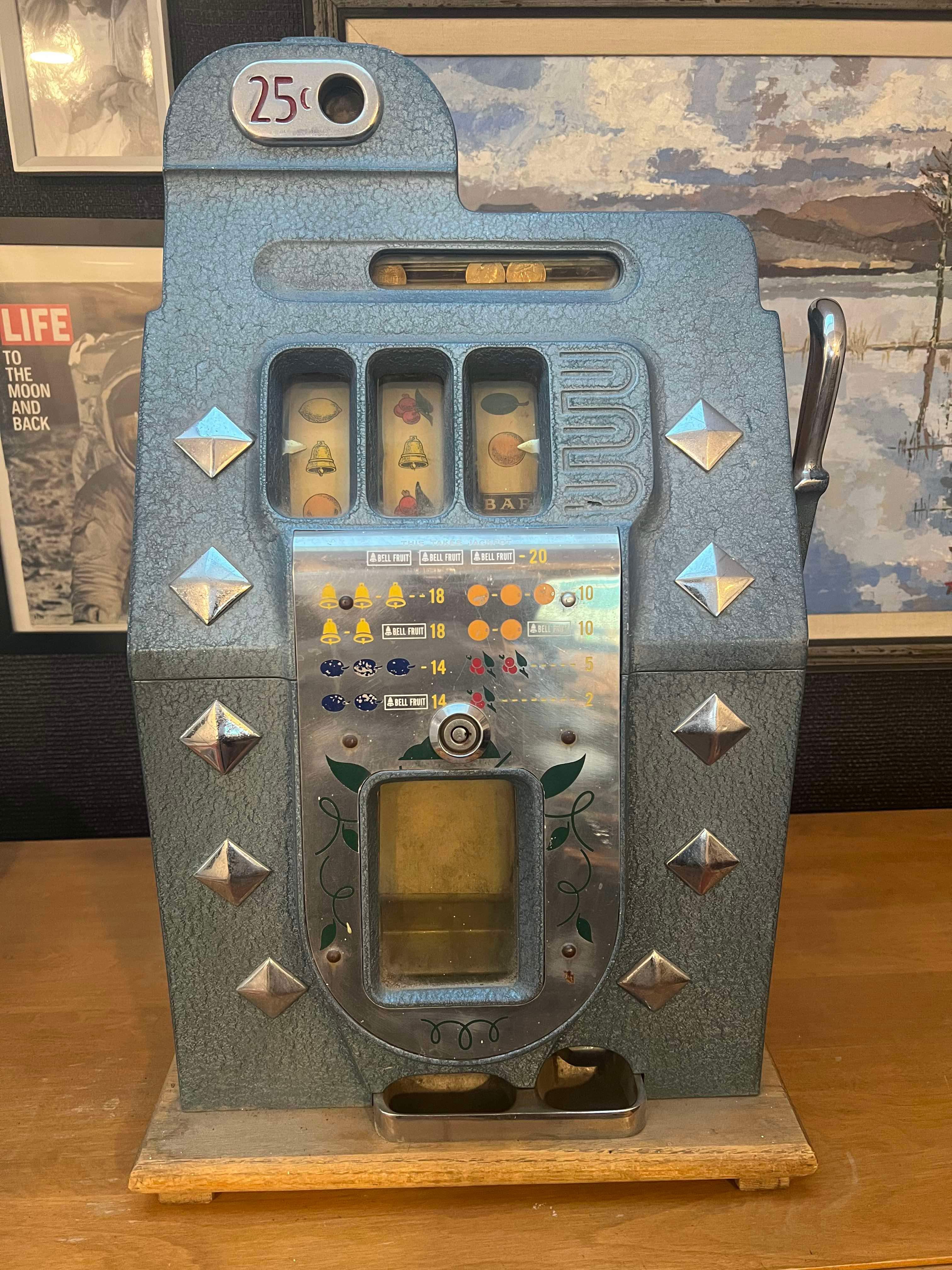
California the “Golden State” is the US’s largest Indian gaming state, with yearly casino earnings of around $9 billion. California has 76 Indian casinos and five mini-casinos, owned mainly by its 109 tribes. (playtoday.com) Today nearly everyone is familiar with slot machines, the original “One-Armed Bandit” and they can be found in many states which now have legalized gambling of one type or another. Below is a machine from the collection of a family member, an early 1940’s Mills Diamond Front Slot Machine, originally produced in 1933 by the Mills Novelty Company of Chicago. Mills was one of the few companies which manufactured both gambling and vending machines.

But their rapid adoption also became the key to their eventual downfall. In 1911, 16 years after the invention of the slot machine, slots were outlawed in California.

The first few decades of the 20th century saw rapid social changes as well as industrial and technological ones. The proliferation of gambling devices, though regulated to some extent, saw them popping up “everywhere,” along with lotteries and card games. And gambling was considered to be one of the chief vices, often found in proximity with alcoholic beverages and prostitution, numbers rackets, off track betting and other “vices.” Reformers managed to get laws passed to control if not outlaw many of these. But whether legal or illegal, many of these activities simply went underground, available but not “too” visible.

Due to the ban, cash prizes would not be distributed any longer, but the fruit machine found a way to work around the ban. To emphasize that they were vending machines, not gambling machines, fruit symbols–cherry, orange, lemon–replaced the poker symbols and then the prizes were given out as sweets and chewing gum according to the corresponding slot flavor.


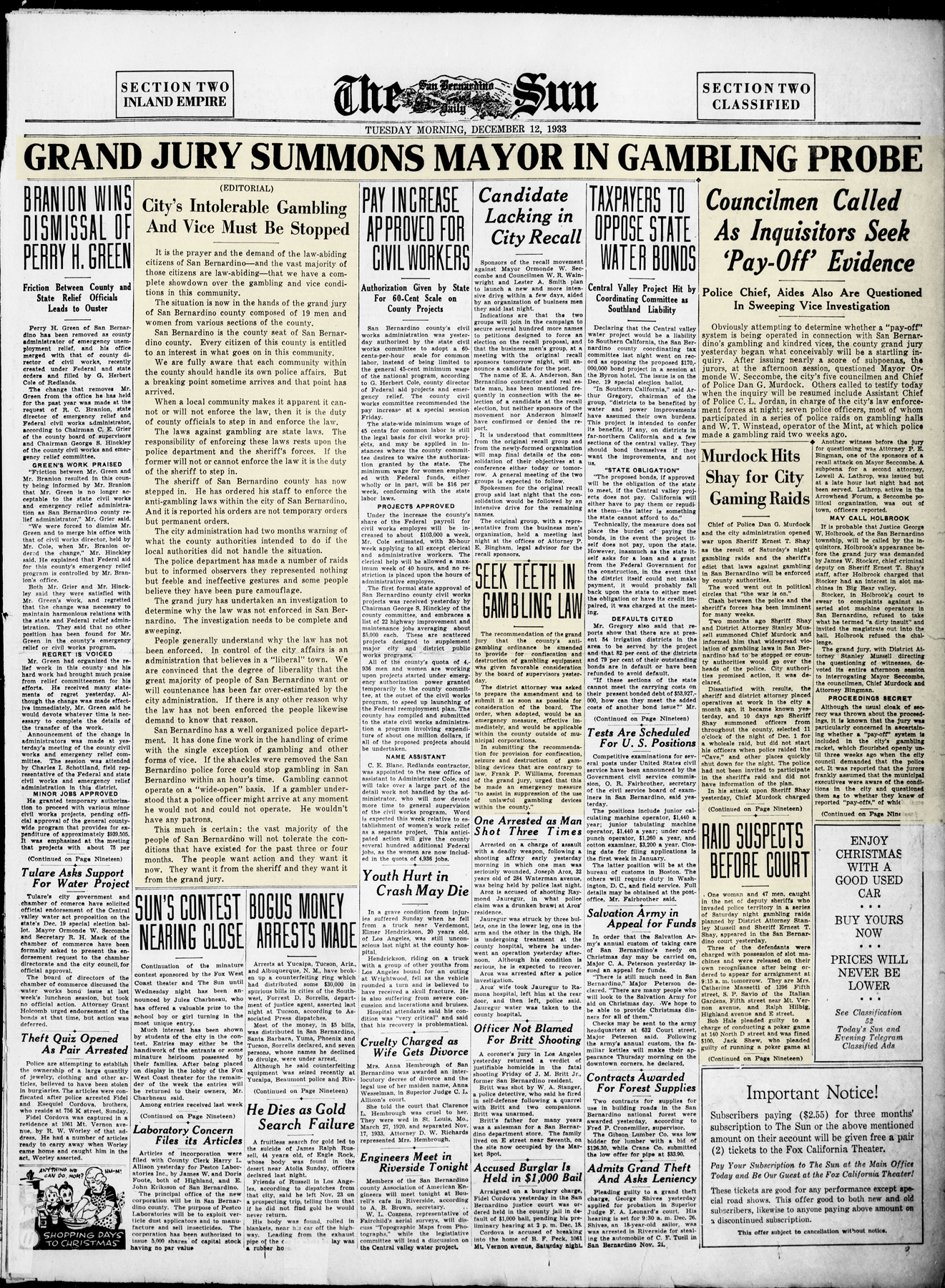
The headline couldn’t get any more graphic: “Grand Jury Summons Mayor in Gambling Probe.” The date of the newspaper, December 12, 1933. That attention-grabbing headline overshadowed three other articles on the same page. The editorial, “City’s Intolerable Gambling and Vice Must be Stopped,” gave some indication of what was going on in the city of San Bernardino that year. A smaller headline read “Seek Teeth in Gambling Law”. But the one that caught my attention simply stated “Raid Suspects Before Court”. And there in the second paragraph, in the last sentence, was my grandfather’s name. Ralph Hilbig, Highland Avenue and E Street. 

What on earth is going on here?

Caught up in the sweep to rid the town of vice, gambling, and lotteries were any number of small business owners in possession of slot machines which were paying out in coin, not sweets or candies. With the legalization of gambling in the neighboring state of Nevada in March 1931, Californians may have felt emboldened, expecting their state too would take up the cause. Or perhaps just thinking that gambling, in small venues or as a side hustle, would be overlooked, tolerated even in communities that prided themselves on being “progressive.” After all, with the repeal of Prohibition in 1933, the cultural climate did seem to be changing dramatically.

With gambling being illegal at the time throughout the US, one wonders how, or why there were so many slot machines in use. According to Nevada Magazine several California novelty companies made their own versions of the slot machine. Shortly after the slot machine’s invention California law banned cash payouts. For a time winners were paid in redeemable trade checks, chewing gum, candies, and sometimes cigars.

My grandfather’s pharmacy was one of several small businesses in San Bernardino, California during the 1930s which had a slot machine on their premises. The Mills Diamond Front machine introduced in 1939 which is pictured above and owned by a family member, is an example of the slots in use at the time. This beautiful Mills Gooseneck Silent, also known as a Mills Skyscraper machine, was produced by Mills beginning in 1932 (below). It is available on eBay from a vendor who lives in Escondido, California (ironically, my grandparents’ home city).

An article from the 1904 edition of the Hanford Weekly Sentinel spoke to public opinion at that time. Slot machines had been abolished in nearly every California city by that time, though still legal in California. The Hanford notes that “the contrivances were the outgrowth of the gambling spirit which abounds among the people, not only here, but everywhere. The machines were robbers, not doubt; all gambling schemes are robberies.” (Thursday, June 2, 1904)

It wasn’t until February of 1911 that a bill would be introduced to the California State Legislature which would criminalize possession or operation of slot machines. The bill was signed by Governor Johnson in April after having been amended, reducing the penalty of possession from a felony to a misdemeanor.

One would think that all of these laws would have been sufficient to shutdown gambling for good. Yet 12 years later, my grandfather was one of many who were arrested in his home town of San Bernardino for possession of two slot machines. What happened? Stay tuned! We will take a deeper look next week.