Looking Back At 50

Wooster High School Home of the Colts

June 4, 1970—It was a Thursday and the celebration that evening would be at the Centennial Coliseum, built in 1965 and the go-to venue for Reno’s large gatherings. Concerts, square dancing conventions, and high school graduations all made use of the Coliseum’s cavernous spaces.

But just a month before, on May 4 at Kent State in Ohio, the National Guard was called out to control student demonstrations. By the end of the day, four students were dead and nine others were wounded, marking the first time that students in the US had been killed during an anti-war rally. It was a shocking introduction to adulthood for us graduates.

Reno calls itself “The Biggest Little City in the World.” We might have been small, but by no means were we unaffected by events that were occurring at the end of the 60s. Looking back 50 years, I’m still surprised at what all we had seen, or participated in, during our years at Wooster High School. It’s as if our time in high school had been marked with confrontation and upheaval that we were too young to even recognize, though with lasting effects.
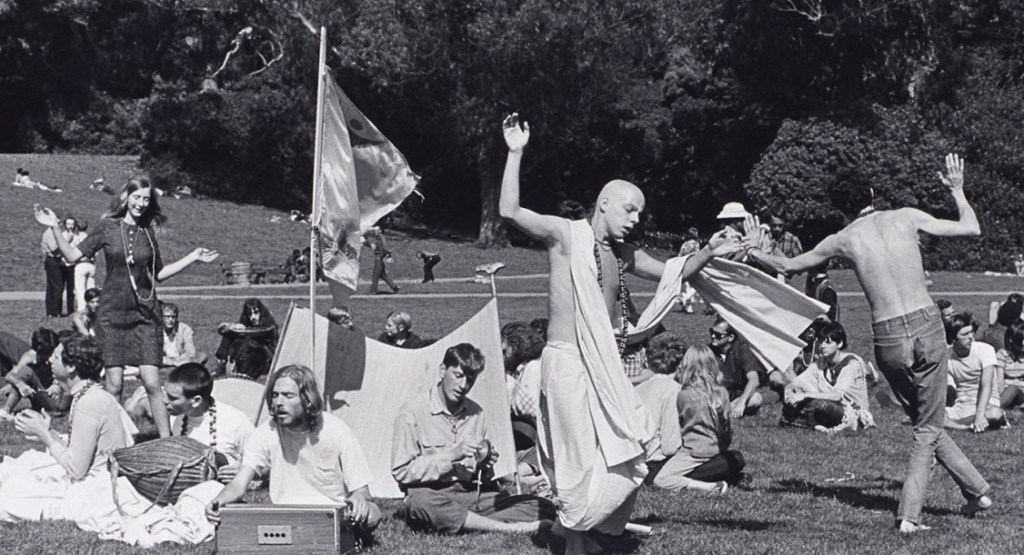
Summer of Love, dancing in the park. Image from Goldenstate.is

Express Yourself

Most of my graduating class entered school in the fall of 1967 not realizing the depth of change our country would soon embark upon. 1967 has been remembered as the “Summer of Love.” San Francisco, especially the Haight-Ashbury District, became the center of a special moment in time. Hippies and the 60’s provide plenty of material for retro parities today, and many of us look back on those embroidered bell bottoms, beaded necklaces and tie-dyed tshirts with a certain nostalgia now, I suppose. The love didn’t last long.

Our Junior Year—August 1968 the evening television was filled with video of protests in Chicago surrounding the Democratic Convention. Thousands of anti-war demonstrators took to the streets in what was to become a common occurrence. The next year, on October 15, 1969 the Moratorium to End the War in Vietnam saw students from local high schools as well as the University of Nevada join thousands of others in cities across the US, many of us protesting for the first time.

Walking on the Moon

Our time in school was not just marked by protest or social upheaval. There were other events that drew us together, celebrating triumph and accomplishment. On July 20, 1969, the world watched as Neil Armstrong stepped out onto the moon, fulfilling a promise President Kennedy had made in 1961 to safely land an American on the surface of the moon before the end of the decade. To this day, I can’t think of that moment without hearing Sting and the Police singing, “Walking on the moon.”

Astronaut Neil A. Armstrong, Mission Commander, works at the Lunar Module (LM). Image taken at Tranquility Base during the Apollo 11 Mission. https://catalog.archives.gov/id/16685088

Draft Day

Perhaps the single greatest event of our high school years, at least for the men, occurred in December 1969. A lottery drawing – the first since 1942 – was held on December 1 at Selective Service National Headquarters in Washington, D.C. Dates and numbers were called out and posted on a large board. You can watch the CBS video on YouTube here. “Mayberry RFD” was preempted to show the lottery and I’m sure many of us would rather have been watching it. A Wooster graduate whose birthday fell on September 14, number 001, was the first draftee from Reno. (https://www.sss.gov/history-and-records/vietnam-lotteries/). Not compelling reality TV by today’s standards, but it certainly had our attention.

Earth Day, April 22, 1970

Though there was plenty to divide us, many of us were brought together when we participated in the first Earth Day. On April 22 protests, rallies, and activities across America helped to bring awareness to and spearhead change in environmental practices. The Earth day website notes that “By the end of 1970, the first Earth Day led to the creation of the United States Environmental Protection Agency and the passage of other first of their kind environmental laws, including the National Environmental Education Act,  the Occupational Safety and Health Act, and the Clean Air Act.”

Having the voting age lowered to 18 by President Nixon in 1970 had huge repercussions. “To close his statement on the Voting Rights Act (of 1965) Amendments, RN turned back to the issue of the 18-year-old vote. Anticipating that the court test would rule the provision in question unconstitutional, President Nixon called for an immediate constitutional amendment lowering the voting age to 18. In July 1971, Congress passed the Twenty-Sixth Amendment to the United States Constitution, which set the minimum voting age for all Federal, State, and local elections at eighteen years of age.” Nixon Foundation

I’m not sure if there is one singular event or act that could summarize our three years in school. Certainly the deaths of Reverend Martin Luther King, Jr. and Senator Robert Kennedy shocked all of us and brought an awareness to politics and the civil rights movement that had not existed in our young lives before then. Weekends spent attending, or playing in football games, high school dances, first cars and rock concerts are seemingly shared by every graduating class, each generation. But missing out on your prom and graduation ceremony this year? Well I think that’s one that will go down in the books.
From Farmwell to Ashburn Farm

A year ago we sold our home and moved out to Loudoun County. As we have begun to learn more about our new community, I was surprised to learn that I had a connection to the area that stretched back more than a century.

Nevada, my home state, was admitted to the Union in 1864. Our first Senator from Nevada, William Morris Stewart, served for nearly thirty years and, nearing the end of his time in Congress and heeding the advice of his physician to take some time in the country, bought a dairy farm in Farmwell, Virginia. So where is this Farmwell today? For the answer to that, we need to go back nearly 124 years.

By the 1980s, dairy farms in Ashburn were being replaced by subdivisions.

When we moved out to Ashburn Farm last year, I was overwhelmed at how much the area had been developed. Ashburn, Ashburn Village, Ashburn Farm, Broadlands, Belmont: the development had vastly overtaken the dairy and turf farms I remembered from the 1990s when, for a time, I had lived in Sterling.

Senator Stewart Buys a Virginia Farm

Nevada Senator William Morris Stewart (from his biography)

Senator William M. Stewart of Nevada has bought a fine farm in Virginia, not far from Washington. The senator is largely interested in breeding fine horses, and in order to more fully carry out his plans he has purchased a fine old property near Farmville, VA. The farm consists of 586 acres of splendld land in the vicinity of the Blue Ridge Mountains, and is said to be fully equal to the Kentucky Blue Grass Region for stock raising.” November 25, 1895 The Evening Times

A Local Name Change

In the Alexandria Gazette and Virginia Advertiser, in an announcement from a page of the paper dated May 5, 1896 we read: “at the request of Senator Stewart, who has bought a farm near Farmwell, Loudoun County, Virginia, the name of the post office at that place has been changed to Ashburn. It is said that mail for Farmwell was frequently delivered to Farmville.”

Much was written about the dairy farm over the several years he owned it. Glowing reviews of the state-of-the-art machinery for milking, separating, sterilizing and cooling, along with the cleanliness of the barns, were featured in local newspapers. The descriptive language verged on paid endorsement, if that were possible.

Again from The Evening Star, December 28, 1901, the following article trumpets:

PURE MILK FOR WASHINGTON

A Thousand Families to be Supplied With Ashburn Milk
2,000 Acre Milk Farm in Virginia

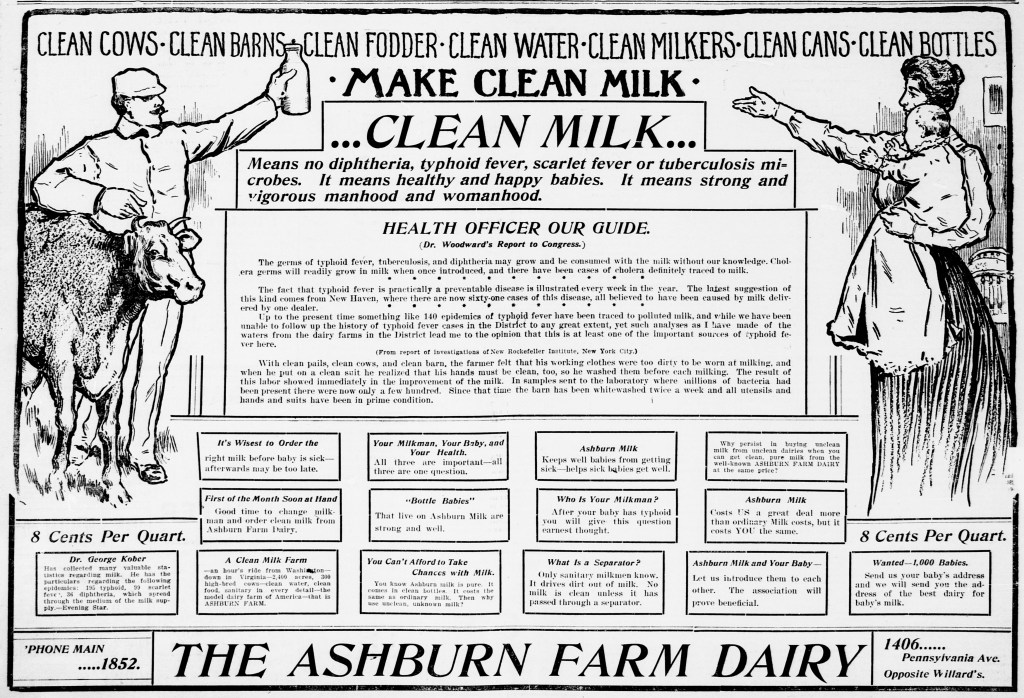
“Clean milk from clean cows, fed on clean food, drinking clean water, milked by clean men in clean barns, sent to Washington in clean cans and delivered to families in sealed bottles.”

Whew! Pretty hyperbolic language for a dairy farm!

It seems the existing farmhouse was also quite modern, boasting “an abundance of room, surrounded by spacious verandas which look out on green lawns, beyond which on all sides are rolling fields and woodland.” The Evening Star, June 4, 1900.

In a related article, the home was described as having “more bathrooms in it than most city mansions.” As the senator had a mansion in Dupont Circle (Stewart’s Castle, no longer standing), this was again high praise for the area.

Start the New Year with clean milk
Clean milk for 8 cents a quart

Speaking of milk production, the author goes on about the cleanliness of the operation, how the fresh milk was transported to the dairy via a small railroad system, where it was then separated, pasteurized, and bottled. “Every detail is expensive,” writes the author, “and the wonder is that the company should offer its milk at 8 cents a quart, the same as any other milk.”

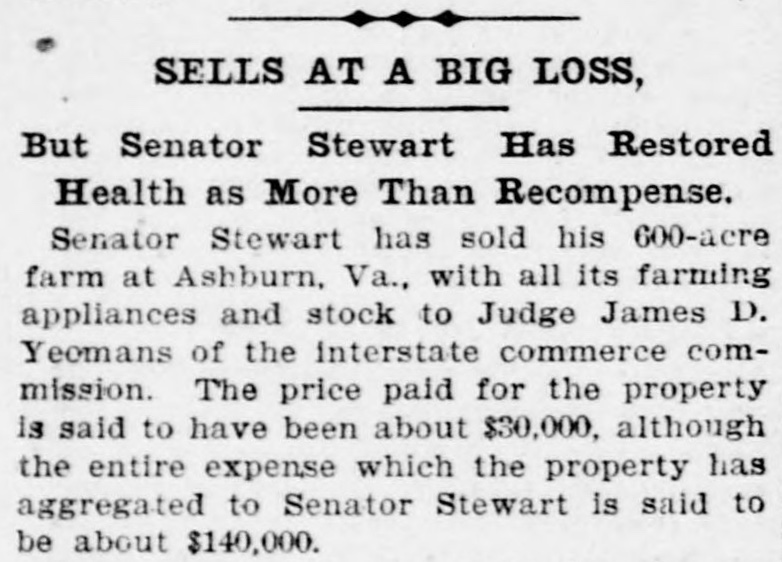
It would seem that even with all the qualities of superior milk, the Ashburn Dairy Company couldn’t make a profit. In July 1903 Stewart sold his dairy on 14th Street in Washington, DC. For sometime the farm was used to raise stock. The following year, the dairy farm in Ashburn was sold to Judge James Yeomans. At the age of 77, the senator sold the farm at a loss, having purchased and invested over $140,00, selling for $30,000. 

Senator Stewart sells his Ashburn property, The Evening Star, June 4, 1904.

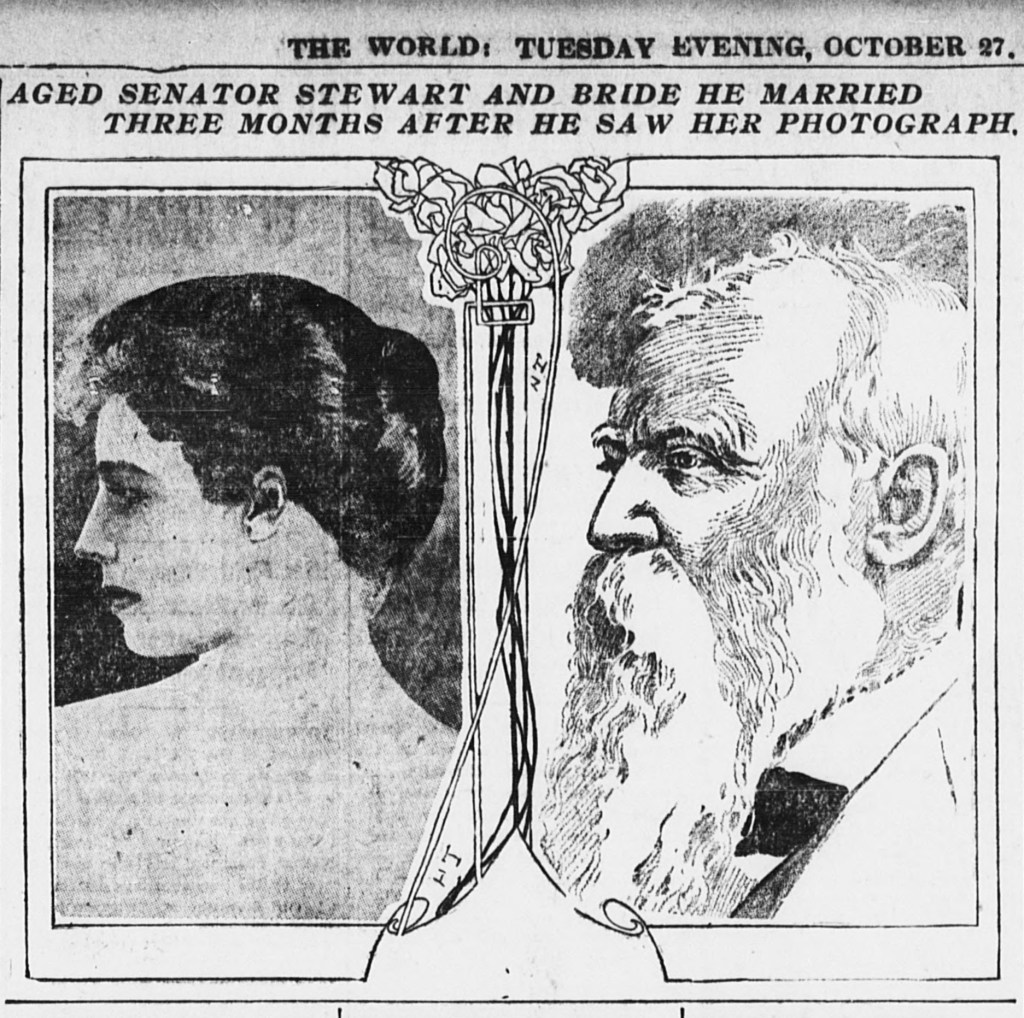
In a twist that would have sent today’s style magazines into a headspin, in 1903 the then 76-year-old widowed senator married a second time. After having seen a photograph of Mrs. May Agnes Cone, 44, Stewart invited her to be a guest at his country place, Ashburn Farm. Three months later, wedding bells. (The first Mrs. Stewart had died in an automobile accident in September 1902).

In looking back over his long and varied career, Senator Stewart writes in his 1908 memoirs, The Reminiscences of Senator William M. Stewart of Nevada,” of the many legal cases he took part in, fights won, laws passed. Nowhere does he mention his Ashburn dairy farm or the time spent in the Virginia countryside recovering his health. 

But one item he notes in passing, devoting barely eight pages to the subject, was his authorship of the Fifteenth Amendment, passed by Congress February 26, 1869, and ratified February 3, 1870. The Fifteenth Amendment granted African American men the right to vote. Rewriting a resolution offered to the Senate Judiciary Committee by Senator Henderson of Missouri ( No state shall deny or abridge the right of its citizens to vote or hold office, on account of race, color, or previous condition), Stewart offered his own reading:

“The right of citizens of the United States to vote or hold office, shall not be denied or abridged by the United States or any State on account of race, color, or previous condition of servitude.”

The final adopted language left out “or hold office.”

The Voting Rights Act of 1965, signed into law by President Lyndon B. Johnson, aimed to overcome legal barriers at the state and local levels that continued to prevent African Americans from exercising their right to vote as guaranteed under the 15th Amendment to the U.S. Constitution. Credit: https://www.history.com/topics/black-history/voting-rights-act

It’s a strange thing to be remembered for trying to bring clean milk to the citizens of Washington, DC and yet be forgotten for his efforts to ensure all citizens were represented thru their vote.

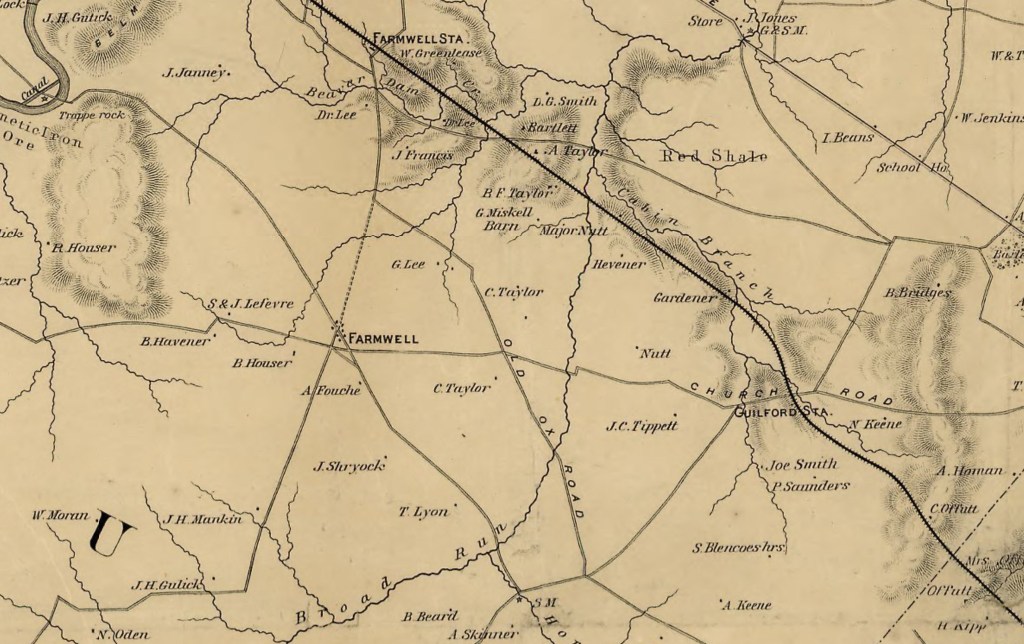
Farmwell? The name is memorialized as a one mile strip of road here in Ashburn, from Smith Switch Road to Ashburn Road. The three names for 625 to 640 (Waxpool Road, Farmwell Road, and Ashburn Farm Road) are certainly confusing!

Map of N. Eastern Virginia and Vacinity of Washington, 1862 Library of Congress
Image from “Map of N. Eastern Virginia and Vicinity of Washington, 1862” showing Farmwell. Library of Congress

Note: the Library of Congress website, Chroniclingamerica.loc.gov has a wealth of newspapers from across the US, dated 1789 to 1963 and fully searchable. Quotes and images are taken from their website.

Mandarin Orange Marmalade

A couple of weeks ago, my granddaughter and I made a batch of grape jelly and a batch of strawberry jam. The jam turned out wonderful and I plan on making more soon. The grape jelly, not such a great success: it’s delicious but did not set up as firm as I had expected. Over time it’s likely to get a little more firm, but as it’s not my favorite jelly, that’s not really an issue for me.

A bag of juicy Mandarin oranges.

What I really like, however, is orange marmalade. The best that I’ve had is made from Seville oranges, tangy and bitter sweet. But I haven’t seen any Seville oranges in our local markets. Mandarin oranges, however, were on sale this week at our local Giant. So I picked up a couple of bags (6 pounds worth) and shopped the internet for a good marmalade recipe.

There are a lot of recipes available online, I’m surprised anyone buys cookbooks these days, and it was easy to find a recipe that suited my low-fuss cooking style. There aren’t a lot of ingredients involved as one can imagine (fruit, water, added sugar and possibly pectin); however I threw in a cinnamon stick to give it a little extra kick, and three lemons (juice and peels) to help recover some of the acidity that the mandarin oranges were missing.

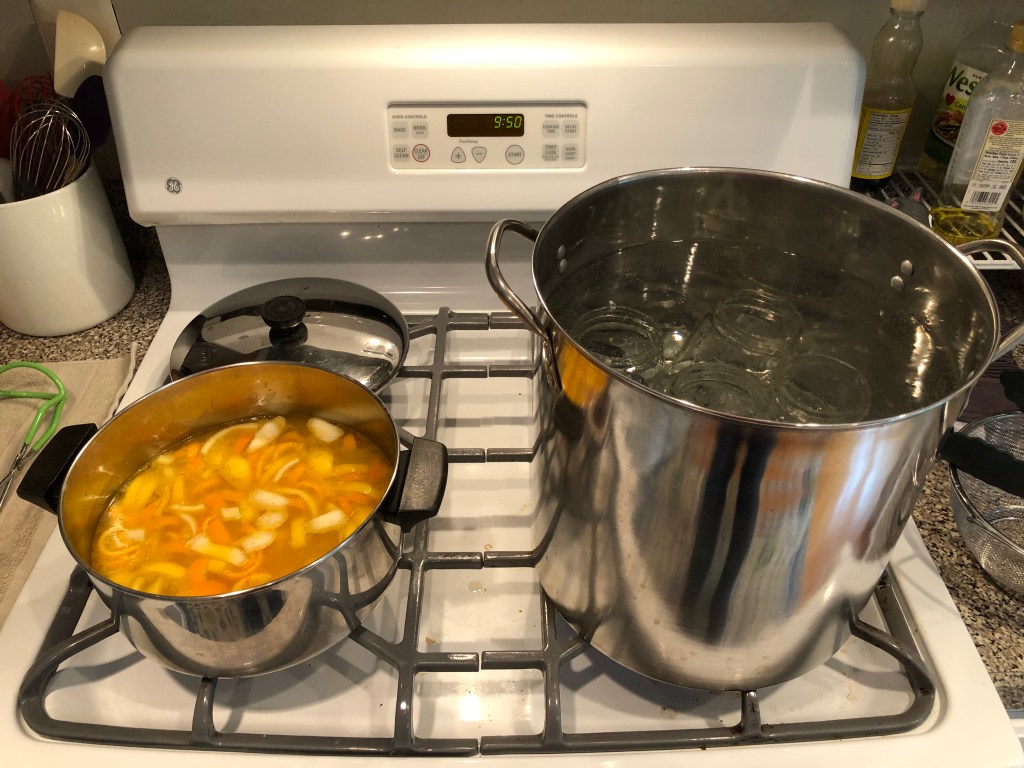
Oranges cooking on the stove, jars and lids sterilizing in their water bath.

Homemade marmalade is a much slower process than I had expected. Just squeezing the juice from two bags of oranges, then scraping and slicing the peels to add to the mixture, took more than an hour. The recipe I used suggested starting the day before with this step and I’m glad I did. The kitchen was soon filled with the pleasant aroma of fresh-squeezed oranges and reminded us of our first taste of Florida orange juice on our honeymoon years ago. Really, it was that memorable.

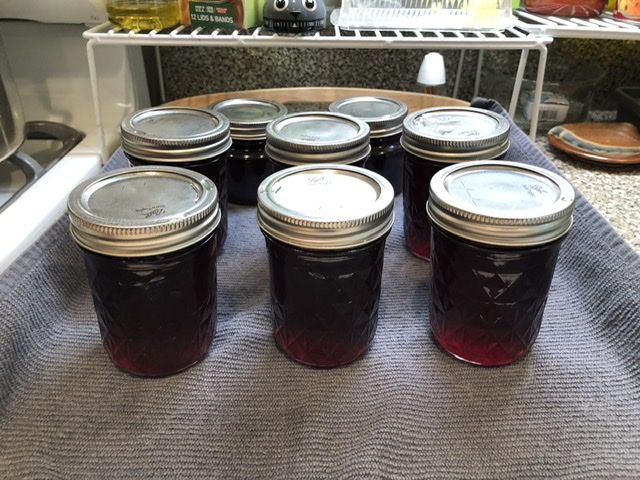
Mandarin orange marmalade, canned and ready for the pantry.

The recipe indicated that 4 1/2 pounds of oranges, with the added quart of water and sugar, would yield 5 1/2 cups of jam after cooking down to about half the volume. I used 6 pounds of oranges, three lemons, and less sugar than called for but more pectin, and ended up with 5 1/2 cups. It could be that I have more juice to water ratio than the recipe, but the taste test was delicious!

If you are interested in taking a look at the original recipe, you can find it on the A Family Feast website. Do you have a favorite family recipe for jams and jellies? Share in the comments section below. See you in the kitchen!

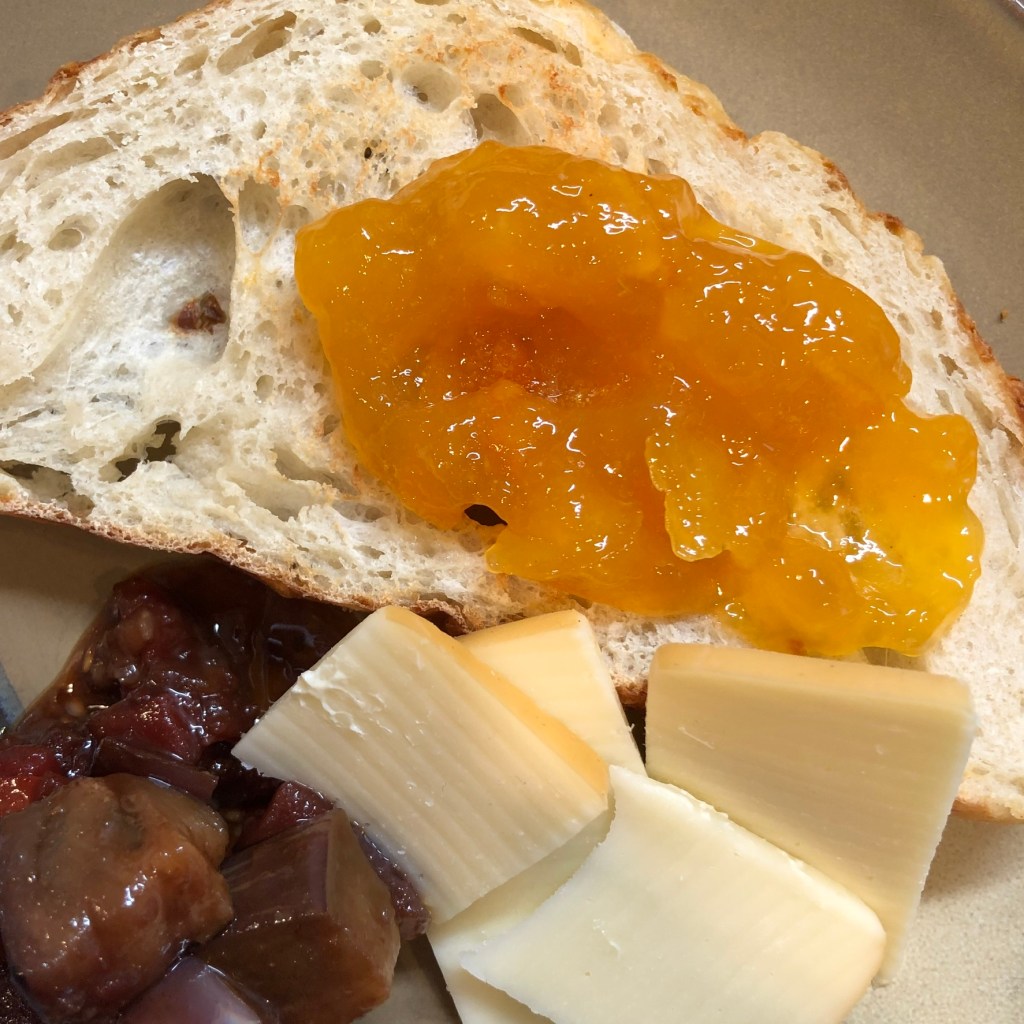
Toast with marmalade, eggplant caponata, and smoky Gouda.

Home Made

John Landis Mason invented the Mason Jar on November 30, 1858. In 1884, Ball Corporation began manufacturing glass home-canning jars, the product that established Ball as a household name and licensed Mason’s design.

I didn’t grow up in a household where we canned fruits and vegetables. Living in the suburbs, our garden only had a few tomato plants, a few green vegetables and the occasional zucchini plant. It was our small version of a Victory Garden but it never produced much more than we could eat that summer.

However, my Dad’s sister and her family always had a huge garden and they canned as much as possible. Back during the late 50’s and on into the 60s, I remember visiting the cousins “on the ranch”  and helping pick blackberries, cherries, apples, and a variety of smaller vegetables that they would preserve. I have great memories of helping cook apples for apple butter, making watermelon pickles, and helping prepare the jars and lids for canning. It was a lot of work and the large country kitchen was full of small helpers, my cousins and I each with an assigned task.

I think it was that sense of sharing in a generations-old activity that encouraged me to try canning with my granddaughter. 

What is America’s favorite flavor? According to data based on the U.S. Census data and Simmons National Consumer Survey (NHCS), 163.97 million Americans consumed strawberry jams, jellies and preserves in 2019. So strawberry jam was on our list to try.

Nearly 128 million consumed grape jams or jellies. Raspberry, blackberry, and apricot round out the top five flavors, though considerably farther behind (50; 38; and 33 million). So we bought fresh strawberries from the market and a gallon jug of Welch’s grape juice to make strawberry jam and grape jelly. 

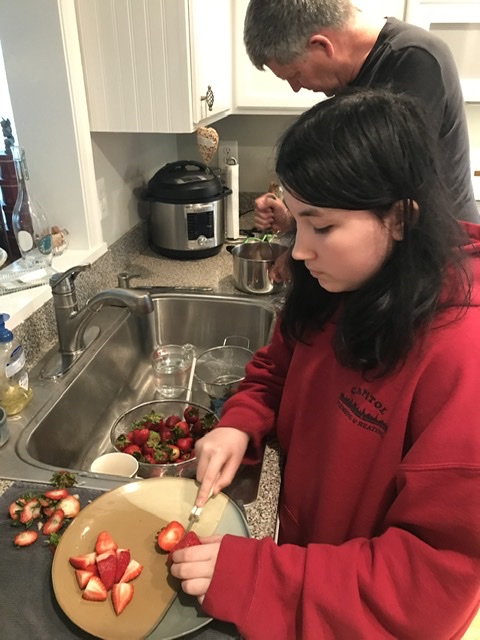
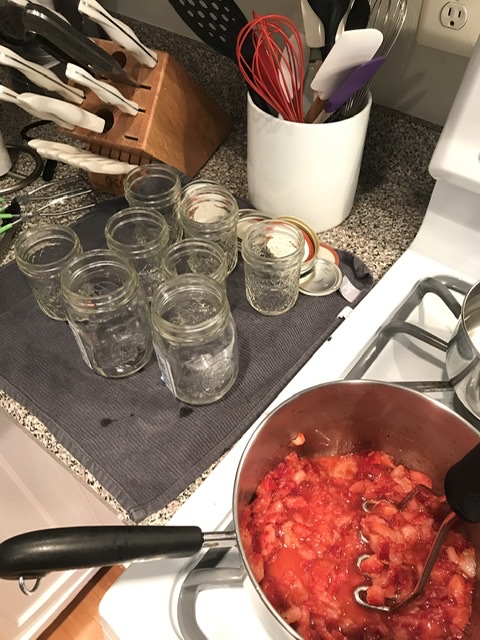
If you haven’t tried your hand at home made preserves, it’s surprising how much time is involved in preparing utensils, boiling water, sterilizing bottles and lids, cutting up fruit, measuring sugar and many other little tasks. While I got our little production underway, Cadence cut up the strawberries we had purchased.

Our assembly line worked pretty smoothly, the kitchen was filled with the smell of ripe strawberries, and the introduction to an element of frontier living went better than I could have hoped. We’ve got enough bottled preserves to last us through the winter, and though we never did make the pickles I had promised her, there is still time to try this summer.

While searching online for recipes and where to purchase mason jars, I was really surprised to see the many creative uses for mason jars that people have been inspired to share. The website freshpreserving in particular, had a lot of fun DIY projects for jars. The locking ring and lid are particular features of the mason jar. However, the website masonjars marketplace has an array of accessories to replace the traditional lid with pour spout lids, dispensor pumps, or spray tops to make reusable glass storage ware.

The wedding industry doesn’t seem to have slowed down in their love of rustic, DIY presentation and the mason jar has a proud position at the table as well as in lighting and other creative uses. And whatever your style, Etsy has it covered with over 51,000 entries alone for “mason jar decor.” That’s a pretty good heritage for John Mason and his glass container patent for the “Improvement In Screw-Neck Bottles.” It was the first hermetically re-sealable glass jar (US 22186A). His improvements, coupled with a rubber washer, transformed the capabilities of the home canning industry and solidified Mason’s place in history. (masonjars.com/history)

Mason jar wine glasses, a little bit country.
Wedding decor with firefly lighting and themed drink ware.
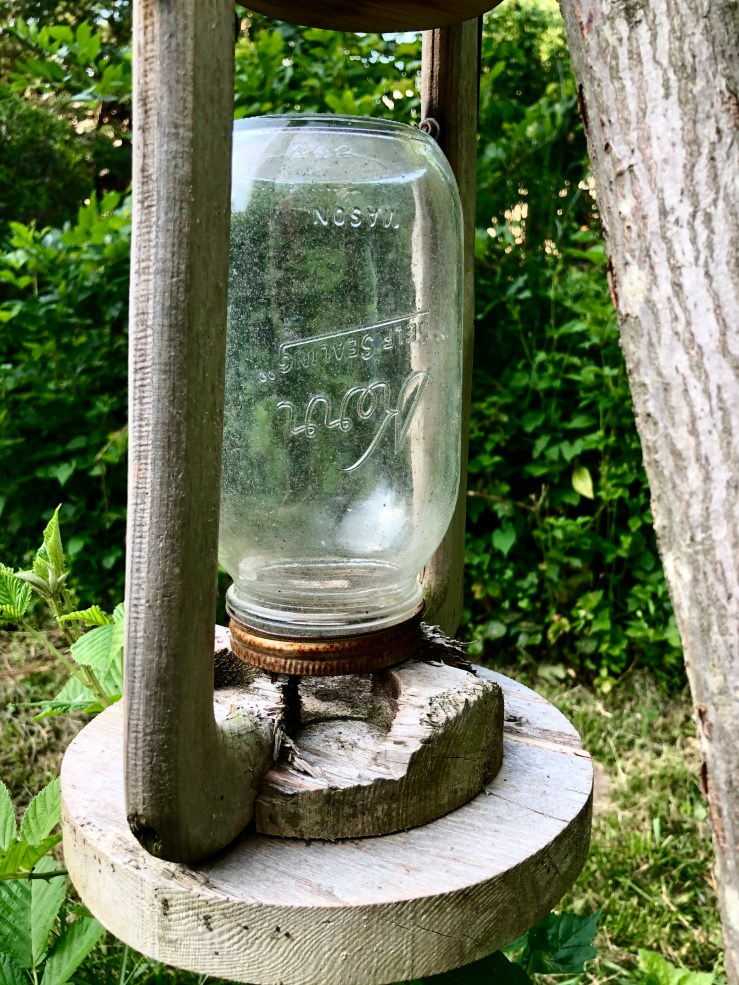
Rustic mason jar bird feeder.

Smells Like Home

Recently we remodeled the guest bathroom. It started out as quick fix to a leaking faucet, but as so often happens, the project expanded a bit in scope. Mission creep that ended up with new tile, vanity and bathroom fixtures. But I digress.

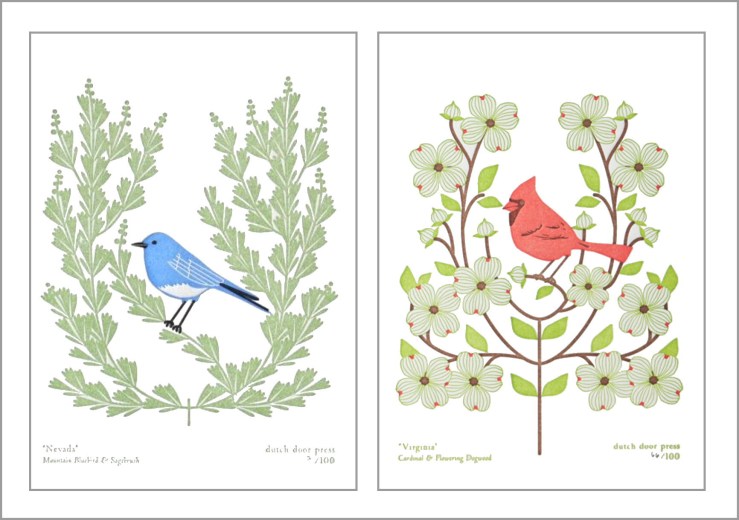
The new bathroom design took a decided turn towards modern farmhouse, but it did allow us to feature a couple of letterpress prints we had purchased years before on a vacation out west. Dutch Door printers had created an American states series, “Birds and Blooms of the 50 States”. Each print featured that state’s bird surrounded by the state flower. We purchased both a print of Virginia and of Nevada (my home state) but hadn’t displayed them before. The completed guest bath was perfect: lots of black, grey and white were the perfect backdrop for Virginia’s state bird—the cardinal, and dogwood blossoms.

Nevada was a bit harder to incorporate in our decor. How to feature the mountain bluebird and artemisia, known commonly as sagebrush? But when my niece sent me a cutting of sagebrush from Reno, we had everything we needed. When I opened the box, the aroma of desert sage was incredible.

There are other smells, scents that immediately remind me of home. The sharp aroma of pine trees or wood smoke draws me back to summer evenings and fire crackling in the wood stove in our cabin at Lake Tahoe. A newly mown lawn invariably reminds me of fields of alfalfa; my cousins and I are riding on a flatbed trailer wrestling with bales of hay. 

With all of their bittersweet memories, I suppose there is nothing to compare with the smell of morning coffee and the heavy presence of bacon frying, filling the house with the promise of fried eggs, toast and coffee for breakfast. My Dad always rose early, always made the coffee first, and loved his San Francisco sourdough bread. 

I suppose one could make an argument for fresh-from-the-oven apple pie, or even the sweet scent of chocolate chip cookies baking. The aromas of baking are captivating and stay with us for a lifetime. But for me they hardly compare with some of the pungent flavors of the desert. Even after years of living in another state, stepping off a plane after we had landed in Reno and walking across the tarmac to the main terminal (long before the modern passenger boarding bridge), the hot, dry wind always carried with it the smell of sagebrush. Home again. 

Summer Projects

As any parent knows, the summer vacation time between the end of school and the Labor Day weekend can be a challenge. For students who are experiencing a breath of freedom (no more teachers, no more books!) the summer weeks stretch out ahead in full, unscheduled promise. For parents however, each day brings the challenge of organizing activities, educational or entertaining, and making the most of each opportunity. But this year, summer camps and weekend outings, trips to the zoo or King’s Dominion, have all been changed. 

As grandparents of a tween (twelve going on twenty) this summer has brought even greater challenges than usual. Our vacation plans for Florida were canceled early in the aftermath of Covid-19 shutdowns. Still, we have been blessed with great weather and outdoor venues are beginning to return to a degree of normalcy, even if that means 50% occupancy and social distancing. 

Yet each day stands before us demanding answers, hours to be filled, adventures to be planned whether large or small.

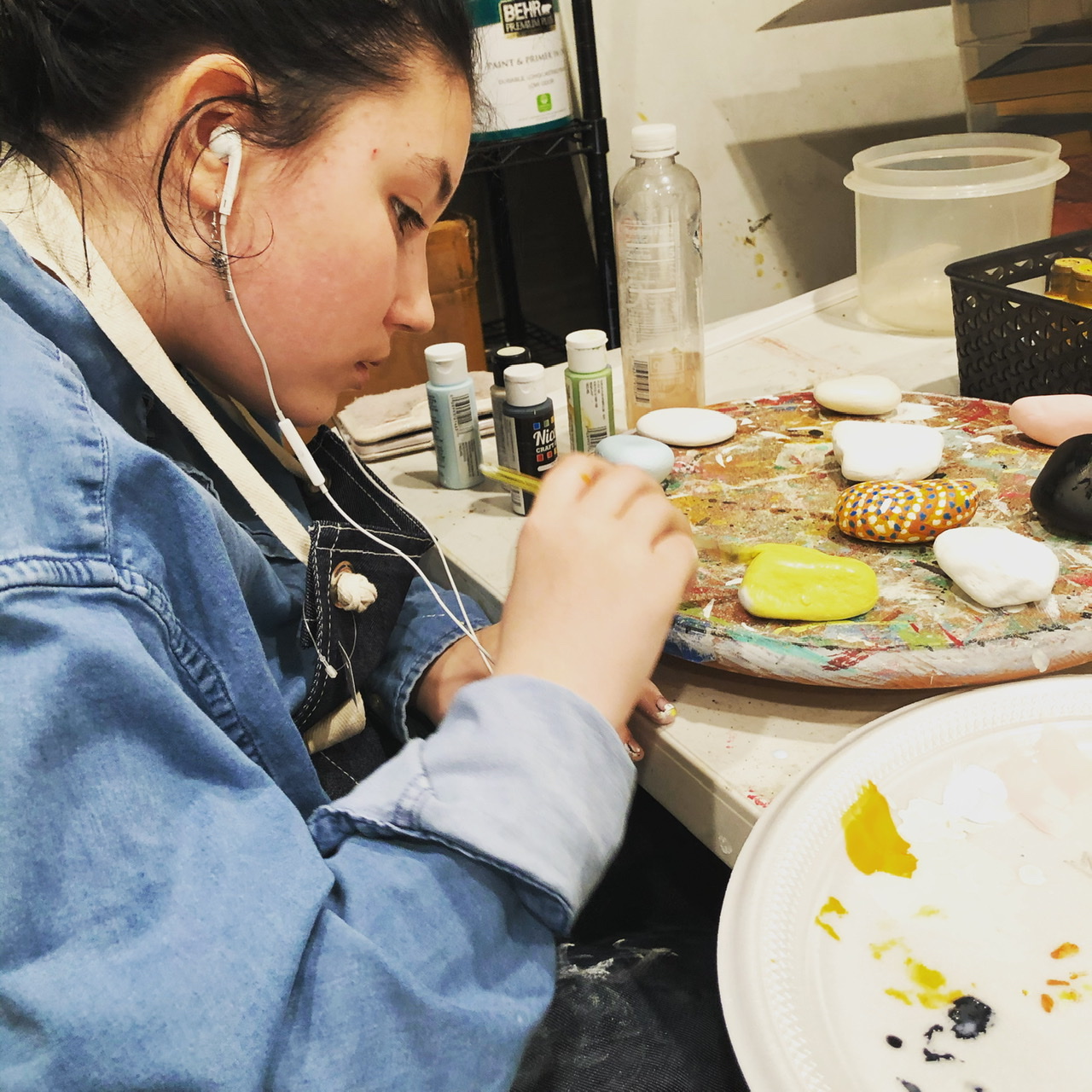
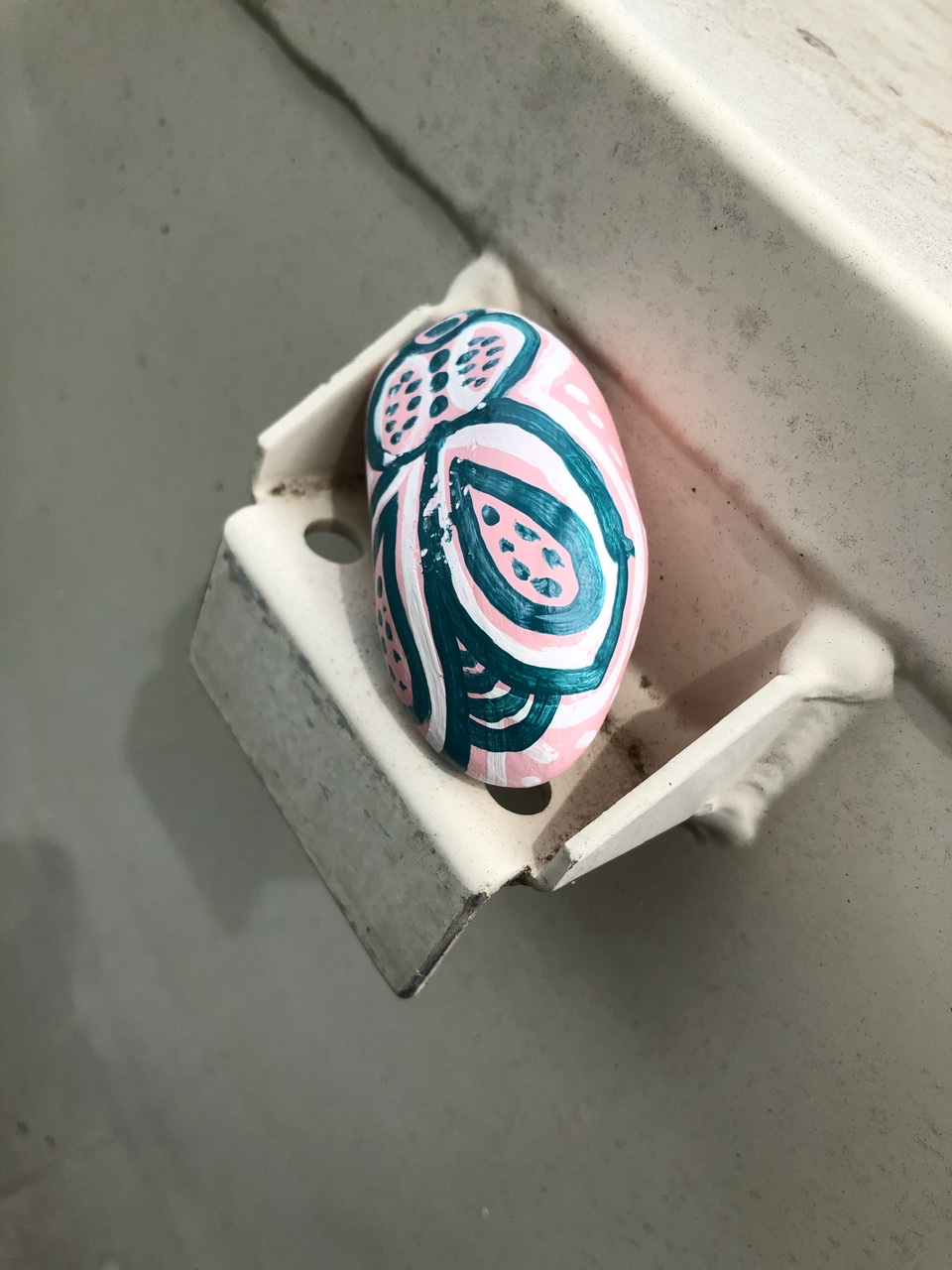
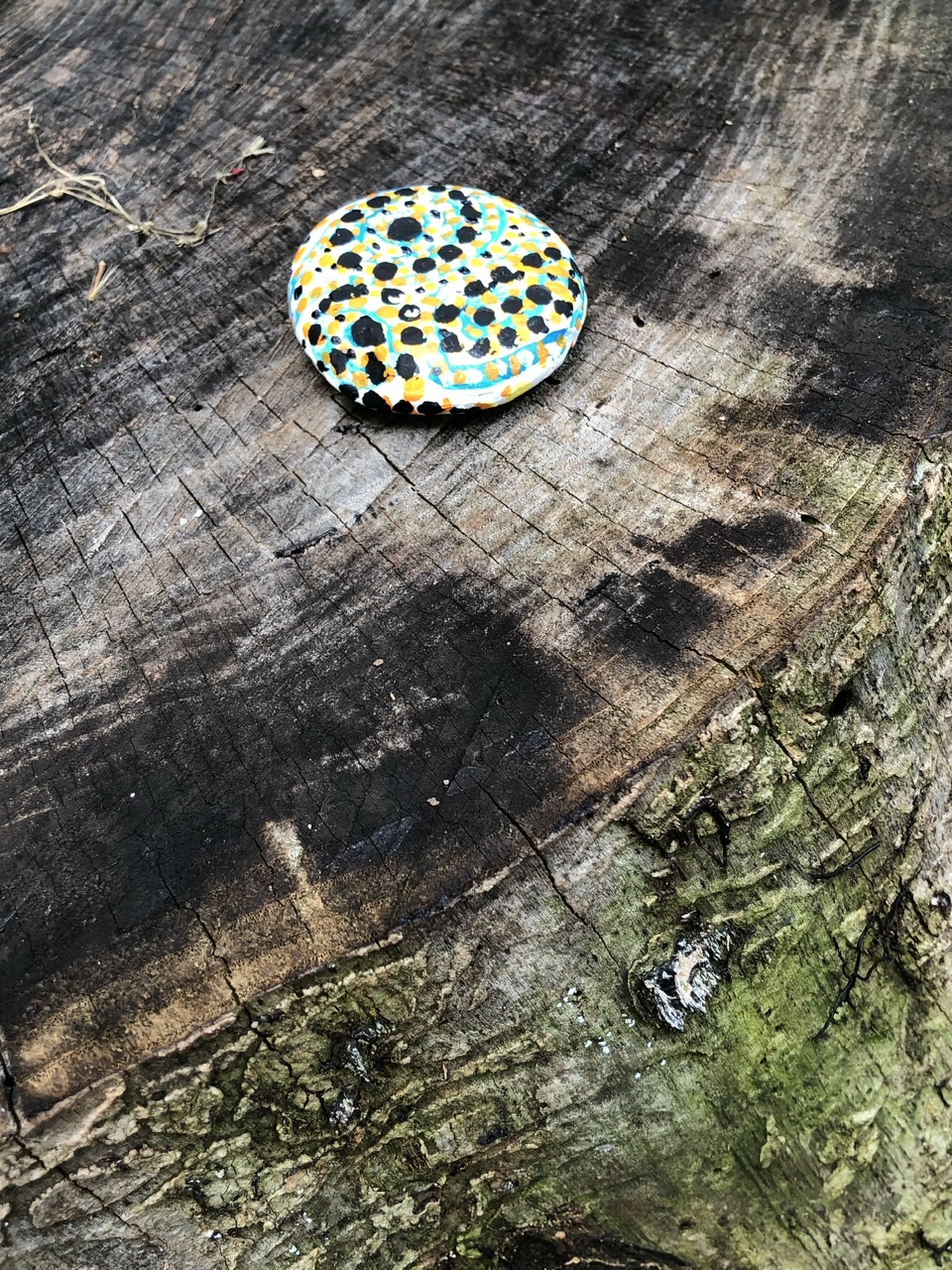
And that is what brought us to painting rocks for the neighborhood. The past several weeks we have spotted painted rocks hidden among the tree trunks and leaves along our walking path. Well, we have smooth river rocks in the garden; a wide assortment of acrylic paints in my studio; plenty of time to add our own creations to the neighborhood collection. Let’s do this.

The best outcome of all? The project took a couple of days to complete. We had to first paint our rocks with white, then a background color. Then decide on patterns and designs. Our project culminated in a walk thru the woods to distribute our creations. It’s a small act of charity, the opportunity to serve others in a creative way; I’m hoping that these little seeds will slowly take root and flourish. 

Our summer vacation plans may have been changed in unexpected ways. But the endless possibilities still remain.

16 Weeks Later

On Ash Wednesday, February 26, I went in to INOVA Loudoun for knee replacement surgery. It was nearly 25 years after I had had the same knee operated on for a torn meniscus. At that time I was as told that, because of the presence of arthritis, I would eventually need surgery. The “wait and see” period lasted far longer than I had expected, but eventually it caught up with me.

Total knee replacement surgery has become quite common here in the States. According to the Agency for Healthcare Research and Quality, https://www.ahrq.gov more than 600,000 knee replacements are performed each year in the United States. Several of my friends have had their’s done as have a number of my extended family members. One Aunt had both knees replaced and two hip surgeries! So it wasn’t something that I had any anxiety about. Still, I had some concerns regarding length of recuperation and, to be honest, whether or not I would actually be better off afterwards.

This past New Year’s Eve, a group of us went out together for dinner and dancing. This was the fifth year we had all celebrated together and it’s been a lot of fun. Since taking ballroom dance lessons as a group, we have all looked forward to getting together and ushering in the New Year, putting into practice the lessons learned in fox trot, swing, and waltz. But it was with difficulty I struggled through a couple of dances and I ended up sitting out most of the evening. My hope was that, with surgery and rehabilitation, I would at least be able to get back to an activity I enjoyed.

Surgery took longer than expected; years of compensating for my deteriorating condition had caused secondary issues with muscles and bone displacement. Thankfully my surgeon was able to correct my stance and now my legs are straighter than they’ve been in years (a decided plus for the fox trot!). 

But recovery was long, slow, and challenging. Shortly after I began physical therapy, the country went into quarantine as a result of Covid-19. Many businesses were closed, entire sectors of the economy shut down, schools closed, millions of people lost their jobs, tens of thousands have died from the effects of a virus we had not seen before.

And then we came face-to-face with the results of generations of unjust treatment when coast to coast demonstrations and protests exploded across America. Through all of this, we have just begun to recover and “get back to normal”. Yet, even as I know my newly refurbished knee won’t be the same as before, we recognize as a country we won’t be “returning to normal.” The challenge ahead of us lies in creating something stronger, better than before we were broken. Healing is never guaranteed but we can’t miss the opportunity to set things right, not restore but make better.

Twice a week for physical therapy, a Starbucks marker for each visit.

Meet the Royals

It’s been said that if you search long enough through your family tree, eventually we all end up being related to royalty.

Joshua Taylor, president of the New York Genealogical & Biographical Society, writes that “In the US, millions can trace their ancestry back to European royalty through ‘gateway ancestors’ — early colonial Americans with documented lineage to royal lines.” Today, “these ancestors often have millions of living descendants who can claim royal descent. The odds are increased the longer a family has been in a country or region.”

And we’ll never be royals, it don’t run in our blood. That kind of lux just ain’t for us, we crave a different kind of buzz.

Lorde, 2013
Phillip 2, Duke of Savoy
(1438 -1497)

Last week I wrote about my Great Grandfather and some of his life as a pioneer in Colorado, US. And the family album has entries for ancestors stretching back to the settling of Connecticut in 1658.

There is very little written about my Father’s family (my Great Grandfather came over from Germany in the late 1880s). However, on my Mother’s side of the family there is a wealth of information to be gone through. Her ancestors were among the founding fathers of our nations, tracing lineage back to Thomas Ranney of Connecticut in 1658. All that has been documented in our family book, “The Ranney-Willis Family 1658-1967.” But it is the Ranney side of the family that seems to gone on forever into the distant past.

What if I looked on FamilySearch and, using their family tree software, scrolled back through ancestors who might lie outside of the materials available to our family’s researcher back in 1967? I wondered if I might indeed find some royal connection or titled ancestor, a coat of arms or a family crest waiting to be framed and hung on our walls.

Phillip II, Duke of Savoy was the first name to pop up in my search. Aha! Royalty indeed! Phillip was born February 5, 1438 and died November 7, 1497. Philip II apparently had 6 wives and possibly 34 children, though there seems to be considerable overlap in the dates and perhaps some were counted more than once.


Louis, Duke of Savoy (1413-1465)

Louis Duke of Savoy, was born February 24, 1413 . He died January 29, 1465 (reigned 1440-1465). What I found of particular interest was that, in 1452 he received the Shroud of Turin from Margaret de Charny, who had inherited it from her father, Geoffrey II de Charny.

Geoffrey had inherited it from his father, Geoffrey I de Charny of Lirey, France, who had received it as a dowry from his wife, Jeanne de Vergy of Besancon, France. The history of the shroud from the 15th century is well recorded. In 1578 the shroud was transferred to Turin and held by the House of Savoy until 1946, at the end of the Kingdom of Italy and bequeathed to the Holy See in 1983.

The Shroud of Turin, from Wikipedia.

The ancients seem to have been a prolific lot with many wives and children being recorded. Humbert II had 17 children. Thomas I had 16 children. Philip II apparently had 6 wives and possibly 34 children, though there seems to be considerable overlap in the dates and perhaps some were counted more than once. But with progeny running all over the castle, it’s easy to see how, generations later, it wouldn’t be hard to find a royal ancestor.

My search along the genealogy trail grows cold with Count Humbert I of Savoy, 980-1042. But really, who needs to go back over a thousand years tracing their ancestry if they aren’t, well, Royals?